
Astronomik OIII 6 nm CCD Clip Filter for Canon EOS M Series Cameras
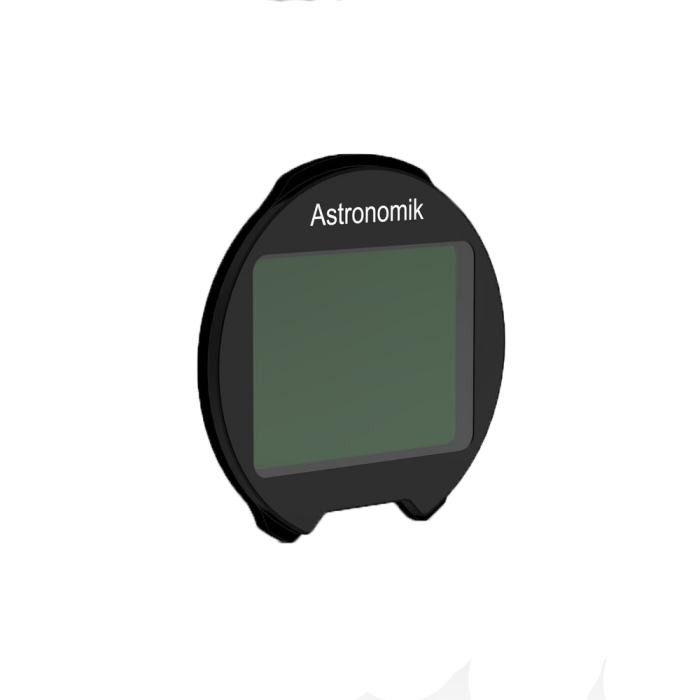

Astronomik OIII 6 nm CCD EOS M Clip Filter
Please Note : The "M" series of Astronomik filters are designed to work with the new mirrorless cameras from Canon.
- Astronomik OIII CCD Imaging Filter with ultra narrow 6 nm FWHM in an EOS M clip configuration made especially for Canon EOS M1, M10, M3, M5, M6, and M50 cameras
- Canon EOS-M Clip filters are also compatible with all EF-M bayonet lenses, as well as all EF and EF-S bayonet lenses with the use of an optional adapter
- Transmits virtually 100% of the OIII line
- Works best for planetary nebulae and supernova leftover astrophotography
- Extremely narrow 6 nm FWHM bandwidth
- Allows transmission of approved wavelengths while, at the same time, blocking all unwanted emissions
- Coatings keep this filter from acquiring damage via the effects of scratching, aging, and high humidity
- Diffraction limited, this filter will not compromise your telescope's optical performance
- All Astronomik filters are delivered with a durable plastic storage case of supreme quality
- Made in Germany, a country recognized for producing high-quality optics!
More About Astronomik OIII 6 nm CCD Filters
Whether imaging under ideally dark conditions, or in a heavily populated area with strong light pollution, for OIII emission line nebulae astrophotography, the Astronomik 6 nm OIII CCD is the optimal filter. Offers complete obstruction of artificial light sources such as mercury and sodium vapor, the principal light pollution culprits, along with natural skyglow and moonshine. This greatly highlights the contrast between OIII line (501 nm) objects and the sky background. With this OIII CCD filter, your imaging potential is significantly improved as greenish and blueish objects can now be photographed.
Using this filter guarantees 88% transmission or more at OIII (501 nm). This filter is made to Astronomik's exacting standards. While transmission ratings may vary between each filter, you are guaranteed a transmission rating greater than 88%, with a typical transmission rating of around 92-95% for the 6 nm OIII. The specific T-Max will be listed on the filter case. You can rest easy knowing that every unit is thoroughly tested and guaranteed to meet Astronomik's stellar benchmark of performance! When compared to the 12 nm filter, the 6 nm OIII enables a higher contrast improvement due to its smaller FWHM (full width at half maximum). The result is an exceptionally dark background.
For observing from locations with severe light pollution, or for imaging faint objects in regions of the Milky Way heavily crowded with stars, the 6 nm filter is the optimal choice. The 6 nm FWHM is matched to allow maximum performance with CCD and CMOS sensors with an extremely low dark current! The Astronomik OIII 6 nm CCD Filter also features a new MFR coating technique to enable you to use a single filter on all instruments up to f/4 while maintaining their current performance level.
Like all Astronomik filters, this OIII 6 nm CCD EOS M Clip Filter is parfocal with all other Astronomik filters. Although its thickness is a minuscule 1 mm, this filter is still highly resistant to potential damage that scratching, aging, and high humidity can inflict. Diffraction is limited to avoid lessening the optical performance of your telescope. Astronomik filters are delivered in a durable plastic storage container of superior quality.
Astronomik EOS M Clip Filter System
Made from black anodized aluminum and laser-cut on state-of-the-art machines, Astronomik's unique Clip-Filter system can be placed directly into the camera body of Canon EOS M series M1, M10, M3, M5, M6, and M50 models in only seconds. Adjustments are not needed, and all lens functions such as focus, screen, and image stabilization, stay operational! This EOS M Clip-Filter system is also suitable for use with all currently known EF-M lenses, along with all other lenses with EF and EF-S bayonets by using an adapter. This system also serves as a suitable dust shield, preventing dust from gathering on your sensor when taking long exposures.