
Baader 50.4 mm CMOS Optimized LRGB Filter Set
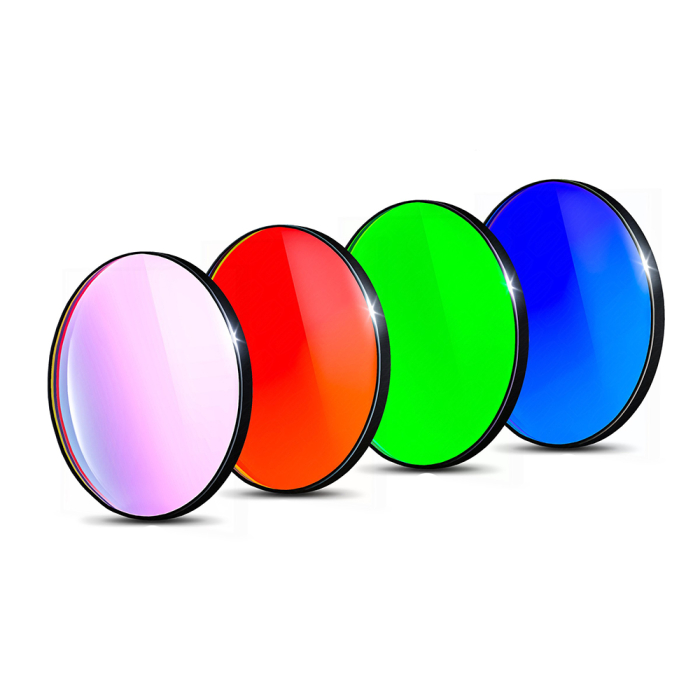

Baader CMOS Optimized LRGB Filter Set
Optimized for current CMOS cameras, these 50.4 mm LRGB (Luminance/Red/Green/Blue) filters from Baader have a balanced design with excellent contrast and transmission. These filters are compatible with extremely slow f/15 telescopes, extremely fast f/1.8 telescopes, and everything in between. Highly desired 1:1:1 subframe exposures are made possible by this balanced design, ideal for automated imaging. Steep slopes at all transmission curves significantly increase transmission for each RGB color channel. This results in filters with color contrast that is in accordance with conventional CMOS quantum efficiency and s/n ratio, as well as in incredibly low levels of stray light and reflections. Unwanted reflections are curtailed even more by lens edges that are blackened all the way around with filter-lead-side-indicator in the form of a telescope-sided black outer rim.
Meanwhile, this set also includes a Luminance “L” Filter that provides 98% transmission over the entire visible spectrum while offering total obstruction of UV and IR regions, including dangerous thermal radiation, at the same time. “L” filters help imagers using digital, CCD, or CMOS cameras sensitive to red eliminate star haziness from their final results.
The majority of filters available from other manufacturers, especially those of the more moderately priced variety, are cut from a larger glass plate. As a result, they form micro-cracks around all edges that make them vulnerable to depreciation through the moisture accumulation, thus causing premature aging. This is not the case, however, with these 1.25" LRGB filters from Baader. Each individual filter in this set contains scratch-resistant Reflex-Blocker™ hard coatings as well as Life-Coat™ sealed coating edges to insulate them from the external environment. The quality of these filters will not diminish no matter how many times you clean them or how long you own them. Filter thickness matches current standards with particular concern for parfocality.
Baader CMOS Optimized LRGB Filter Set Highlights
- CMOS optimized 50.4 mm Round LRGB (Luminance/Red/Green/Blue) Bandpass Filter Set from Baader designed for use with between f/15 and f/1.8 focal ratio telescopes.
- Transmission for each individual RGB color channel is remarkably high in order to decrease stray light and reflections to extraordinarily low levels.
- A balanced design allows the capture of subframes with identical 1:1:1 exposure times, essential for automated imaging applications.
- Transmission curves on all three color filters have steep slopes to increase contrast.
- Separately coated rather than carved out of a larger glass plate, these Baader LRGB filters are all planeoptically polished with Reflex-Blocker™ hard coatings and Life-Coat™ sealed coating edges.
- Current filter thickness standards are met with these parfocal filters.
- The entire circumference contains blackened edges with black outer rim on the telescope side that acts as a filter-lead-side-indicator to prevent reflections resulting from light emissions spilling onto the edge of the filter.
- 98% of emissions originating from visible spectra between 420 nm and 685 nm are enabled passage are enabled passage with the Luminance “L” filter, while total blockage of UV and IR emissions, as well as damaging thermal radiation in the IR is also provided.
- Using the "L" filter with red-sensitive digital and CMOS/CCD cameras makes stars seem a lot less blurry.
- O-III line energy is doubled with the combined use of the "B" and "G" filters to allow the best attainable deep sky S/N through absolute maximum transmission.
- Infrared and near infrared spectral areas from 680 nm to 1200 nm are fully obstructed with the use of this set’s “R” filter, while targets originating from H-Alpha and SII regions are permitted passage.
- Sources of inconvenient light, such as that from Mercury and Sodium vapor street lamps at 580 nm, are totally neutralized via the use of "G" and "R" filters, resulting in a darker background sky and color balance and separation that is without equal.
- Compatible with classic CCD camera technology in addition to newer CMOS camera models.
About the Luminance "L" Filter
The obstruction of UV and IR light originating from the extreme non-visible ends of the spectrum is the main purpose of the Baader Luminance "L" Filter. This includes complete blockage of damaging thermal radiation in the infrared, as well as the prevention of blurry stars when working with digital or CCD/CMOS red-sensitive cameras. Meanwhile, all visible spectral areas between 420 nm and 685 nm are allowed to pass at a 98% transmission rate.
About the Red "R" Filter
With the Red "R" Filter, only transmissions from 595 nm to 690 nm wavelengths are permitted to pass, including those of deep sky objects in the H-Alpha line. While there is an intentional overlap between the "G" and "B" filters in terms of spectral emissions allowed to pass, a purposeful gap between the shortest part of the "R" region and the longest part of the "G" region results in the exclusion of a wide range of unwanted light emissions from street lamps and other terrestrial sources. Red "R" filters fully obstruct the NIR and IR from 680 nm up to 1200 nm while keeping maximum transmission of H-Alpha and SII emissions extremely high.
About the Green "G" Filter
Best suited for imaging O-III emission line objects using CMOS monochrome cameras, Green "G" filters transmit wavelengths between 490 nm and 580 nm. Despite the previously mentioned "G" and "B" filter overlap, the crucial H-Beta and O-III emission lines are clearly independent from one another. Although there are no critically important emission lines to be found in the vicinity of 580 nm, Mercury and Sodium vapor street lights do emit from this region. However, thanks to Baader's RGB filter design, these unfavorable emissions are cut off almost entirely, resulting in a darker sky background as well as better color balance and separation.
About the Blue "B" Filter
Of the three Baader RGB filters, The Blue "B" Filter allows the transmittance of the shortest wavelengths (400 nm to 510 nm). This is especially useful for applications involving objects emitting from the H-Beta line (486 nm) such as the Horsehead nebula. Like the "G" filter, the "B" filter also passes O-III emissions (501 nm). When used in combination, these two filters provide double the O-III line energy for unmatched deep sky S/N via extremely high peak transmission.