All coupons, tax, shipping, store credit and gift cards will be applied during checkout.

The Newtonian reflector OTA employs a thermally balanced optical component called a primary and secondary mirror to reduce spherical aberration. By adjusting the mirrors to increase contrast, one can view planets, the deep sky, and astronomy. Is a reflector with many attachments something an astronomer anticipates? Be ready to see the universe with this Apertura AD8 8-inch Dobsonian telescope.
×
![]()
Highlighted Products

Apertura CarbonStar 150 Imaging Newtonian with 0.95x Coma Corrector
A Perfect Match to Super-charge Your Astrophotography: nothing truly offers value for an aperture like a Newtonian. Apertura has brought the image Newtonian back into the forefront with the CarbonStar 150, Comparing the integrated Apertura 0.95x Photographic Reducing Coma Corrector (PRCC) with the previous 6" f/4 imaging model alone, you receive close to 20% more illumination in the center of frame!.

Sky-Watcher Quattro 6" F/4 Imaging Newtonian OTA
With a focal length of 600 mm and multi-coated parabolic reflectors, the SkyWatcher 6-inch Quattro Imaging Newtonian is a swift f/3.9 Newtonian telescope. The scope has a 6x30 finderscope, a coma corrector/reducer, and a 2" dual-speed 11:1 Crayford-style focuser. The Askar 71F Flat-Field refractor can help obtain an apochromatic image of nebulae and galaxies..

Celestron Omni XLT 150 OTA - Optical Tube Only
Featuring its aspheric design and hand-figured optics, the Celestron Omni XLT 150 Newtonian Reflector is an excellent choice for astronomers looking for outstanding optical performance since it enhances already exceptional qualities. Its 6-inch aperture and advanced coatings provide Askar's apochromatic accuracy and SkyWatcher's exceptional imaging speed. Its aspheric form and hand-figured optics offer more precise, more brilliant views.
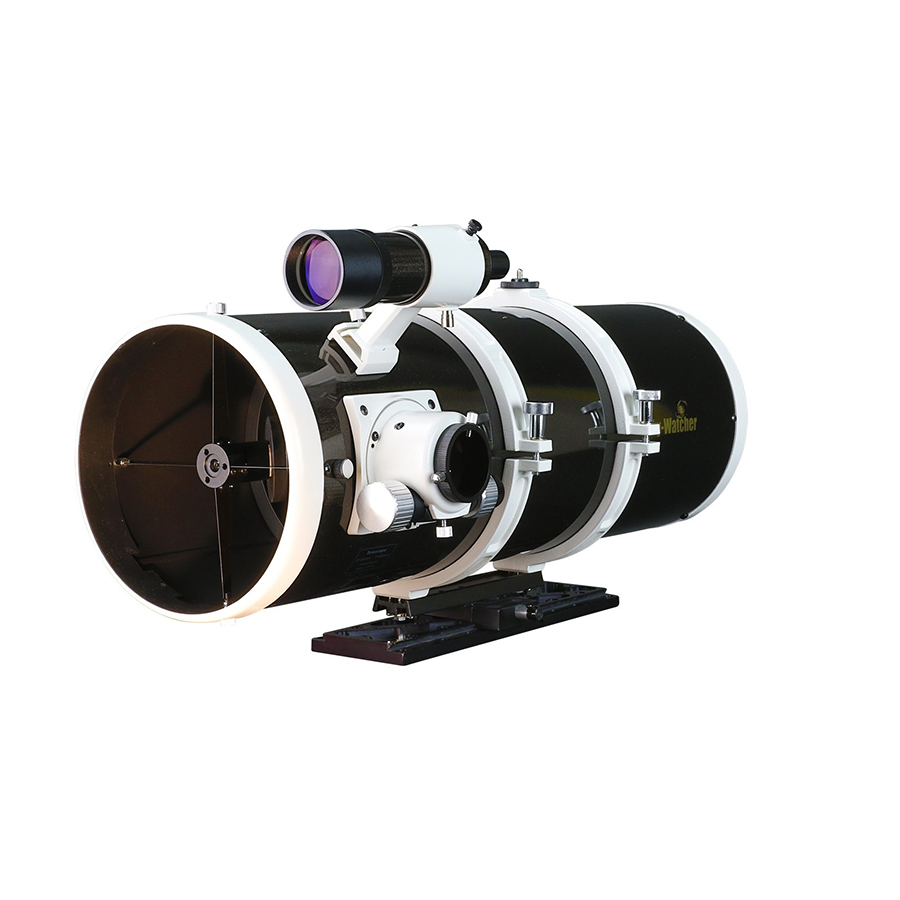
Sky-Watcher Quattro 8" F/4 Imaging Newtonian OTA
The SkyWatcher Quattro f4 Imaging Newtonian is compatible with a broad range of equatorial mounts, and it comes with a bracket, a tube ring with a Vixen-style dovetail bar, and an 8 x 50 finder that is straight-through. The Quattro Coma Corrector can be added as an extra feature if desired. It will fix the coma that fast Newtonians often experience around the mirror's periphery. The focal length of this 8-inch SkyWatcher Quattro f4 Imaging Newtonian is 800 mm. For brilliant and sharp images, the parabolic reflectors are fully multi-coated and made of ground borosilicate glass. Anyone who is planning on doing deep-sky imaging and wants to shoot to the field's edges, this adjustment is helpful.
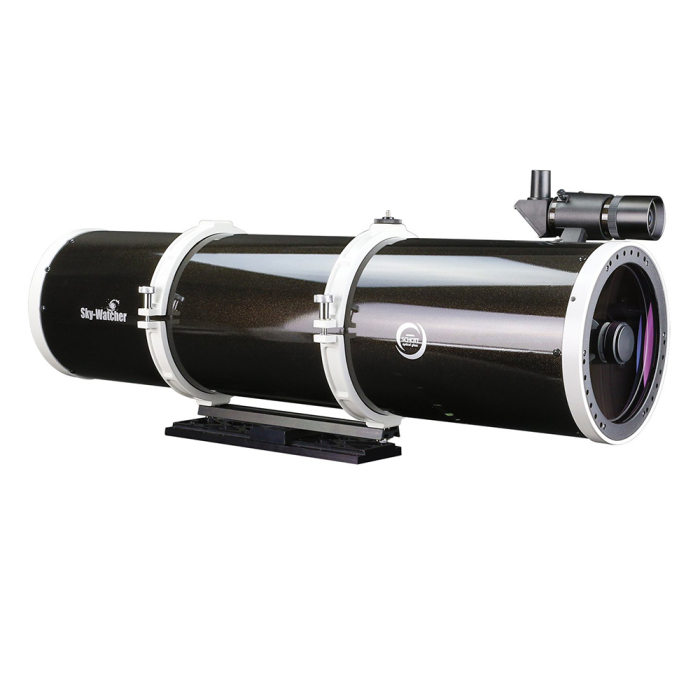
Sky-Watcher Starlux 190 mm Maksutov-Newtonian Telescope OTA
An excellent crossover telescope is the Sky-Watcher Starlux 190MN. Wide-field astrophotographers will find it ideal due to its high-quality Maksutov-Newtonian design, quick f/5.3 optics, multi-coated Pyrex mirrors, and corrector constructed with renowned Schott glass. Not only are Maksutov-Newtonians superior to fast Newtonians because of their built-in field correction, but they also hold their own against Schmidt-Newtonians in terms of contrast and image sharpness. The Sky-Watcher Starlux 190MN includes a V-Style (Vixen) dovetail bar mounted on a tube ring, a right-angle erect picture 9 x 50 finder, and a bracket. Simply add preferred mount and some eyepieces, and it’s good to go.
More About This Category
A reflector telescope, often referred to as a Newtonian in deference to its inventor, Isaac Newton, uses mirrors to gather cosmic light, allowing us to see celestial objects that would otherwise be invisible to the naked eye. The light gathered from the aluminized primary mirror at the back of the telescope reflects up the tube assembly to a small secondary mirror, which is angled perfectly so as to direct the beam of light into an eyepiece and finally, your waiting eye. You can see why it is called a reflector!
The Newtonian reflector telescope has evolved into the focal point of amateur and professional astronomy. These telescopes separate and offer finely detailed images of the objects in space through primary and secondary mirrors in collecting and focusing light. Astronomers from all walks of life will appreciate this extensive review of their applications, significance, and characteristics.
Newtonian reflectors are versatile tools for various astronomical observations. With proper alignment, users can quickly start observing celestial objects. The modular design allows for customization with accessories like focusers, cameras, and filters. Why are Newtonian reflectors a Top Choice?

The ideal crossover for visual observation and astrophotography is the Sky-Watcher Starlux 190 mm Maksutov-Newtonian Telescope. Sharp, highly contrasting images come from its f/5.3 lenses, multi-coated Pyrex mirrors, and Schott glass corrector. Having built-in field correction, this design beats both conventional Newtonians and Schmidt-Newtonians. Perfect adjustments guaranteed by the 2" dual-speed Crayford focuser are vital for obtaining crisp photos. The set comprises a V-style dovetail bar, tube rings, and a 9x50 right-angle rect image finder.

Designed for imaging and visual observation, the fast, adaptable Sky-Watcher 10" f/4 Quattro imaging Newtonian Telescope, Through its multi-coated borosilicate glass parabolic mirrors, its 1000 mm focal length and f/4 focal ratio, produces brilliant, sharp images. Perfect corrections necessary for astrophotography are made possible by the 2' dual-speed 10:1 linear power focuser. The optional Quattro Coma Corrector is ideal for deep-sky photography since it improves edge sharpness. 36.5 lb makes it ready for several equatorial installations.
Applied to control the entering light, a flat secondary mirror and a parabolic primary mirror shape the optical tube assembly (OTA) of the Newtonian reflector telescope. Familiar with refractors, this construction eliminates chromatic aberrations—which generate blurriness of vision because different wavelengths of light from the object focus at various points in space. Unlike telescopes with lenses, Newtonian reflectors provide distortion-free views utilizing mirrors instead of lenses.

Features diffraction-limited optics, an 8" OTA with a built-in cooling fan, and a 2" dual-speed linear-bearing Crayford focuser for exact adjustments, the Apertura 8" f/4 Newtonian telescope is perfect for wide-field imaging. The OTA weighs eighteen pounds, has a 28" length and a 9" diameter. Its smooth black inside reduces reflections, and the central-spotted parabolic central mirror guarantees sharp, clear images. An 8x50 finderscope improves targeting; the included split tube rings fasteners to several mounting. Astrophotography and observation make this telescope a flexible choice with simple collimation and versatility.
For astrophotography, reduced optical aberrations and large apertures in Newtonian reflectors make a perfect fit. Usually found in cameras and other picture systems, Newtonian reflectors give precisely defined images of astronomical objects. In a Newtonian reflector, collimation is used to arrange the mirrors, such as best optical performance results. It should be done routinely about telescope motion. Most customers verify collimation before each observation session. Whether for wide-field astrophotography or detailed planetary observation, a well-maintained Newtonian OTA can be a reliable and powerful tool in astronomical endeavors.