Mu Cephei
Also known as the Garnet Star, Mu Cephei has a strong, coppery color and is known to be a semi-regular variable. Its magnitude ranges from 3.4 to 5.1 over a period of 730 days.

September 2020
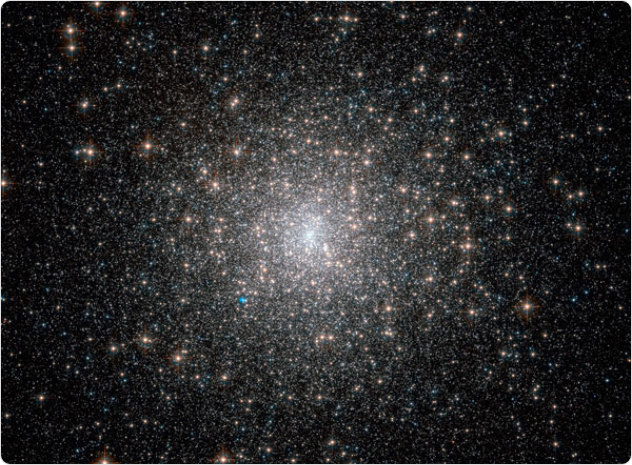
M15 is relatively easily found with binoculars. Draw a line through Baham (Theta Pegasi) and Enif (Epsilon Pegasi) and, within the same binocular field of view as Enif, you’ll see a magnitude 6 star with a faint, fuzzy star beside it. Telescopically, it doesn’t look like much at low power, but increasing the magnification and using averted vision will reveal more.
At about 100x, you’ll see a condensed, bright core, with a halo that extends about twice as far as the diameter of the core itself. Averted vision may allow you to resolve some of its stars, while larger scopes can show chains of stars reaching out from its center. M15 was discovered by Jean-Dominique Maraldi in 1746 and is thought to be roughly 175 light-years in diameter.
Source: NASA, ESA
Mercury emerges into the evening twilight around the middle of the month, but is a challenging target, low over the western horizon. A one day old Moon appears to its upper right on the 18th. Jupiter and Saturn are both easily seen and are well placed for observation throughout the evening. Look for a waxing gibbous Moon nearby on the 24th and 25th. Faint Neptune reaches opposition on the 12th, but you’ll need a starchart or a Goto scope to find it. Mars rises around mid-evening and should be well-placed for observation by roughly 11PM. It’ll increase in brightness over the month and will rival Jupiter by the beginning of October. Uranus can be found some 14 degrees to the east of Mars, while Venus moves from Gemini to Leo during the month. It rises about three and a half hours before the dawn and is close to the Praesepe star cluster on the 13th. The Moon turns full on the 2nd and then new on the 17th.
Also known as the Garnet Star, Mu Cephei has a strong, coppery color and is known to be a semi-regular variable. Its magnitude ranges from 3.4 to 5.1 over a period of 730 days.
This famed nebula appears very close to Deneb, but requires dark skies to see it. Although it can be seen with the naked eye, due to its size it’s best observed with binoculars
Also known as the Garnet Star, Mu Cephei has a strong, coppery color and is known to be a semi-regular variable. Its magnitude ranges from 3.4 to 5.1 over a period of 730 days.
This famed nebula appears very close to Deneb, but requires dark skies to see it. Although it can be seen with the naked eye, due to its size it’s best observed with binoculars
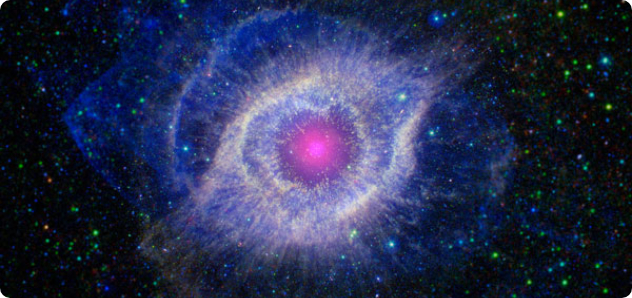
A challenging target for beginners, the Helix is large but faint. It can be found with binoculars under a dark sky, while a medium-sized scope is required to see the central hole.
Source: NASA/JPL-Caltech
Magnitude: The measure of an object’s brightness in the night sky, the system was first used by the ancient Greeks. The higher the number, the fainter the object, with the brightest objects having values below zero. The naked eye can see to roughly magnitude six.