Stellarvue 102 mm ID Guidescope Rings for 80 mm Finder - R102LV
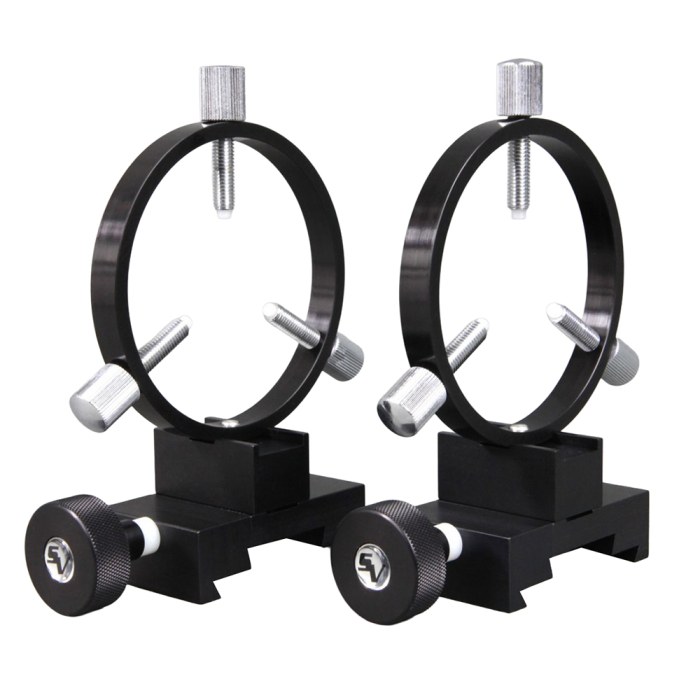

102 mm ID Guidescope Rings for SV 80 mm Finder
This is a set of two adjustable rings that are made to mount a Stellarvue 80 mm finderscope or telescope onto a larger telescope for use as a super finder and/or photographic guide scope. Each ring has three aluminum adjustment screws with nylon tips. Each ring is mounted to a dovetail shoe that will slide onto either a Losmandy (D rail) or Vixen (V) rail. This ring system has an inside diameter of about 102 mm. This is the perfect size for holding our 80 - 85 mm guide scopes, finderscopes, or telescopes. It will also hold our former model SV90T telescopes either in aluminum or carbon fiber. It will not hold our new version SVX90T, for this telescope use the R120LV guide scope rings.
When mounting a guide scope on top of another telescope, it is necessary to use adjustable rings. Adjustable rings allow the finder or guide scope to be moved slightly in relation to the main telescope. This is necessary because if non-adjustable hinged rings are used, the two instruments will never be pointed in precisely the same direction. When using a guide scope as a super finder, adjustable rings will allow the user to make sure each telescope is centered on the same object. When doing astrophotography, adjustable rings will make it possible to point the guide scope at a relatively bright guide star while the main telescope is centered on the object being photographed.
In order to use this system, mount the rings by inserting the rear of the finderscope into them, DO NOT remove the dew shield of a finderscope as the lens will fall out. The straight through finder will slide into the rings. It may be necessary to remove the back of the right angle finderscope so the prism does not get in the way as you insert it into the rings. Then simply slide the ring bases onto the top rail on your telescope. Stellarvue rails are sold separately. Choose a rail that is the proper length and hole spacing to work with the dual rings on your telescope.