
Eyepieces
How to Calculate Magnification
Your eyepieces will be some of the most important accessories you’ll own - so selecting the right eyepieces will be crucial to your viewing experience. Different focal length eyepieces are going to provide different magnifications: lower magnification eyepieces are best used for deep space objects while higher magnification is typically used for planetary and lunar observation. To find out the magnification of any given eyepiece, you simply divide the focal length of your telescope by the focal length of your eyepiece!
For example, you have a telescope with a focal length of 500mm, and a 10mm eyepiece. You take 500 and divide it by 10 and you get 50x magnification! Longer focal lengths scopes provide higher magnifications for any given eyepiece.
Highest Useful Magnification: “300 Power”
You’ll find that a maximum magnification of 300x is a fairly conservative number across most of the information you may find online. Our team at High Point Scientific generally recommends a conservative estimate of 40 power per inch of aperture to achieve the maximum useful magnification of your scope with the upper limit being around 300x.
For example, If you have a 4” refractor, we recommend that you do not exceed 160x. If you have a 14” Schmidt- Cassegrain, the full 300x magnification should be fine under the right seeing conditions. You may find that you can push that magnification a bit further, but with our conservative estimate above you wont be dissapointed! Please keep in mind that increasing your magnification too far past your scopes potential will lead to a decrease in visual quality. While the object in your eyepiece will grow in size as you increase the magnification, the resolution of fine detail will disappear. Finding that happy balance between size and resolution is fairly subjective, but typically falls within our recommendation and yields excellent results.
Field Of View: Wider is More Fun For Observation
While eyepieces that offer a very wide field of view are a treat to look through, these can become increasingly expensive. We find that eyepieces offering a field of view between 70 and 82 degrees offer the perfect balance of price and field of view.
A common misconception is that field of view and magnification are the same, but that isn’t the case. You can have two 10mm eyepieces, one with a 52 degree field of view and the other with a 82 degree field of view. They will both offer the same magnification on the same scope, but the space around the object you are viewing will be more plentiful with the 82 degree field of view. There will be more space around the objects to view, but as mentioned magnification between the two eyepieces will remain the same - meaning that the object you’re viewing will be the same size in both eyepieces. These wider field of view eyepieces provide you with a much more immersive feel when looking through the eyepiece and is something to consider when buying an eyepiece for larger deep sky objects. Wider field of view eyepieces are also great when you want to push a higher magnification and still see all of the object you’re viewing, such as the full Moon.
Barlows
2x, 3x, 4x: What advantage does a Barlow offer?
Barlow lenses can effectively double, triple, quadruple, or quintuple the magnification of the eyepiece you’re using. We typically recommend a 2x or even a 3x Barlow for the majority of telescope and eyepiece combinations. The incredible thing about a Barlow is that it can essentially double your eyepiece collection! Consider this: You have an eyepiece collection containing a 30mm, 20mm and a 7mm. With a 2x Barlow, you now have a 30mm, 15mm, 20mm, 10mm 7mm and a 3.5mm eyepiece set! Typically, Barlow lenses of 4x or 5x magnification are used for planetary and lunar imaging under very nice seeing conditions.
1.25" or 2"
Barlows in this realm are available in both 2” or 1.25” with a variety of qualities. 2” Barlows are more versatile in the sense that they come with a 1.25” adapter, accepting nearly all size eyepieces! A disadvantage is that not all telescopes can accept a 2” eyepiece or Barlow lens. The 1.25” Barlows are typically less expensive and will work with virtually every telescope on the market. Our advisors at High Point Scientific will be more than happy to point you towards the right Barlow for you!
ED Glass and Ultra High Quality Powermates
ED glass Barlow lenses and TeleVue Powermates are unmatched in quality. These are going to provide the highest quality views when compared to other Barlow lenses of different brands. These are used with higher end eyepieces as well as with planetary cameras. Please keep in mind that there is little advantage to using these high end Barlow lenses with lower end eyepieces or telescopes. Your views are only as good as your lowest quality piece of glass!

H3 - Section Title
Lorem ipsum dolor sit amet, consectetur adipiscing elit, sed do eiusmod tempor incididunt ut labore et dolore magna aliqua. Ut enim ad minim veniam, quis nostrud exercitation ullamco laboris nisi ut aliquip ex ea commodo consequat. Duis aute irure dolor in reprehenderit in voluptate velit esse cillum dolore eu fugiat nulla pariatur. Excepteur sint occaecat cupidatat non proident, sunt in culpa qui officia deserunt mollit anim id est laborum.
H2 - Section Title
Lorem ipsum dolor sit amet, consectetur adipiscing elit, sed do eiusmod tempor incididunt ut labore et dolore magna aliqua. Ut enim ad minim veniam, quis nostrud exercitation ullamco laboris nisi ut aliquip ex ea commodo consequat. Duis aute irure dolor in reprehenderit in voluptate velit esse cillum dolore eu fugiat nulla pariatur. Excepteur sint occaecat cupidatat non proident, sunt in culpa qui officia deserunt mollit anim id est laborum.
H3 - Section Title
Lorem ipsum dolor sit amet, consectetur adipiscing elit, sed do eiusmod tempor incididunt ut labore et dolore magna aliqua. Ut enim ad minim veniam, quis nostrud exercitation ullamco laboris nisi ut aliquip ex ea commodo consequat. Duis aute irure dolor in reprehenderit in voluptate velit esse cillum dolore eu fugiat nulla pariatur. Excepteur sint occaecat cupidatat non proident, sunt in culpa qui officia deserunt mollit anim id est laborum.
Lorem ipsum dolor sit amet, consectetur adipiscing elit, sed do eiusmod tempor incididunt ut labore et dolore magna aliqua. Ut enim ad minim veniam, quis nostrud exercitation ullamco laboris nisi ut aliquip ex ea commodo consequat. Duis aute irure dolor in reprehenderit in voluptate velit esse cillum dolore eu fugiat nulla pariatur. Excepteur sint occaecat cupidatat non proident, sunt in culpa qui officia deserunt mollit anim id est laborum.
H3 - Section Title
Lorem ipsum dolor sit amet, consectetur adipiscing elit, sed do eiusmod tempor incididunt ut labore et dolore magna aliqua. Ut enim ad minim veniam, quis nostrud exercitation ullamco laboris nisi ut aliquip ex ea commodo consequat. Duis aute irure dolor in reprehenderit in voluptate velit esse cillum dolore eu fugiat nulla pariatur. Excepteur sint occaecat cupidatat non proident, sunt in culpa qui officia deserunt mollit anim id est laborum.
APERTURA 10" DOBSONIAN TELESCOPE - $649
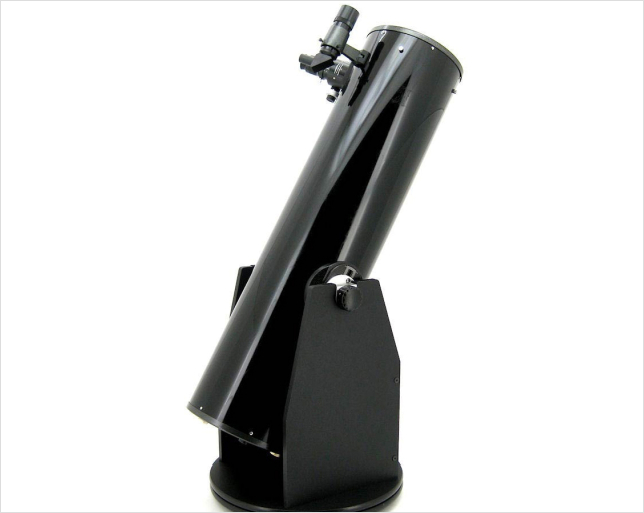
The Apertura 10” Dobsonian Telescope is our team’s favorite manual telescope on the Best Telescopes list. The huge 10” primary mirror opens up the Universe, providing access to thousands of celestial objects, and the “fast” f/5 focal ratio displays a pleasingly wide field of view when observing the night sky.
Sitting on a simple Dobsonian alt-azimuth mount, the Apertura 10” Newtonian is an excellent telescope to help you learn the location of celestial objects in the sky by “star-hopping”. It is great for beginners since learning how to use the Apertura Dob takes just a few minutes. Older children LOVE a Dobsonian because they can push it around and discover the Universe with their own eyes, without help from their elders. More seasoned amateur astronomers enjoy a “light-bucket” Dobsonian for its low price per inch of aperture, it’s stealth-like silence, and because there are no bells and whistles to get between the astronomer and the night sky.
From your first time out under the stars with this telescope, the Apertura 10” Dobsonian will be sure to prove itself with the smooth action of the mount, the easy setup, and the breathtaking views that the 10” aperture provides. Whether you go hard-core and explore the Universe with a simple planisphere or star chart or you cheat a little and splurge for an app that will help you find objects, the Apertura will become a trusted companion on your journey to becoming intimately familiar with the wonders of the universe.
APERTURA 10" DOBSONIAN TELESCOPE - $649
The Apertura 10” Dobsonian Telescope is our team’s favorite manual telescope on the Best Telescopes list. The huge 10” primary mirror opens up the Universe, providing access to thousands of celestial objects, and the “fast” f/5 focal ratio displays a pleasingly wide field of view when observing the night sky.
Sitting on a simple Dobsonian alt-azimuth mount, the Apertura 10” Newtonian is an excellent telescope to help you learn the location of celestial objects in the sky by “star-hopping”. It is great for beginners since learning how to use the Apertura Dob takes just a few minutes. Older children LOVE a Dobsonian because they can push it around and discover the Universe with their own eyes, without help from their elders. More seasoned amateur astronomers enjoy a “light-bucket” Dobsonian for its low price per inch of aperture, it’s stealth-like silence, and because there are no bells and whistles to get between the astronomer and the night sky.
From your first time out under the stars with this telescope, the Apertura 10” Dobsonian will be sure to prove itself with the smooth action of the mount, the easy setup, and the breathtaking views that the 10” aperture provides. Whether you go hard-core and explore the Universe with a simple planisphere or star chart or you cheat a little and splurge for an app that will help you find objects, the Apertura will become a trusted companion on your journey to becoming intimately familiar with the wonders of the universe.
EXPLORE SCIENTIFIC AR102 REFRACTOR WITH TWILIGHT I ALT-AZ MOUNT - $579.99
Any “Best Telescopes Under $1000” list would not be complete without a good quality refractor, and the Explore 102 mm Doublet telescope is one of our favorites for many reasons. First of all, we have an Explore AR102 set up at the High Point office so we can do a little observing at a moment’s notice.
Our staff loves the Explore Twilight 1 Alt-Azimuth Mount for its ease-of-use, stability, and smooth movement. Most anyone can set this telescope up and learn to use it in a few minutes. Simply place the Twilight I mount and tripod, which weighs a mere 7 pounds, in your favorite location, attach the AR102 OTA (about 10 pounds) to the mount, slide in the included diagonal, add an eyepiece (sold separately), and voila, you are ready to observe!
The Explore Scientific 102 mm f/6.5 classic refractor provides sharp, high contrast images of terrestrial objects as well as celestial wonders like Saturn, Jupiter, the Orion Nebula, Andromeda Galaxy, and more. With 4” of aperture, you will be amazed at how many planets, stars, and deep-sky objects you can see! Just add a star chart, a few eyepieces, and a solar filter if you want to view the Sun, and this very versatile refractor will show you our incredible Universe for years to come.
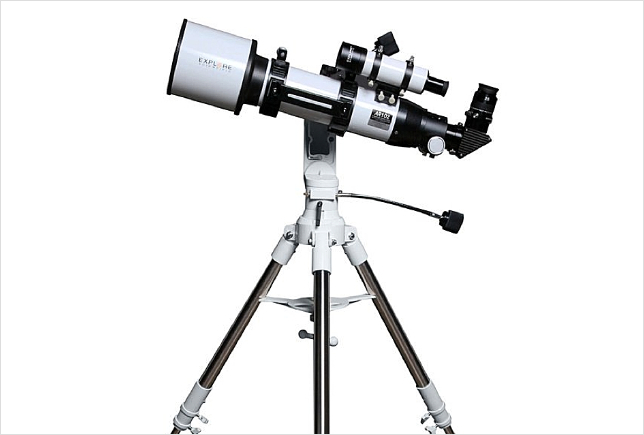
EXPLORE SCIENTIFIC AR102 REFRACTOR WITH TWILIGHT I ALT-AZ MOUNT - $579.99
Any “Best Telescopes Under $1000” list would not be complete without a good quality refractor, and the Explore 102 mm Doublet telescope is one of our favorites for many reasons. First of all, we have an Explore AR102 set up at the High Point office so we can do a little observing at a moment’s notice.
Our staff loves the Explore Twilight 1 Alt-Azimuth Mount for its ease-of-use, stability, and smooth movement. Most anyone can set this telescope up and learn to use it in a few minutes. Simply place the Twilight I mount and tripod, which weighs a mere 7 pounds, in your favorite location, attach the AR102 OTA (about 10 pounds) to the mount, slide in the included diagonal, add an eyepiece (sold separately), and voila, you are ready to observe!
The Explore Scientific 102 mm f/6.5 classic refractor provides sharp, high contrast images of terrestrial objects as well as celestial wonders like Saturn, Jupiter, the Orion Nebula, Andromeda Galaxy, and more. With 4” of aperture, you will be amazed at how many planets, stars, and deep-sky objects you can see! Just add a star chart, a few eyepieces, and a solar filter if you want to view the Sun, and this very versatile refractor will show you our incredible Universe for years to come.