All coupons, tax, shipping, store credit and gift cards will be applied during checkout.

In observational astronomy, a finder scope is an essential tool because telescopes have limited fields of vision. By allowing observers to find deep-sky targets using bright reference stars, it makes navigation more efficient. Because misalignment can lead to lost observation periods, astronomers must adjust the finder scope before using it. Finder scopes are entertaining on their own since they display larger star fields and clusters. In the end, a properly oriented finder scope functions as a navigation system, turning the night sky into a navigable map, emphasizing how important it is to become proficient with this instrument before utilizing the telescope.
×
![]()
Highlighted Products
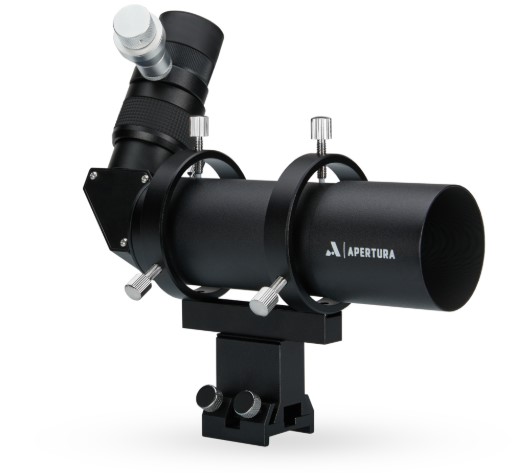
Apertura 10 x 50 Right Angle Finder Scope with Illuminated Reticle Eyepiece
One of the main challenges with manual mounts on telescopes is centering objects in the eyepiece. The Apertura 10 x 50 Right Angle Finder Scope simplifies this process with its expanded field of view. Once aligned, users can easily position targets within the reticle's crosshairs, ensuring they are also centered in the eyepiece. The built-in erect image prism presents the sky upright, reducing neck strain. This finder scope provides 10x magnification with a 5° field of view and improves light gathering for star identification with a 50 mm aperture. A 20 mm lens with crosshairs and a helical focuser make it easy to focus on anything. The fact that it is strong (anodized metal) and only 26 ounces makes it look even better. It is more useful because it has a fast release bracket and an integrated illumination for better crosshair brightness.
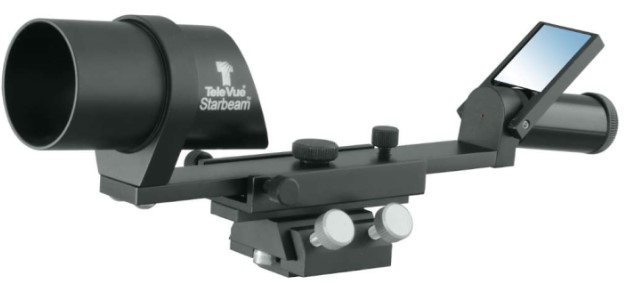
Tele Vue Starbeam with Quick Release Base for Tele Vue Telescopes
The Tele Vue Starbeam has a flexible flip mirror that lets you see clearly from 0° to 90°. It has a "red-star" indicator that shows where the scope is in relation to the sky, and the brightness can be changed so that it can be seen in dim or dark situations. With a 39 mm aperture, the device makes sure that the projected picture can be seen clearly from a range of distances. The well-made glass lens splits the light beam and keeps the "red star" fixed against the sky background. With a precision of 6 arcminutes, it helps find specific items. The Starbeam has a quick-release bracket that makes it easy to store and works with a number of finder shoes, such as Orion and Sky-Watcher types..
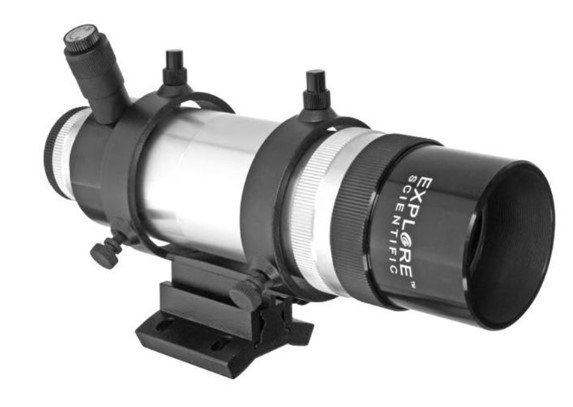
Explore Scientific 8x50 Straight-Through Correct Image Finder Scope
This 8 x 50 Erect Image Finder Scope from Explore Scientific will make the finder on your telescope better. The illuminated reticle that comes with it will help you center and find things. This is the Explore Scientific 8x50 Right Angle (also called Erect Image). The finderscope gives you a wide field of view of 6 degrees and lets you focus precisely on both the main target and the eyepiece illuminated reticle. Now with the new Illuminator II, which has a long power life. Images that are right-side-up and straight from left to right are made by a precisely polished roof prism. This means that things are not backwards and upside down like they are in most viewfinders. The illuminated reticle from Explore Scientific has an open center that makes it perfect for finding things because the item you are focusing on is not hidden by crosshairs. There are scale marks for 1.5o, 3o, and 4.5o.
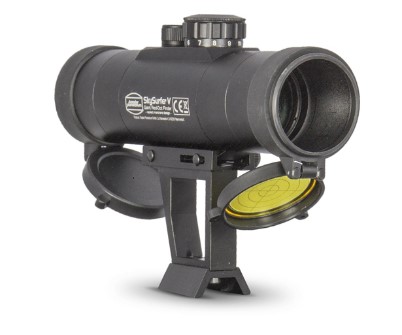
Baader Planetarium Sky Surfer V with Quick Release Dovetail - Night & Day Design
The Baader Planetarium Sky Surfer V Finder is a high-quality red dot finder made from black anodized metal that is meant to work with any telescope. It has a big 45 mm clear opening that makes it easy to find things, and it comes with dewshields that can be taken off to keep dew from building up. Optimized visual layers make it possible to see the sky almost completely through them. The finder is easy to use because it only has two knobs for elevation and azimuth adjustments, and the red dot locator's strength can be changed in 11 positions. There are three connection bases included so that it can work with telescopes of different sizes. A 3 Volt rechargeable battery lets you use it for a long time.
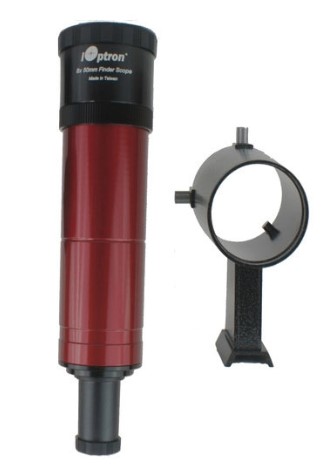
iOptron 8x50 Finder Scope with Bracket
This 8x50 Finderscope from iOptron is an outstanding option for deep-sky astronomers who require additional magnification and aperture in order to discover extrasolar objects that are less visible, such as binary stars, nebulae, or galaxies. This product comes with a bracket that is equipped with a dovetail mount, which allows it to handle a wide variety of finder saddles. Additionally, it comes with three thumbscrews that enable proper alignment with the optical component.
More About This Category
Choosing the best finderscope for your telescope will make finding and centering celestial objects easier, and some finder scopes can also be used for terrestrial viewing or guiding during astrophotography sessions. Here is short list of the most common telescope finders:
Red Dot Finder or Reflex Finder: This simple and easy to use finder offers a zero magnification view of the sky that is right-side up and left-to-right correct. When you look through a red dot finder that has been aligned with your telescope, you will see a red dot (hence the name!). To use a red dot finder, simply move your telescope while looking through the finder until the red dot is centered on your intended target, then look through the eyepiece. Some red dot finders project shapes other than a red dot, like a bull's eye or a crosshair. Other models let you choose from a collection of illuminated reticles or dots.
Optical Finder Scopes: An optical finderscope is basically a small telescope or monocular that has an integrated eyepiece with low magnification. A 7X or 10X magnification finder is most common, but other finders offer 8X or 9X or even have interchangeable eyepieces. Common finderscope apertures are 30 mm (for small telescopes), 50 mm, or 60 mm. Remember the rule of astronomy optics...the larger the aperture, the more light it gathers to reveal fainter objects.
There are two basic optical finderscope body styles: Right Angle Finders and Straight-Through Finders. A right angle finder scope has an eyepiece that faces up. Most people agree that this makes it easier to look through, especially when the telescope is pointing high overhead. Many right angle finders are "image erect" or "image correct" as well, which means the image you see will be right side up and/or left-to-right correct. If you will be using your telescope during the day as a big spotting scope, having an image erect right angle finder is recommended. A straight-through finder puts the eyepiece at the back facing out. Many astronomers use a straight-through finder because it offers the brightest images, and, when doing astronomy, it is not important to have right-side up images.
Solar Finders: If you will be viewing the Sun through your properly filtered telescope, you will need to make sure the finder you use is absolutely safe. The best way to insure that is to trade out your regular finder with a solar finder explicitly made for solar use. Most solar finders are not designed to be looked through. Instead, they project an image of the sun on a screen that is aligned to your telescope's eyepiece. When the Sun is centered in the screen, it will be centered in the eyepiece.
Want to know more about choosing and using finder scopes? Read the High Point article entitled Types of Finder Scopes for Astronomy.
If you need help choosing a finder scope for your telescope, feel free to contact one of our non-commissioned product advisors by phone or email. We are here to help and want your experience in astronomy to be the best it can be!