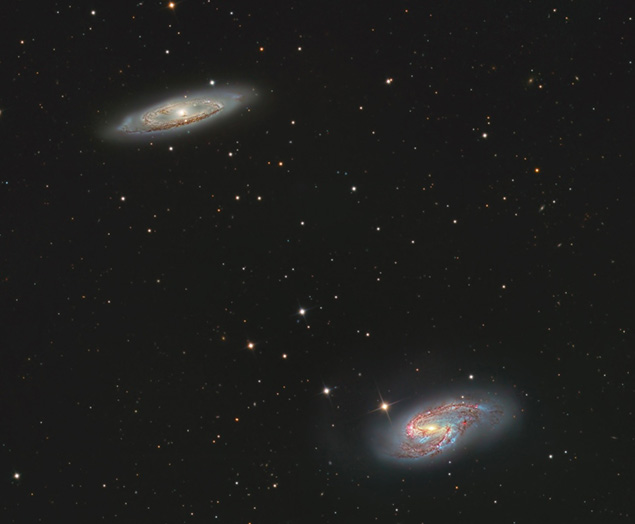
M65 & M66
- Type: Galaxies
- CONSTELLATION: Leo (both)
- Distance: 41 million light-years (both)
- Magnitude: 10.1 (M65) and 9.7 (M66)
- APPARENT DIAMETER: 8’ (M65) and 10’ (M66)
March brings the start of spring - also known as “Galaxy Season” to astronomers everywhere - and there’s a fine pair to be found in the constellation of Leo, the Lion. The galaxies were discovered simultaneously by the French astronomer Charles Messier on March 1st, 1780, who noted that they both appeared within the same low powered field of view.
Of the two, M66 is slightly larger and brighter, with small scopes showing a sizable halo with a bright, oval core. Larger scopes (250mm or more) will reveal some mottling, with dark bands near the core and the possibility of seeing the spiral arms. It’s a similar story with M65, with an extended halo toward the south. Lastly, look out for NGC 3628, a magnitude 10 galaxy located toward the northeast.
Image source: Bill Snyder