What’s In the Sky This Month? April 2020
Our Nearest Neighbors
Both Uranus and Neptune are too close to the Sun to be seen this month, but Venus remains visible for about four hours after sunset. Look for a waxing crescent Moon nearby on the 26th. Meanwhile, Mars has now skipped past both Jupiter and Saturn in the predawn sky. Jupiter is clearly the brightest of the three; Mars and Saturn start the month at about the same brightness, but Mars should appear a little brighter by the end. Look out for the last quarter Moon as it passes the three planets from the 14th to 16th. Mercury can also be seen in the predawn twilight for the first half of the month. You’ll find it very low over the eastern horizon, about 15 to 30 minutes before sunrise. Lastly, the Moon turns full on the 8th and then new on the 23rd.
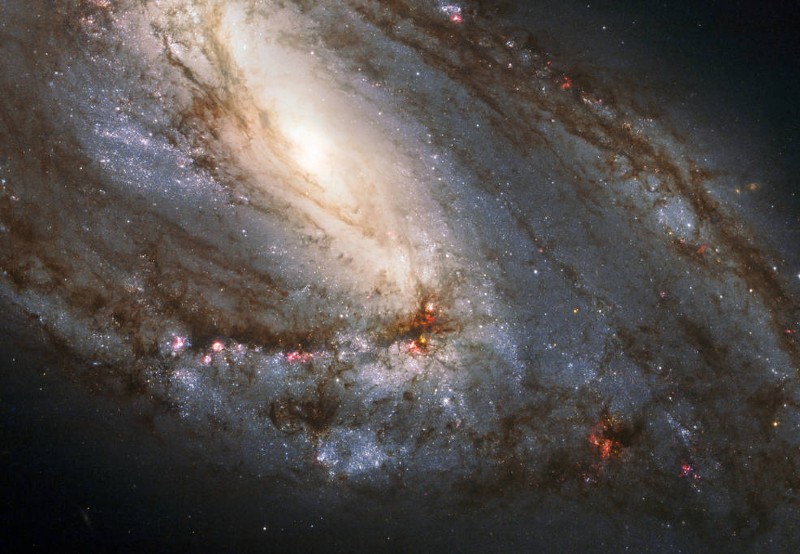
M66
| Type: | Spiral Galaxy |
| Constellation: | Leo |
| Distance: | 41 Million Light Years |
| Magnitude: | 9.7 |
| Apparent Diameter | 8.9’ x 4.0 |
M66 is the brightest of three galaxies that make up the Leo Triplet. The other two, M65 and NGC 3628, are slightly fainter, but you might be able to catch the trio with 15x70 binoculars. If you’re lucky enough to spot them, you’ll see three tiny, misty specks within the same field of view. It might not seem like much, but remember you’re looking at three galaxies containing billions of stars, some 40 million light years away.
Through a telescope, a magnification of about 50x will keep the three within the same field of view. M66 appears as a misty halo surrounding a large, bright, oval core with a row of three stars along its western edge. Larger telescopes of around 250mm may show hints of the galaxy’s arms along the southern side.
A Planet Among the Pleiades
Keep your eyes on Venus from the 1st to the 9th. It’ll appear within the same 10x50 binocular field of view as the Pleiades, with the pair closest on the 3rd. Not to be missed!
Spring Fireworks
The Lyrid meteor shower reaches its maximum on the 21st. The waning crescent Moon won’t interfere too much, and under ideal conditions, you could see about 18 meteors an hour.
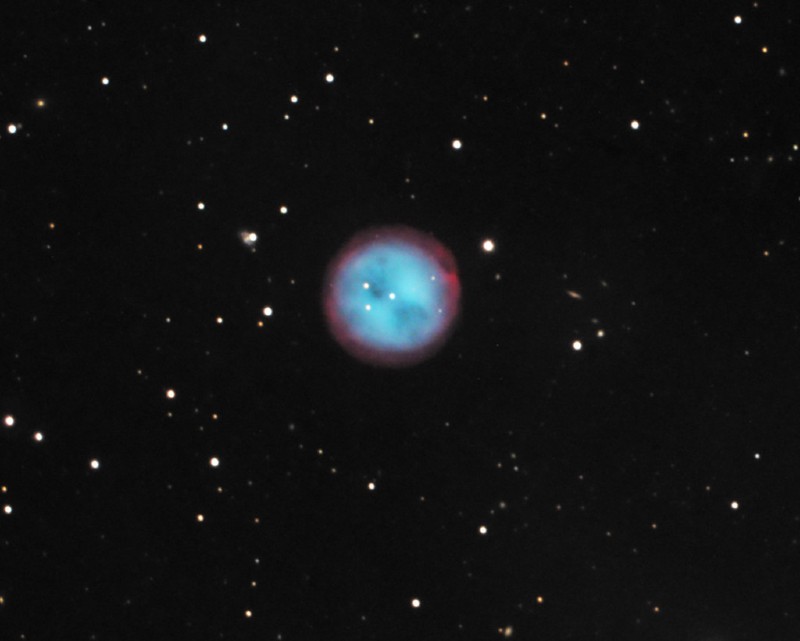
M97
Also known as the Owl Nebula, this challenging planetary nebula is best observed with telescopes under dark skies.
Algieba
Binoculars show two stars, but a telescope at 100x will split the brighter star into a fine pair of gold and white stars.
Stellar Concepts
Conjunction:A conjunction occurs when two objects occupy the same area of sky. For example, Venus forms a rare conjunction with the Pleiades at the beginning of the month. Similarly, the Moon frequently forms conjunctions with bright stars and planets as it moves across the sky.
Free Printable Celestial Calendar