What's in the Sky This Month May 2020
Our Nearest Neighbors
Venus remains a prominent sight in the evening twilight at the start of May, but is rapidly sinking towards the Sun. You’ll have difficulty finding the planet during the last week of the month. It’s replaced by Mercury, which becomes visible from about the 17th onwards. The pair are close together on the 20th and 21st, with both planets appearing within the same binocular field of view. Meanwhile, in the morning sky, Jupiter, Saturn and Mars are readily apparent. Jupiter is slowing catching up to Saturn, and while the red planet brightens from magnitude 0.4 to 0.0, it’s still far from its best. Neptune should now be visible in the predawn sky to telescopic observers, but you might need to wait a little longer for Uranus to escape the Sun’s glare. Finally, the Moon is full on the 7th and turns new on the 22nd.
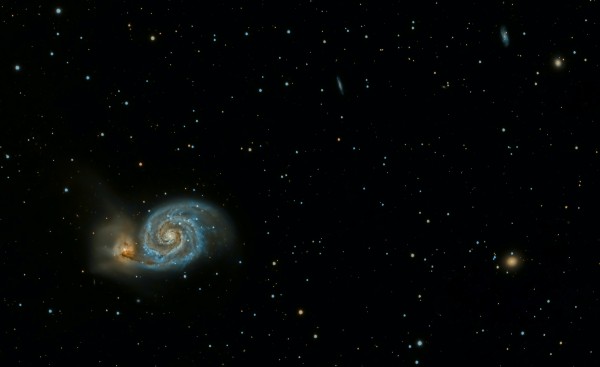
M51 - The Whirlpool Galaxy
| Type: | Spiral Galaxy |
| Constellation: | Canes Venatici |
| Distance: | 43 Million Light Years |
| Magnitude: | 8.7 |
| Apparent Diameter | 13.8’ x 11.7’ |
You’ve no doubt seen pictures of this galaxy in books, magazines and online. Photographically, it can be stunning, but you’ll need a larger scope to see its spiral structure. If you’d like a challenge, try spotting the galaxy with just binoculars. It can be found close to the star Alkaid, (aka Eta Ursae Majoris) and can sometimes be glimpsed as a tiny, elongated misty patch with 10x50 binoculars under clear, dark skies. You’ll get a similar view through a small telescope, but you’ll need a midsized scope - roughly 8 inches or more - to see any mottling in its grey misty light. This is also when the arms of the galaxy start to show themselves, but you’ll likely need to use averted vision to see them.
Morning Meteors
If you’re an early riser, look out for the Eta Aquariid meteor shower before dawn on the 5th. Under good conditions, you can expect to see between 10 and 30 an hour.
Cor Caroli
Easily split with a small telescope, Cor Caroli (aka Alpha Canum Venaticorum) is a springtime favorite with astronomers. A low magnification shows a white primary star with a slightly fainter golden companion.
M3
One of the finest globular clusters in the entire sky, M3 can be glimpsed with binoculars but is best observed with a telescope.
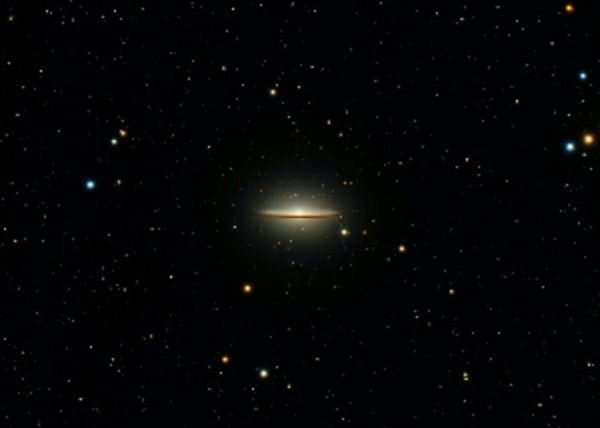
M104 - The Sombrero Galaxy
Detectable in binoculars, this galaxy resembles its namesake hat when observed telescopically.
Stellar Concepts
Averted Vision: The practice of looking at an object using your peripheral vision. By looking just to the side of the object, the light-sensitive rods in your eye's retina are able to detect more light and see fainter details.
Free Printable Celestial Calendar