What's in the Sky This Month? June 2020
Our Nearest Neighbors
Mercury returns to the evening twilight and is visible for the first three weeks of the month. It’s best seen in the first ten days, low over the west-north-western horizon; look for it below the twin stars of Castor and Pollux in Gemini. Conversely, Venus is lost within the Sun’s glare until mid-month, when it will emerge into the pre-dawn sky. Jupiter is now rising at around 10:30pm, with Saturn following about a half hour later. You should be able to fit them both within the same binocular field of view. Mars is steadily improving in brightness and appears within two degrees of Neptune from the 11th to the 15th. Lastly, Uranus rises around 3am for early risers. As for the Moon, it turns full on June 5th and new on the 21st. Look for the waning gibbous Moon close to Jupiter and Saturn on the 8th and 9th.
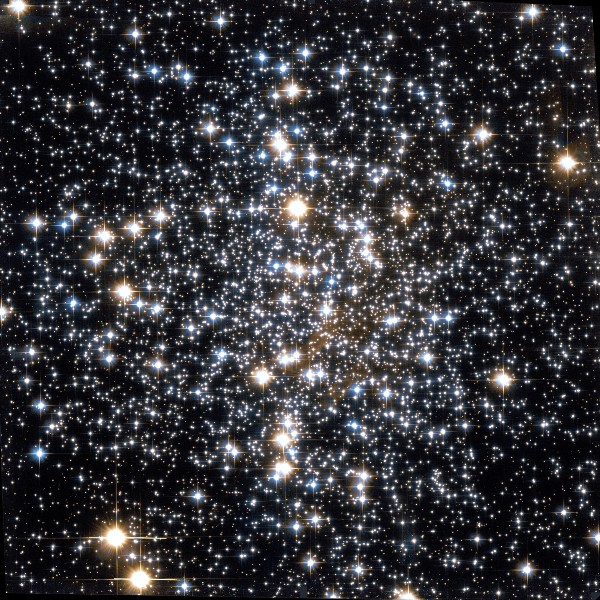
M4
| Type: | Globular Cluster |
| Constellation: | Scorpius |
| Distance: | 9,800 light-years |
| Magnitude: | 5.4 |
| Apparent Diameter | 36’ |
Late spring and early summer is a great time to observe globular clusters, and Messier 4 (M4) is a fine example. While it can be found within the southerly constellation of Scorpius, the Scorpion, and is best seen from southern latitudes, it can still be enjoyed by many in the northern hemisphere. Depending upon your location and your eyesight, it might just be visible to the naked eye, but otherwise you’ll need binoculars to spot it. A telescope at low power, around 30x or so, will show a small, misty patch, and you might notice its slightly elongated shape. Higher magnifications reveal more; in particular, look out for a concentrated bar of stars across its center. Use averted vision to resolve individual stars within the cluster.
Graffias
Graffias, or Beta Scorpii, is an easy double for telescopic observers. Low power will reveal a pair of white stars, with the primary being twice as bright as its companion.
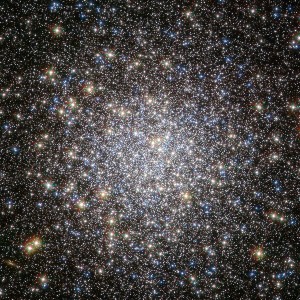
M5
Another fine globular cluster, this time in the constellation of Serpens. Visible with binoculars, it has a small, bright core and appears within the same field of view as 5 Serpentis.
June Bootids
The June Boötids meteor shower reaches its maximum on the evening of the 26th and early morning on the 27th. Not a major shower, you can only expect to see 1 or 2 an hour.
Beta Librae
Also known as “the emerald star,” many observers have reported a distinctly greenish tint to its light. What color does it appear to you?
Stellar Concepts
Globular Cluster: A globular cluster, as the name implies, is a spherical ball of hundreds of thousands of stars. Most globulars can be found forming a halo around our galaxy’s core and contain older stars. Telescopically, many appear comet-like at low power but higher magnifications and astrophotography can reveal countless stars.
Free Printable Celestial Calendar