Our Nearest Neighbors
July belongs to Jupiter and Saturn, with Jupiter reaching opposition (see Stellar Concepts below) on July 14th and Saturn following on the 20th. The just-past full Moon appears nearby on the evening of the 5th. Meanwhile, Neptune creeps into the evening sky and rises at around 10pm by the end of the month. Mars shines in the hours after midnight, with the last quarter Moon nearby on the morning of the 11th and 12th. Uranus rises around 1:30am on the 15th while Venus dominates the pre-dawn twilight. Get up early on the 17th to see a crescent Moon close to both Venus and the bright star Aldebaran. Mercury also makes an appearance in the morning sky from the middle of the month, but is best seen during the last week. Try looking toward the east at about 20-30 minutes before sunrise. Lastly, the Moon turns full on the 5th (see below) and new on the 20th.
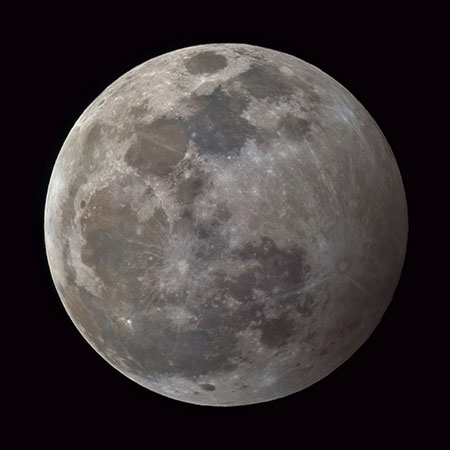
Penumbral Lunar Eclipse
| Date: | July 4-5 |
| Constellation: | Sagittarius |
| Distance: | 235,505 miles (379,099 km) |
| Magnitude: | -12.7 |
| Apparent Diameter | 31.6’ |
This July 4th brings a special event that’s better than fireworks - and it’s visible across almost the whole of the North American continent. A penumbral lunar eclipse occurs when the Moon passes through the outer, less dense area of the Earth’s shadow. Unlike a total lunar eclipse, the Moon won’t turn orange, but its light could appear a little dimmer than usual. The eclipse begins at 11:07pm ET (8:07pm PT), with mid-eclipse occurring an hour and 22 minutes later, at 12:29am ET (9:29pm PT). For this eclipse, just a little more than the upper third of the Moon will skim the Earth’s shadow, but this should be enough to notice a difference. If not, there’s another opportunity in the early hours of November 30th.
The Keystone Cluster
An outstanding globular cluster in the constellation of Hercules, you should be able to detect this with binoculars. Telescopes will reveal chains of stars arcing out from its center.
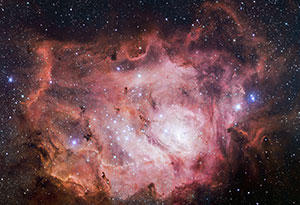
The Lagoon Nebula
Also known as Messier 8, it may be glimpsed with the naked eye, but appears bisected when observed with binoculars or a telescope. Look for a scattering of stars nestled within it.
The Butterfly Cluster
Number 6 in Messier’s catalog, this star cluster is visible with the naked eye and binoculars, but is best seen with a telescope. Its butterfly shape is easily seen at low magnification.
Alp Her
Also known as Rasalgethi, this double star can be split with a small telescope at a magnification of about 125x. The primary appears orange with a blue-green companion.
Stellar Concepts
Opposition: A planet, asteroid, or dwarf planet is said to be at opposition when it’s directly opposite the Sun in the sky. As a result, like the full Moon, it rises at sunset, sets at sunrise, and is therefore visible throughout the night. It’s also when the object is brightest and appears largest when observed telescopically.
Free Printable Celestial Newsletter