What's In The Sky This Month? October 2020
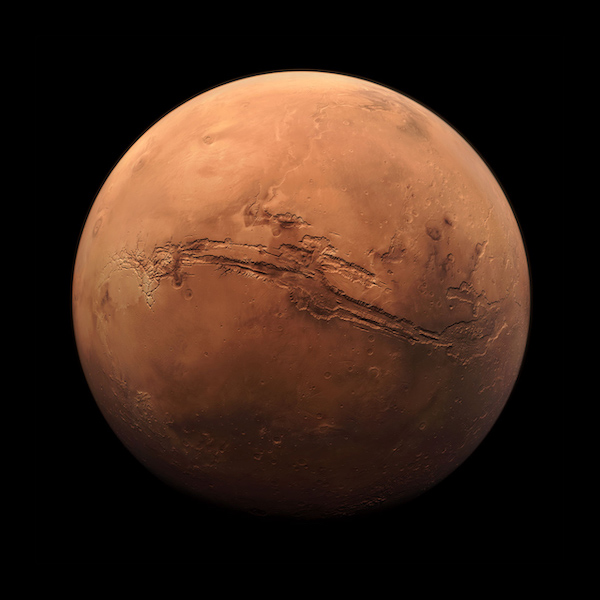
Mars
| Constellation: | Pisces |
| Distance: | 62.5 million km |
| Magnitude: | -2.6 |
| Apparent Diameter | 22.4” |
If you’ve never seen Mars through a telescope, now’s your chance. In fact, it’ll be your best chance in 15 years, as the planet won’t appear this large until 2035. It’ll reach opposition on October 13th, and at magnitude -2.6, it’ll outshine everything in the sky except the Sun, Moon and Venus. You’ll find it rising in the east after sunset and it’ll remain visible throughout the night before setting in the west around sunrise.
Telescopically, its disc will appear a little more than half the size of Jupiter’s. While this puts it well within the reach of almost every telescope, you’ll ideally need a larger scope and a higher magnification to get the best views. A magnification of about 100x will show the dark surface features on its pale orange disc and could also afford a glimpse of the southern polar ice cap.
Our Nearest Neighbors
You might just be able to spot Mercury very low over the south-southwestern horizon just after sunset for the first few days of the month. However, it’s a challenging object and you’ll need a clear, totally unobstructed view. Jupiter and Saturn continue to shine toward the southwest; a nearly first quarter Moon will hang below Jupiter on the 22nd. Neptune is also well placed and should be worth observing from about 9PM onwards. October, however, belongs to Mars, with the red planet being at its best throughout the month. Uranus is also at its best, but is located in the barren southern area of Aries. Early risers can enjoy lovely Venus in the hours before the dawn. It’s among the stars of Leo and will pass very close to Regulus on the 2nd and 3rd, with the crescent Moon nearby on the 13th and 14th. The Moon itself will turn full on the 1st, new on the 16th, and then full again on the 31st.
M31, The Andromeda Galaxy
The most distant object easily seen with the naked eye, M31 is a favorite target for astronomers and astrophotographers alike. Even a small telescope can reveal faint details in its edge-on spiral arms.
M52
Another open cluster in Cassiopeia, M52 can appear conical in small scopes, with a bright star at the tip. Averted vision will reveal many of the cluster’s fainter stars.
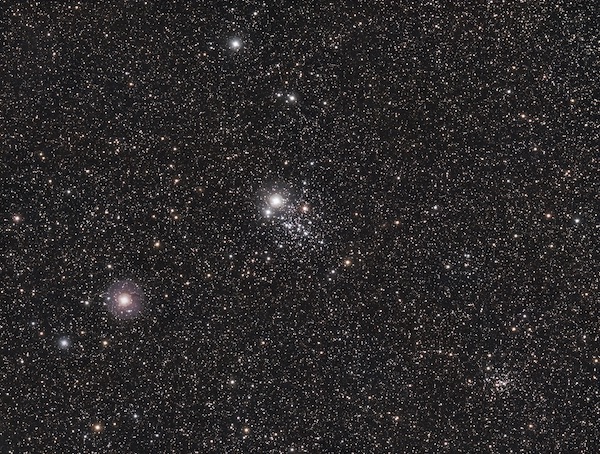
NGC 457, The Owl Cluster
With the double star Phi Cassiopeiae marking the eyes, this fine open cluster is a lovely sight in scopes. A low magnification of 50x is all that’s required for the best view.
Eta Cassiopeiae (Achird)
Barely split at a low magnification of 35x, this brilliant white star has a coppery colored companion. A third, faint blue component becomes visible with higher magnification.
Stellar Concepts
Open Cluster: An open cluster is a group of hundreds or thousands of stars that formed from the same nebula. As such, the stars are typically fairly young and appear blue-white. The clusters can vary considerably in size and density, and can often appear to form familiar shapes and patterns.