All coupons, tax, shipping, store credit and gift cards will be applied during checkout.

Newtonian reflectors on mounts that are not computerized are the best form of observational astronomy. They put optical performance and manual control at the center. There are big holes in these telescopes called apertures that let in a lot of light. Most people really like them. The telescopes show a lot of details about the moon, the planets, and things far away like galaxies, nebulae, and star groups. The Newtonian mirror is stable, easy to move, and quick to set up. They work well with simple alt-azimuth mounts, Dobsonian mounts, and flat-top mounts. While steel or metal tripods are stiffer, Dobsonian bases made of wood are more flexible and make moving smoother. These systems are great for visual stargazing, outreach, and those who want the biggest aperture for the least amount of money. Because of this, manual Newtonian telescopes are an important piece of scientific gear that will always be in style.
×
![]()
Highlighted Products
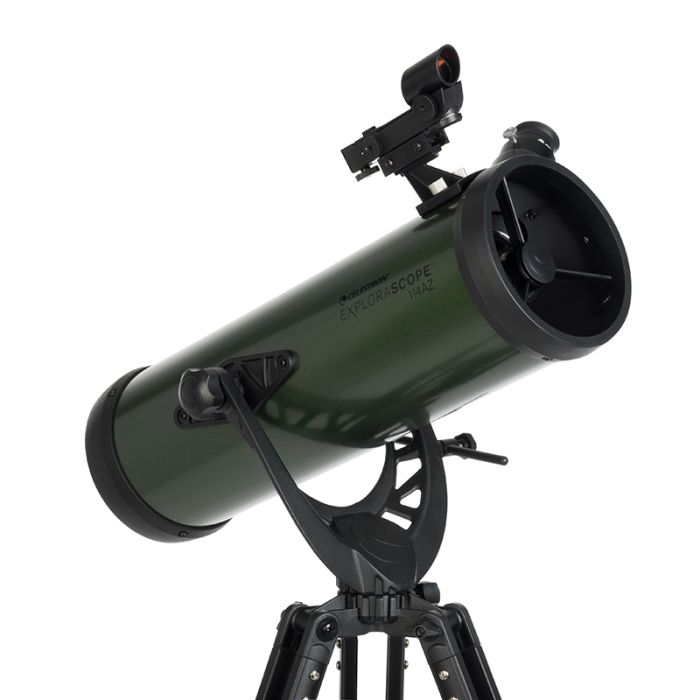
StellarMate Pro Astrophotography Controller
The Celestron 4.5" Explorer Scope Reflector is perfect because it weighs just 6.7 pounds and integrates with Celestron's SkyPortal program. It helps one view Venus, the Moon, and galaxies, among other celestial bodies.

Celestron Travel Scope 80 Alt-Az Refractor with Smartphone Adapter
Extending the portability and simplicity of use, the Celestron Travel Scope 80 Refractor presents a lightweight design with an 80 mm aperture, covered glass lenses, and a bespoke bag. It features a preassembled mount and tripod and is appropriate for viewing terrestrial or night sky.

Explore Scientific FirstLight 127 mm White Tube Maksutov-Cassegrain w/Twilight I Mount
Explore Scientific offers the FirstLight MAK127, a telescope for celestial and deep-sky exploration. It features a 127 mm f/15 White Tube Maksutov-Cassegrain optical tube, Twilight 1 alt-azimuth single-armed fork mount, a 25 mm Plossl eyepiece, a red dot finder, and a smartphone camera adapter. The telescope has a magnification of 250x and a 1900 mm focal length.
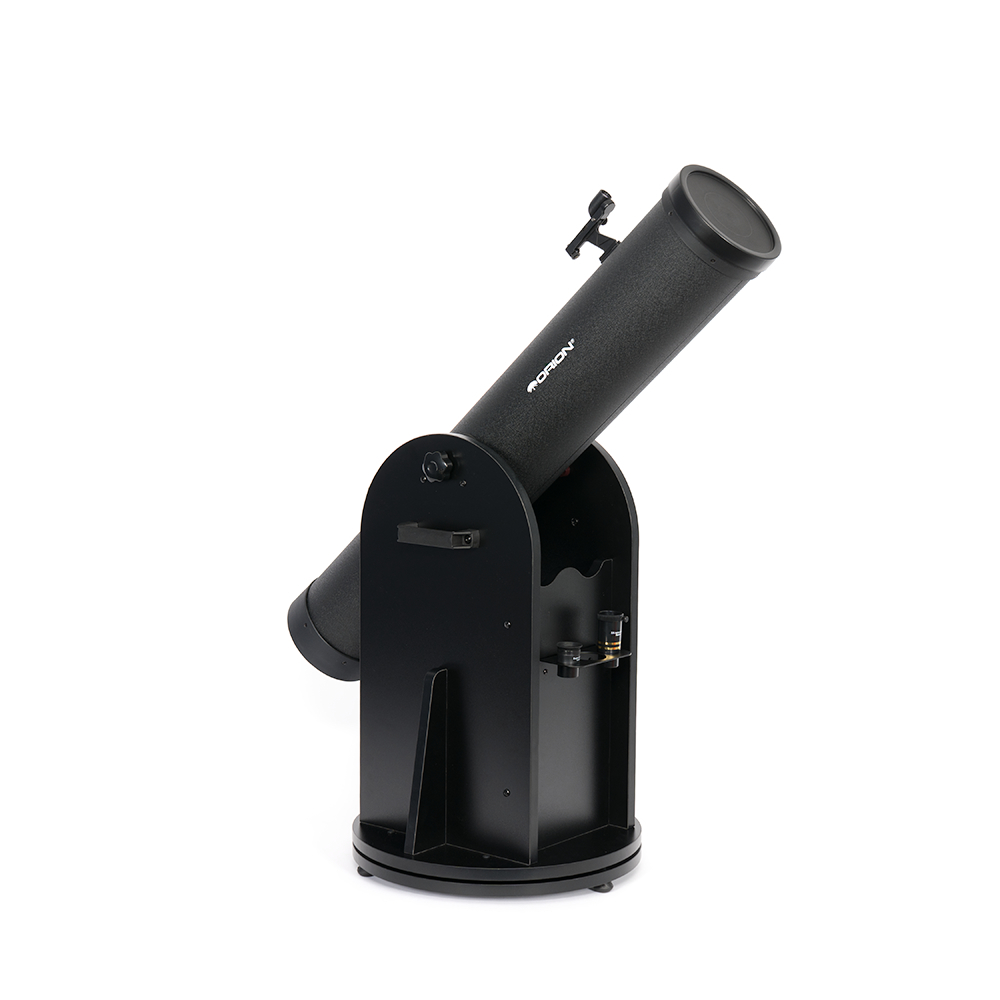
Orion SkyScanner 135mm Dobsonian Reflector Telescope
If this is the first attempt at using telescope, the Orion SkyScanner BL135mm Dobsonian Reflector Telescope is a great pick. This TV has a huge 135mm screen that makes sky things like the Moon and the Orion Nebula very clear. The optical tube moves easily on a strong base, and it comes with a red dot finder scope to make things even easier. The guide tube and handle can be taken off, which lets you move the camera around. It has good eyepieces (25mm Kellner and 10mm Plossl) that can magnify 44x and 110x, respectively. It also has a 3x Barlow lens for extra zoom. It can be use with the Orion MoonMap 260 to learn more about the moon.
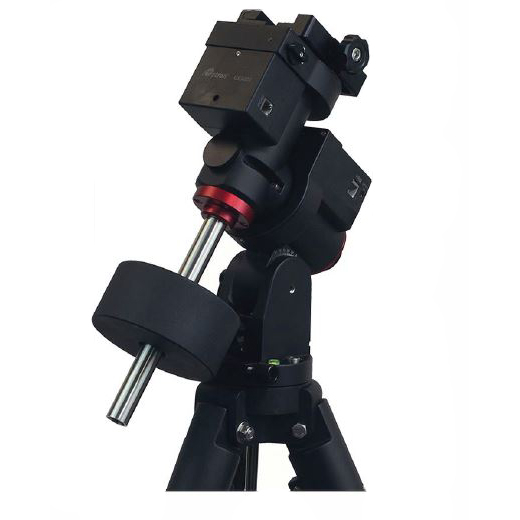
iOptron GEM28EC German Equatorial Mount with 1.5" Tripod and Hard Case
Real-time periodic error correction, an integrated iPolar, a lightweight 1.5" frame, and a hard case are all part of the iOptron GEM28EC mount. It only weighs 10 pounds, but it can hold up to 28 pounds because it is designed to be efficient, like CEM mounts. A secure lock gear engagement system, built-in WiFi, and an ST-4 auto-guiding port are some of the most important features. With the Go2Nova 8409 controller and a collection of 212,000 objects, the precision stepper motor makes sure that GoTo works correctly. The strong tripod has 1.5" stainless steel legs that make it easy to move around. The mount comes with advanced worm gear design, latitude and azimuth adjustment ranges, and full power specs, all of which ensure reliable performance for astrophotography and observation.
More About This Category
Newtonian reflectors were groundbreaking in their initial optical shape. Instead of lenses, which suffer chromatic aberration or color fringing. Newtonian telescopes concentrate light using mirrors. The concave-surface primary mirror gathers and reflects, pointing a light toward the eyepiece or camera to a secondary, flat mirror. This design reduces chromatic aberration and allows larger apertures at less cost than refractors. Furthermore, the absence of lenses makes Newtonian reflectors more reasonably priced and easily accessible, creating breathtaking celestial body views.
A Newtonian reflector seems amazingly simple. First, lay it precisely on a level, firm surface. Check your Dobsonian mount's elevation (up and down) and azimuth (left to right). After orienting the chosen eyepiece into the focuser, line the finder scope to a dazzling star or the Moon to help in night sky object identification.
Best Uses for Newtonian Reflectors
Newtonian reflectors are relatively wealthy and adaptable in many applications in astronomy. Their wide apertures expose minute features like lunar maria and craters, making them ideal for observing the Moon. They are also suitable for planet research since they show unambiguous images of planetary surface features and atmospheric activities. Large apertures of deep-sky photos let users surprisingly clearly observe galaxies, nebulae, and star clusters using a star chart. Their capacity to collect large light volumes makes them especially useful for observing faint objects undetected by less powerful telescopes.
Newtonian reflectors are a wise choice for amateur astronomers, as compound telescopes can be more expensive and sophisticated. Because of their straightforward construction and fewer optical elements, Newtonian reflectors are a reasonably fundamental, dependable choice. They have a big aperture, improved light-gathering capacity, and fewer electronic components, translating into durability. They have educational worth, are versatile, and demand minimal care. Usually less expensive than automated mounts, Newtonian reflectors avoid chromatic aberration.
Simple, precision-driven observational equipment, such as an equatorial non-computerized telescope reflector, requires hand adjustment for smooth celestial object tracking.
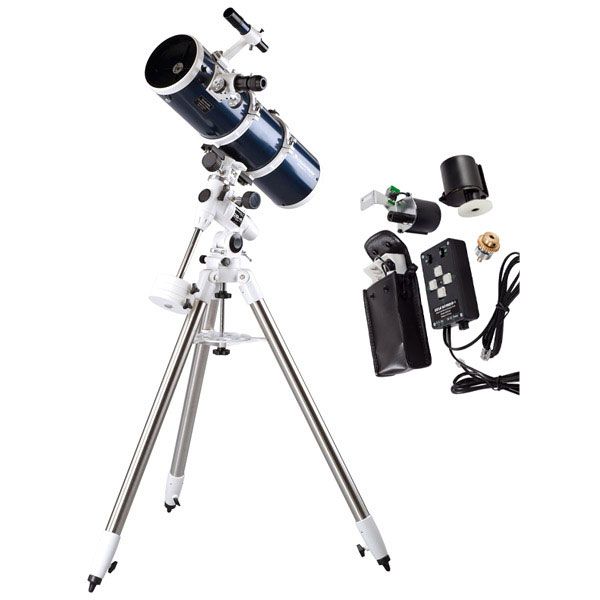
The Celestron Omni XLT 150 Reflector Telescope is 6' Newtonian, designed for amateur and professional astronomers. Its primary mirror is 150mm, its optical tube is cosmic blue, its focuser is 2' Crayford-style, and its 6 X 30 finderscope is Find, track, view, and photograph celestial objects using the Classic Celestron CG-4 German Equatorial Mount. The telescope comes in small packaging, a spreader bar, and a firm tripod made of stainless steel legs for simple mobility and storage.

For initial Moon, planet, and deep-sky object viewing, the Celestron AstroMaster 114 EQ reflector telescope is among its features: a moveable aluminum tripod, 4.5" mirror, and StarPointer finderscope. It calls for no tools; its aperture is 114 mm, its focal length is 1000 mm, and its highest magnification is 269 X.
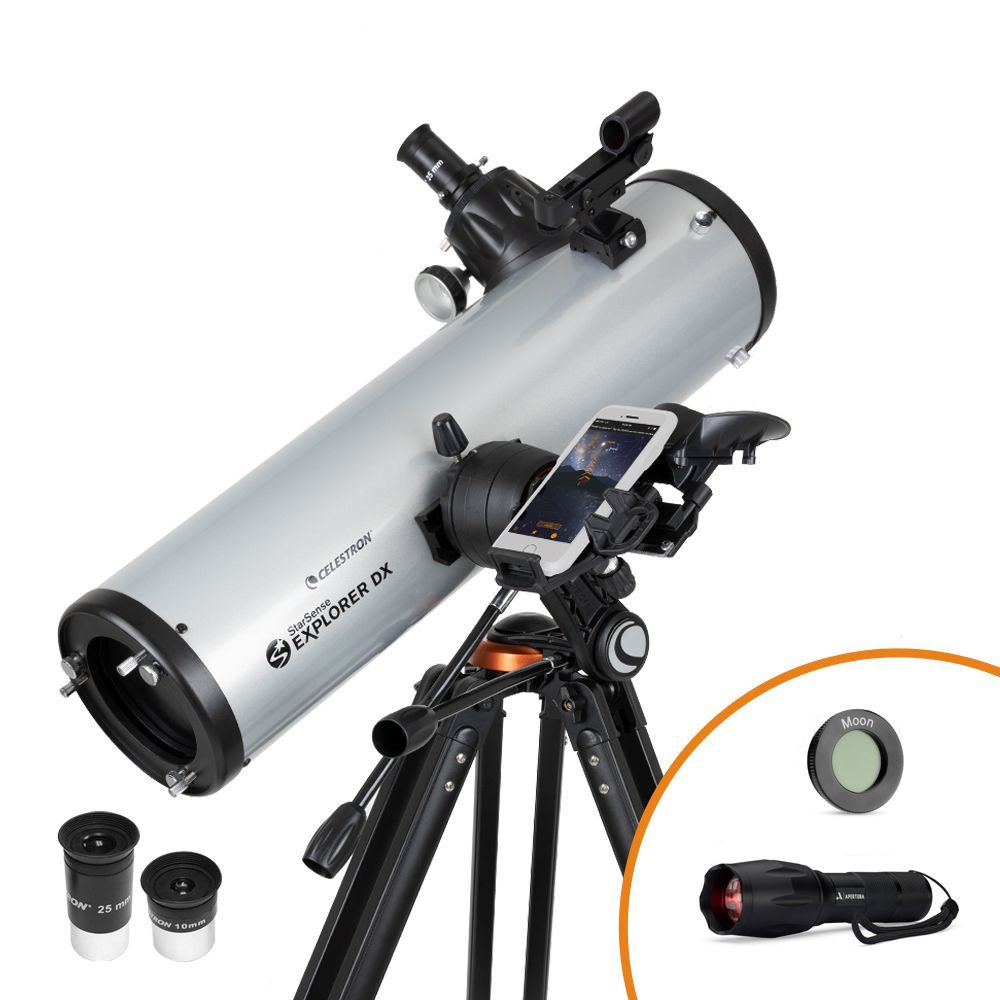
Novice or amateur astronomers will find the Celestron StarSense Explorer DX 130AZ Essential Telescope Bundle to provide an exciting and fun stargazing experience. Its huge Newtonian reflector, StarSense Explorer App, and alt-azimuth mount type guide aim at gathering star pattern data. Its 650mm focal length and 130mm aperture produce 1.3x more light-gathering power than the LT 114AZ.
Its lifetime and performance depend on how its Newtonian reflector is maintained. Sharp images are guaranteed by regular collimation, so sparing mirror cleaning is essential. Steer clear of sudden temperature swings and let the telescope adjust to outside conditions before usage. Keep the telescope dry and dust-free to guard it against moisture and trash.