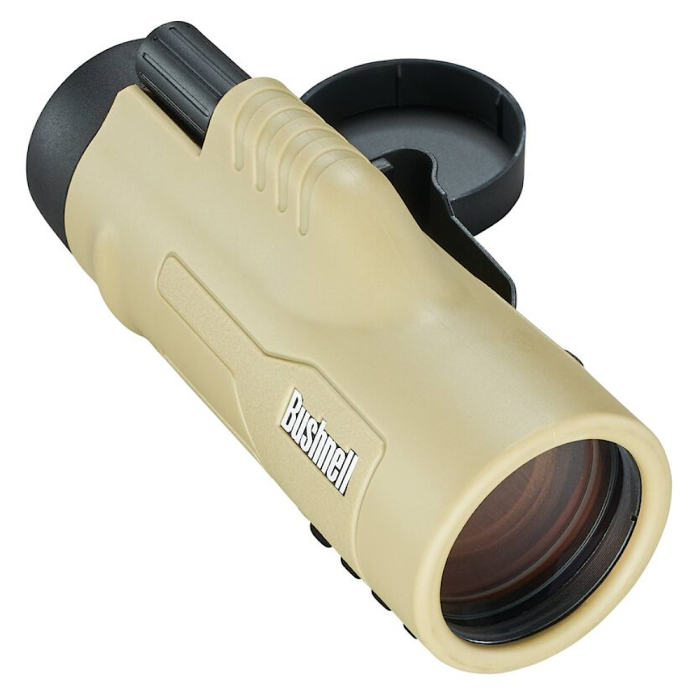
Bushnell Legend 10x42 Ultra HD Tactical Monocular w/ MIL Hash Reticle - FDE
Sold Out
Sold Out - No ETA Available - Not Accepting Back Orders At This Time.THE INDUSTRY'S BEST TELESCOPE AND ASTROPHOTOGRAPHY EXPERTS
Look, we get it. Stating that we’re the “best” can seem a bit like a catch. However, with a combined astronomy experience of over 115 years (117 to be exact), our team of telescope and astrophotography experts, a.k.a. "Gear Experts", knows astronomy and how to service our customers.
We know how to narrow down the products that best fit YOUR needs, rather than push something simply because it’s easy. Once we’ve done that, we ensure you understand WHY we’re recommending the product by teaching you the concepts behind the product and in the process, we demystify all the terminology. Leaving you with confidence knowing you are making the right decision and one that is perfect for you and your goals of viewing the night sky!
Our knowledge is only surpassed by our passion for this wonderful hobby we all love so much. We truly believe our team is a cut above the rest and we look forward working with you!
NON-COMMISSIONED PRODUCT ADVISORS
Our team of product advisors know what it’s like to buy astronomy equipment for the first time. There are so many types of telescopes and accessories that the process can be overwhelming enough without having to worry about pushy salespeople trying to make a big commission.
That’s why our unbiased, non-commissioned product advisors’ only incentive is to recommend a product that they truly believe is the right choice to help you meet your goals, and at a price point that also meets your budget. There’s never any pressure to buy, and you can rest assured that your recommendation is personalized for you rather than motivated by financial gain. We look forward to helping you start your astronomy journey!
Bushnell Legend 10x42 Ultra HD Tactical Monocular MIL Hash FDE
If you're looking for a compact monocular with ED prime glass, PC3 phase coating, Dielectric prism coating, and Rainguard HD - With a MIL Hash reticle - This is it! This great portable optic offers the versatility of having a MIL hash reticle for ranging and calling calling out corrections. ED Prime Glass cuts down color fringing (chromatic aberrations) and allows for the sharpest imaging, so you can see the difference between a left edge hit or a center punch. Bushnell spotting scopes give you the advantage from the world’s high point of brightness, clarity and edge-to-edge detail – whether you’re birding at sea level or hunting above timberline. The HDOS (High definition optical system) combines their key technologies: ED Prime Extra-Low Dispersion glass, premium BaK-4 prisms and fully multi-coated lenses. Together these deliver flawless color fidelity, ultra-crisp images and optimum light transmission. From finding the trail less traveled to perfecting your shot — you belong outdoors. Bushnell develops optics gear to empower you to get out and experience your passion because we love the outdoors as much as you.
Specifications
- Magnification: 10x
- Objective Lens: 42 mm
- Prism System: Roof
- Field of View: 340' @ 1000 Yards
- Eye Relief: 15.2 mm
- Exit Pupil: 4.2 mm
- Weight: 13.2 oz
- Eyecups: Twist-Up
|
SKU Number
|
BUS-191144 |
|---|---|
|
MPN
|
191144 |
|
Binoculars by Magnification
Binoculars by MagnificationThe magnification factor, also known as "power", is listed as the first number given in a binocular's name, like 7 x 50, 8 x 40, etc. In the first example, these binoculars magnify an image 7X more than if you were looking at that image with the "naked eye". When talking about zoom binoculars, the magnification is listed like this: 7-21 x 50. That means the binoculars have a zoom mechanism that takes the power from 7X to 21X as far as the eye can see. Please note that it doesn't matter whether there is spacing between the numbers or whether the "X" is upper- or lower-cased. Don't always assume that more magnification is better! The more power, the harder it is to keep the image stable when hand-holding binoculars. Most people can comfortably hand-hold up to an 8X (most popular for birding), but after that, you may or may not need a tripod for a shake-free view...it depends on your own steadiness and how long you plan to view. |
10X |
|
Binoculars by Aperture
The aperture of a pair of binoculars (or any optical instrument) refers to the diameter of the main optics. Of course, binoculars have two main objectives that are the same size, but the number given for the aperture refers to just one. For instance, 8x50 binoculars have an aperture of 50 mm (and a magnification factor of 8), but unlike a telescope, they have two 50 mm objectives. The larger the aperture, the bigger the binoculars, but more importantly, a larger aperture draws in more light and lets you see more detail in shadow, shade, and other low light conditions.
|
42mm |
|
Binoculars by Body Size
Shopping for binoculars by body size is a great help if you already know you want a pair of compact (small) binoculars or you are looking for large aperture optics for astronomy. In general, the larger the body size the heavier the binoculars will be and the more likely you may need to mount them on a tripod when viewing for any length of time.
|
Monoculars |
|
Weight (ounces)
Weight (ounces)The weight of a binocular is a small consideration next to other more important factors like body size, aperture, and magnification, but it is still nice to know what to expect. Believe it or not, sometimes super small, lightweight binoculars are harder to hand-hold without unwanted binocular movement than larger binoculars are...a little heft helps stabilize them. However, heavier binoculars can fatigue your arms when trying to hand-hold for longer periods of time. If you decide to choose a pair of binoculars by weight, I would use the "Goldilocks" rule; pick something that is not too heavy and not too light...but just right! Unless, of course, you plan to mount your binoculars on a tripod, monopod or other type of support, then the weight doesn’t matter. |
13.2 oz |
|
Prism Design
Prism DesignWant to know how to tell the difference between Roof prism and Porro prism binoculars? Roof prism models look like two straight monoculars connected together in the middle, while the eyepieces are closer together than the main optics of Porro prism binoculars, angling the light path. Most binoculars are either roof or porro prism designs, but there is also a third option: Reverse Porro Prism. This design is used for small compact binoculars where the eyepieces are more widely spaced than the main optics. The prisms are actually reversed so that the light path is altered for this configuration. Like most things in life, which design you should choose is not cut-and-dried. Here are a few basic statements about Porro and Roof Prism designs that may help you:
|
Roof Prism |
|
Waterproofing
WaterproofingWhile there are certainly individuals who don't require a pair of waterproof binoculars, we recommend it for most people. If you will be out on the water, at the beach, in snow, or find yourself in situations where heavy dew is present, you should consider the protection waterproofing can offer. If a pair of binoculars is waterproof, it can withstand getting caught in the rain, dropped in a puddle or getting a beer or soda bath at the ball park. Waterproofing can also keep fine dust and sand from entering the optical system. Keep in mind that "water resistant" is not the same as "waterproof". Most binoculars that are water resistant can get a little wet as long as you dry them off as soon as possible, but they will not keep liquid out if submerged or kept wet. |
Waterproof/Fogproof |
|
Prism Glass
Prism GlassBoth BK-7 and BAK-4 refer to the glass used in a binocular's prisms. The terms were coined by Schott AG, an old and very-well respected glass manufacturer in Germany. BK-7, which is the less expensive of the two, is made with Borosilicate Crown glass, and BAK-4 is made with Barium Crown glass, which has a higher reflective index. There are other differences in BK-7 and BAK-4 prisms besides the glass type. BK-7 can have a less-rounded exit pupil than BAK-4 prisms do, and can cause vignetting of the far edges of an image, especially when using wide angle binoculars with a smaller exit pupil in low-light conditions. BAK-4, on the other hand, produces a round exit pupil that will allow you to see the entire field of view regardless of the lighting conditions.Higher-end binoculars, regardless of whether they are Porro or Roof prism designs will almost always come with BAK-4 prisms, although keep a look out for the glass brand, such as Schott or Zeiss, for the absolute best BAK-4 Barium Crown glass prisms. More modestly priced binoculars may come with either one. If you decide on a pair of BK-7's, look for models that have a larger exit pupil if you plan to view in a variety of lighting conditions. |
BaK-4 |
|
Optical Coatings
Optical CoatingsMost binoculars include optics that have been coated to some degree. Optical coatings increase and even out light transmission as well as enhance contrast. What an optical coating consists of is often proprietary, but you can usually see the coatings by holding the optics at an angle to display a green, blue or brownish tint to the glass. While the addition of coatings is far better than plain, uncoated glass, it is important to know how many optical surfaces are coated. The more, the better. Watch for these terms:
Phase-coatings are often applied to binoculars with a roof prism (as opposed to Porro prisms) to help keep the light from going "out of phase" as it passes through the prism. If you decide to buy a pair of roof prism binoculars, watch for this specification, as it increases clarity, contrast and sharpness. |
Fully Multi-Coated Optics |
|
Exit Pupil (mm)
Exit Pupil (mm)
The size of the beam of light that hits your eye when you gaze through your binoculars or other optics is called the Exit Pupil. It is measured in millimeters. You can calculate the exit pupil by dividing the aperture by the magnification. Therefore, a pair of 8 x 50 binoculars would have an exit pupil of 6.25 mm (50 divided by 8). Basically, the idea is to match the exit pupil to the size of your own pupils. In low light, your pupils open up to let more light in. In bright light they get smaller. So binoculars with a larger exit pupil are good for all lighting conditions, while those with a small exit pupil do not perform as well in low light.
|
4.2 mm |
|
Eye Relief (mm)
Eye Relief (mm)
Eye relief is the minimum distance between your eye and the binocular’s eyepiece that allows the full field of view to be comfortably observed. The measurement is in millimeters and is taken from the last lens surface to the point beyond the eyepiece where all the rays of light come to focus and form a sharp image. Generally, eye relief should be at least 10 mm, but you will find that about 15 mm will provide best comfort without glasses. If you have an astigmatism and need to wear glasses when observing, you may require 15 mm - 20 mm of eye relief for comfortable viewing.
|
15.2 mm |
- Bushnell Legend 10x42 Ultra HD Tactical Monocular MIL Hash FDE
- Soft Carry Case
- Strap
- Cleaning Cloth
