All coupons, tax, shipping, store credit and gift cards will be applied during checkout.

×
![]()
Celestron NexStar Evolution
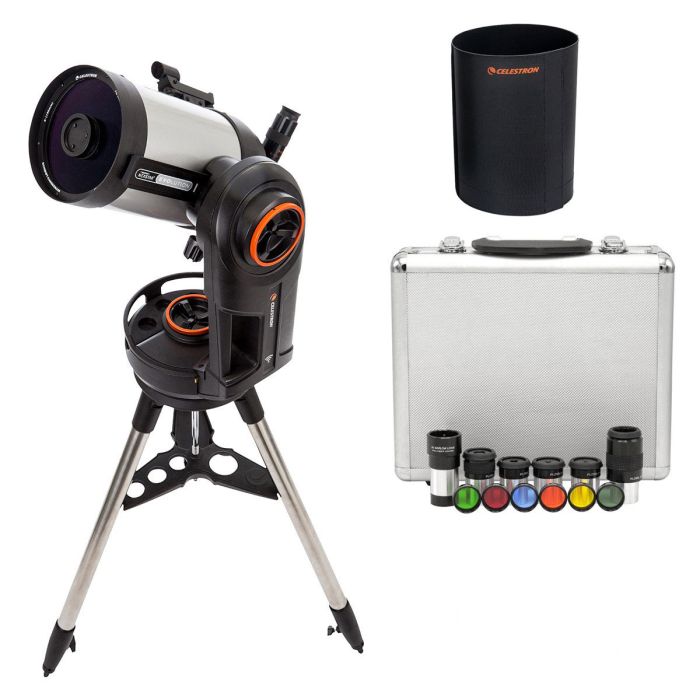
The Celestron NexStar Evolution offers a fully computerized telescope with WiFi control, making it easy for users to locate celestial objects. Its advanced technology and portability make it perfect for beginners and seasoned astronomers. It's related to the NexStar 8SE setup as both share similar alignment and control features for convenience.
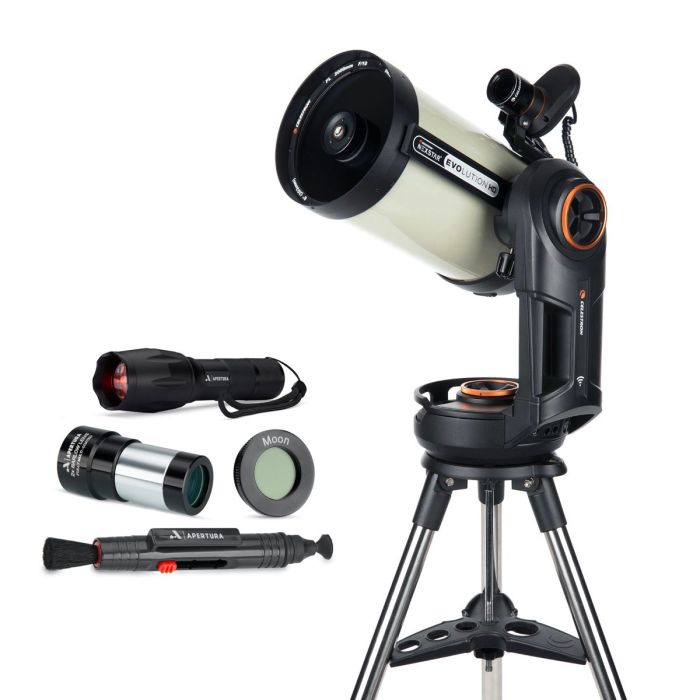
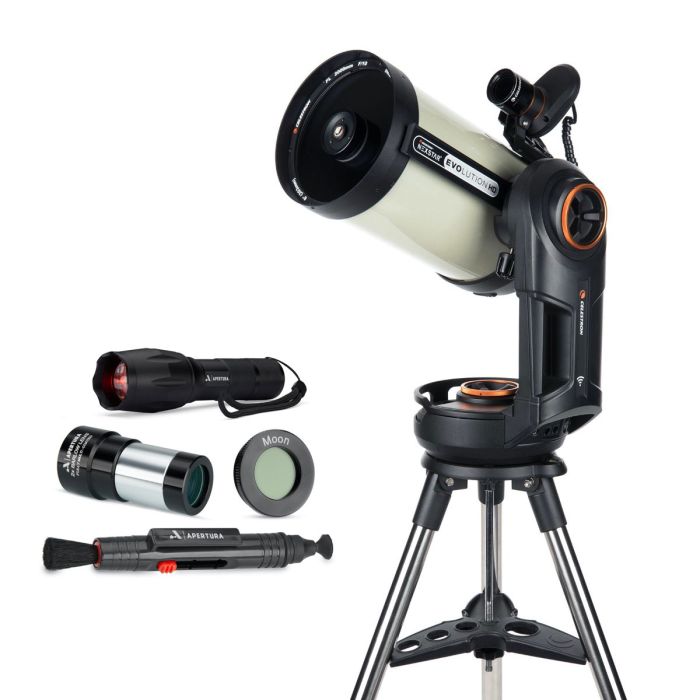
Celestron NexStar Evolution 8" EdgeHD w/ StarSense Essential Telescope Bundle
Celestron NexStar Evolution 8" EdgeHD w/ StarSense Essential Telescope Bundlewhile the StarSense technology simplifies alignment. This bundle is perfect for both beginners and experienced astronomers, ensuring a seamless and enjoyable observing experience.
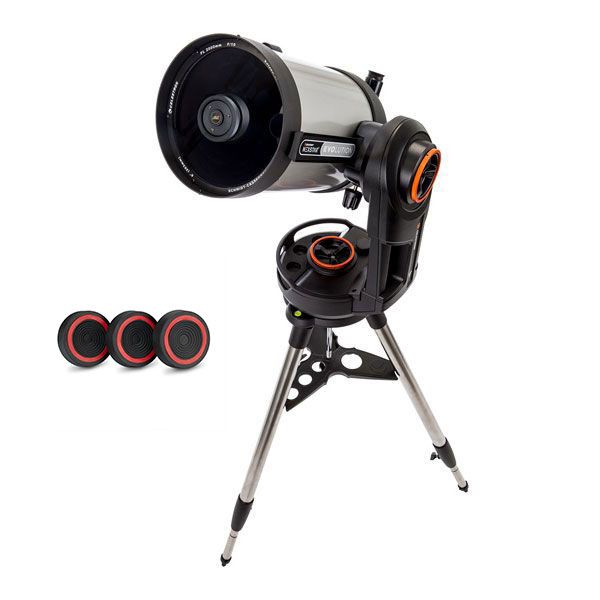
Celestron 8" NexStar Evolution Computerized Telescope
The Celestron 8" NexStar Evolution Computerized Telescope offers advanced features for both novice and experienced astronomers. Its high-quality optics provide stunning images, while the built-in WiFi allows for easy smartphone control. With an intuitive interface and robust design, this telescope ensures a seamless stargazing experience and exceptional performance for celestial exploration.
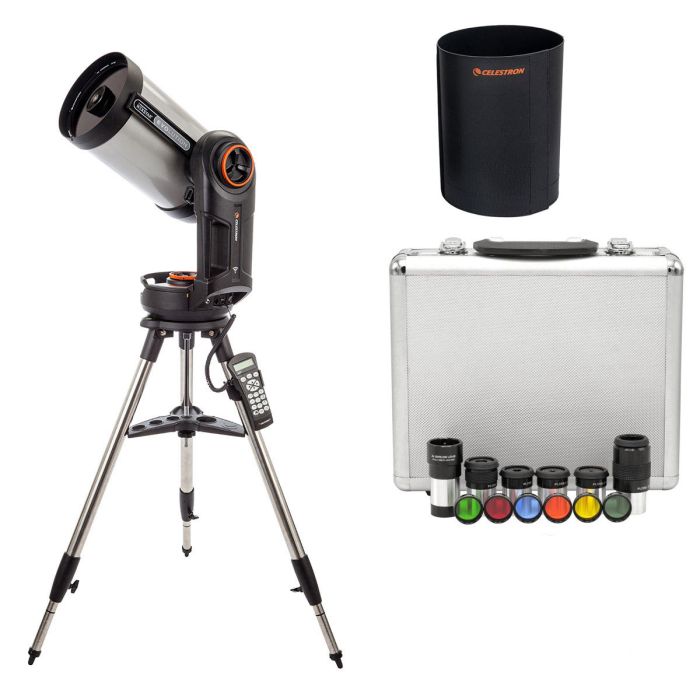
Celestron NexStar Evolution 8 Telescope Bundle
The Celestron NexStar Evolution 8 Telescope Bundle combines exceptional optical performance with user-friendly technology. This package includes an 8" aperture for impressive detail in celestial objects, along with a sturdy mount and intuitive WiFi connectivity for smartphone control. Ideal for both beginners and experienced astronomers, it enhances the stargazing experience significantly.
More About The Celestron NexStar Evolution
The silent whispers of the beautiful night sky and the inquisitive human eyes are connected through a bridge. This bridge is the Celestron NexStar Evolution telescope. A wonder of contemporary engineering housed in a sturdy build that turns stargazing into an extraordinary journey through space and time. Imagine standing on a hilltop, the cool night breeze caressing your face as you set up your NexStar Evolution telescope, ready to explore the mysterious galaxy.
Reveal the universe in all its breathtaking detail as the world around you dims and you peep through the eyepiece.The NexStar Evolution series uses Schmidt-Cassegrain optics for effective light collection and sharp photos. The telescope's extraordinary excellence is ascribed to its power and precision in addition to its optics. Users can immerse themselves in the fascinating view without constant pauses to adjust the telescope.
Capturing clear images of celestial objects can be challenging without the right tools. The integrated battery of the NexStar Evolution series is one of its most significant selling points. When the night takes you, you may go on impromptu stargazing trips without the limitations of external power sources. The NexStar Evolution is your devoted friend, prepared to solve the universe's secrets, whether you're in a calm rural area or a far-flung desert. It's more than simply a tool, it's an artistic creation that fits in well with any setting.
NexStar Evolution Models for the Universe
Every model in the NexStar Evolution series has precise tracking capabilities, which are great options for astrophotography. The precise alignment mechanism and sturdy mount provide sharp, detailed long exposure shots of astronomical objects. For those who enjoy casual stargazing, the NexStar Evolution series offers a hassle-free experience with its quick setup, easy alignment, and intuitive controls. Whether exploring the craters of the Moon, spotting the rings of Saturn, or hunting for distant galaxies, these telescopes provide a rewarding and enjoyable experience.
Astronomy presents numerous challenges for observers, including challenging alignments, poor tracking, limited portability, and connectivity issues. The Celestron NexStar Evolution telescopes address several essential issues. They provide solutions that improve the whole astronomy experience by fusing cutting-edge technology with intuitive features. This series enhances astronomers' experience with advanced features like solid power management, modern networking, accurate alignment, and improved tracking.
- NexStar Evolution 6 - is a compact, high performance telescope with a 6" aperture promising breathtaking views of the Moon, planets, and Orion Nebula. Its mobility permits simple setup and transit. Its goal is to offer an excellent, easy to navigate telescope suited for various astronomical objects.
- NexStar Evolution 8 - this model features an 8" aperture for sharper, more detailed photos. The increased light gathering capability is great for seeing dim deep-sky objects. Such a flexible option for planetary or exploration.
- NexStar Evolution 9.25 - This model is especially well-liked because it can show fine features in deep-sky objects and provides high-resolution images of planets. Serious amateurs who wish to test the boundaries of amateur astronomy frequently select the 9.25.
Here's what we love about the Celestron NexStar Evolution Telescope Series
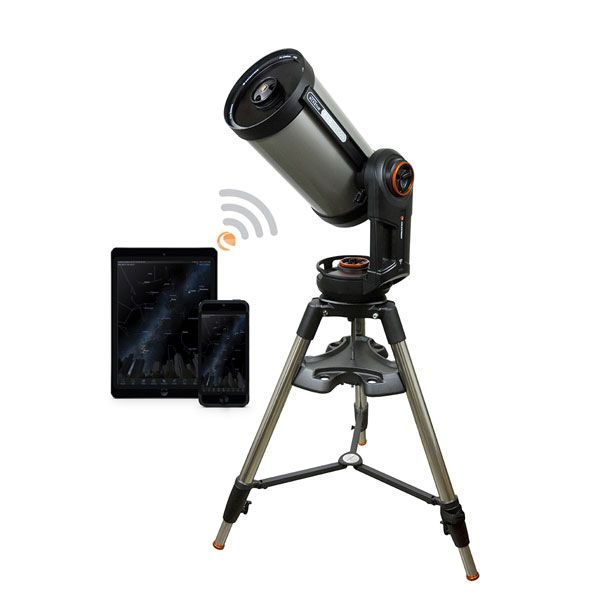
The Celestron NexStar Evolution Telescope is the first telescope to combine smart phone app technology with traditional telescope features. The engineers at Celestron really hit the mark with the Celestron NexStar Evolution. Some of our favorite features include:
- Smart phone app control of your telescope allows you to point your smart phone or tablet at the sky, identify an object with the app's planetary interface and go to that object with the push of a button.
- The app identifies objects for you and even has the ability to offer an abundance of information on any of the 120,000 objects in the app database.
- The Celestron NexStar Evolution's computerized GoTo mount has high-performance worm gears and motors for improved tracking accuracy, along with reduced gear backlash.
- No need to worry about batteries! The Celestron NexStar Evolution has a rechargeable lithium-ion battery with enough power for 10 hours of continuous observing.
- The NexStar Evolution has an improved industrial design with manual clutches and integrated carry handles, plus the added convenience of two accessory trays and a USB charge port for your smart device.
Read our detailed review of the Celestron NexStar Evolution 8" Telescope here!
Telescope FAQs
What is the most popular telescope?
Telescope popularity changes over time, and so the most popular telescope in 2021 may not be the most popular telescope in 2022. That said, there are some telescopes that remain popular over time due to amazing technology, ease of use or price point. Here are a few of our favorite popular telescopes for sale: Dobsonian telescopes have remained popular over several decades. They are priced low compared to other telescopes of the same size, are easy to use, and help you learn the night sky. We recommend the Apertura AD 8" Dobsonian for its quality and included accessories. Another amazingly popular telescope is the Celestron NexStar 8SE. The NexStar 8SE is a portable Schmidt-Cassegrain computerized telescope that is easy to use and has 8 inches of aperture to see deep into space. Smaller NexStar SE telescopes are also available if you want something even more portable that costs less.
How do you know a telescope is good?
Keeping in mind that the word "good" is subjective, there are a few simple ways to know if you have a decent telescope. First and foremost is the quality of the image it delivers. A good telescope will be able to produce sharp images of the Moon and brighter planets on a clear night of steady seeing. Also, a good telescope should not wobble on its mount or tripod. Even if the telescope itself focuses and has good optics, a cheap or defective telescope mount or tripod (or both) will make it almost impossible to find, follow and view objects. Thirdly, the problem may not be whether the telescope works, but if it is big enough to see the objects you want to see. If you are pleased with the images your telescope produces and it makes you happy, then you, personally, have a "good" telescope. Others may want something bigger, more computerized or better for astrophotography, and you may want that too someday, but for now, assuming you can achieve pleasing views and the mount is steady, enjoy your telescope!
What type of telescope is best?
The best telescope is one that you can afford, that you can set up on your own, and that you will use! After that, it all depends on what you'd like to do with your telescope, because there is no one telescope that is "best". Folks who want to look at the Moon, Saturn and Jupiter occasionally but who are not interested in photography would do perfectly well with a medium-sized refractor on a simple quality alt-azimuth mount, whereas those who want to do photography would require an equatorial mount with either computerization or dual axis motor drive. If you want to see as deeply into space as possible, you will want to buy the biggest telescope you can comfortably use. Remember, the bigger the telescope optics, the brighter deep space images will be. As you can see, there really is no one best telescope! For help in choosing the "best" telescope for YOU, which is what really matters, contact a member of our product advisor team and we will guide you through the world of telescopes and buying telescopes online!
Can you look through a telescope with glasses?
Yes, you can keep your glasses on when viewing through a telescope if you like, and in fact you will definitely need to leave them on if you have astigmatism. There are a few things to keep in mind for a good experience, however. Wearing glasses keeps your eye further away from the telescope eyepiece, and if the eyepiece does not have good eye relief - the distance from the lens to where the image comes to focus - you may not be able to see the object very well, if at all. When looking through someone else's telescope, the only thing you can do when this happens is remove your glasses and focus the telescope as best you can. An alternative is to try folding down the rubber eyecup of the eyepiece when viewing with glasses. This brings you a little closer, and depending on the eyepiece, you may have some luck. However, when it comes to your own equipment, if you want or need to keep your glasses on, we recommend all of your eyepieces have a minimum of 15 mm of eye relief, 18-20 mm is even better. This puts the focus point right about where your glasses meet the eyepiece, and will make a huge difference in your viewing comfort.
What is the best telescope mount?
To determine the best telescope mount for you, it is important to think about what you plan to do with the telescope. In general, the "best" telescope mount is a solidly built equatorial mount and tripod that has a large enough weight capacity to easily carry the telescope and any other accessories you plan to use. However, if you want to use your telescope as a spotting scope during the daytime and look at the Moon and planets at night, we would recommend a solid alt-azimuth mount instead. Alt-azimuth mounts, with their simple up, down, right and left movements work best for daytime use or nighttime use when looking at objects that are easy to find in the sky. Telescopes on computerized Alt-Azimuth mounts, like those included with the Celestron NexStar SE line of telescopes, do a great job for both day time and night time observing, however it would not be considered the "best" mount if you plan to do astrophotography. This takes us back to the solid equatorial mount, which is required for long exposures of galaxies, nebulae and other deep sky objects. While you can buy a manual equatorial mount and add dual-axis motors and a hand controller for astrophotography, these days most people prefer the computerized equatorial mount, like the Celestron Advanced VX Mount. Smart electronics help you with alignment and are very accurate when tracking, which makes it way easier to get good results, especially when doing longer exposures.
What telescope accessories do I need?
While the telescope accessories you need depend on the telescope and the kind of observing or photography you plan to do, all telescopes could benefit from a Moon Filter! This inexpensive telescope accessory threads onto a standard eyepiece and blocks some of the light emitted from the Moon. Using a moon filter is similar to wearing sunglasses to help you see better and protect your eyes from becoming overwhelmed with too much light. Here are some other popular telescope accessories: A dew shield for Schmidt-Cassegrain and other catadioptric telescope users, a star chart or planisphere and red flashlight (useful even if your telescope is computerized), extra eyepieces for a change of magnification, and a portable battery and DC or AC adapter to power electronic telescopes. That's just the beginning! Our product advisors can help you choose your telescope accessories, so when you're ready, give us a call!
Is it safe to look at the Sun with a telescope?
No, it is not safe to look at the Sun through your telescope UNLESS you are using a dedicated solar telescope with built-in filtering or you have a quality solar filter properly installed over the front aperture a regular telescope! Have you watched a piece of paper catch fire when light was shined on it through a magnifying glass? A telescope is a powerful magnifying glass! Protect your eyes at ALL times. Beware - even people who do the right thing and use a properly installed solar filter make the mistake of looking through their finder scope to locate the Sun in their eyepiece! To keep from accidentally doing that, remove the finder scope all together and either replace it with a solar finder, which projects an image telling you when the Sun is in the field of view, or use the telescope's shadow to ascertain when the sun is in the proper location. Finally, if you have a little solar filter that screws onto an eyepiece, throw it away. These old-time "solar filters" have been known to fall apart in mid-use because the sun actually melted the glue or other adhesive holding them together!
What does seeing conditions mean?
When amateur astronomers are talking about seeing conditions in astronomy, they are discussing (or complaining about!) current atmospheric conditions. I say "current" because the sky's atmosphere is always changing and will be different not only from night to night, but sometimes from hour to hour! Things like dust, pollen, air currents, temperature, dew point and weather conditions all affect what you see through your telescope. Objects that were in sharp focus at a particular magnification on Saturday night may not come to focus with the same eyepiece on Sunday. This is one reason why amateur astronomers have several eyepieces (3-5 is most common). They not only allow you to increase magnification on nights of good seeing, but decrease magnification when the air is less steady. By the way, if you have a catadioptric telescope with a corrector plate at the very front of your optical tube, a dew shield or dew heater will help keep dew from forming on your optics on a damp night.
Telescope Terms To Know
Aperture
Aperture is the diameter of a telescope's primary mirror or lens listed in millimeters or inches. The bigger the aperture of a telescope, the more light it will gather, allowing the observer to see more detail on celestial objects and ascertain finer details that a telescope of lesser aperture may not see.
Dobsonian Telescope
The Dobsonian telescope consists of a Newtonian reflector optical tube assembly mounted on a very simple alt-azimuth box-style mount with a lazy susan base. This base was invented by John Dobson to encourage people to make their own telescopes from start to finish. Up until that time, telescopes required a heavy equatorial mount that produced a financial or weight barrier for some otherwise enthusiastic budding astronomers. John Dobson and his base changed all that, and even today, Dobsonian telescopes still provide the most light-gathering dollar for dollar.
EdgeHD Telescope
EdgeHD is Celestron's top of the line flat field aplanatic Schmidt-Cassegrain telescope series. You can buy a variety of apertures, from 8 to 14 inches, as an OTA or as part of a telescope/mount package. EdgeHD telescopes are great for visual use but they really shine for astrophotography. With a wide field of view that is three times flatter than a standard SCT, you will see beautiful, pinpoint stars across the entire field, even if you have a full frame (35 mm) CMOS or CCD camera sensor to satisfy.
Eyepiece
An eyepiece is a group of lenses housed in a small package that is closest to the eye when used with a telescope, microscope, or spotting scope. The eyepiece provides a particular magnification when paired with a telescope, therefore most amateur astronomers use a variety of eyepieces to change magnification for different types of objects. The eyepiece nomenclature is expressed in its focal length in millimeters. To figure out the magnification, simply divide the focal length of the eyepiece into the focal length of the telescope. The result is the magnification provided in your particular telescope or one with the same focal length.
Finder Scope
A finder scope fits on top of the main telescope and is used to help you find and center objects in your eyepiece. A finder can be as simple as a red dot finder or it can be a high quality small telescope in its own right.
Focal Length
The focal length is the distance, usually measured in millimeters, between the primary mirror or lens and the point at which the image comes to focus. Generally, classic refractors have a longer focal length, Newtonian reflectors tend to have a focal length that is shorter, and Schmidt-Cassegrain fall somewhere in the middle.
Focal Ratio
The focal ratio is calculated by dividing the aperture (mm) of the primary mirror or lens into the focal length. Example: 2500 mm divided by 254 mm (10") equals an f/ratio of 9.84, which is usually rounded off, in this case to f/10. The focal ratio signifies how quickly a telescope gathers light and tells us something about the telescope's field of view, how long exposures will take during astrophotography sessions, and how much magnification the eyepiece will produce for that telescope.
Highest Useful Magnification
The term Highest Useful Magnification is used by telescope manufacturers to describe the most magnification you can typically be expected to use on a normal night and still bring an image to sharp focus. A basic rule of thumb for maximum magnification is 40X-50X per inch of aperture, with max magnifications generally topping out at 500X or so regardless of the aperture. You will find that maximums vary depending on the night. Observing conditions change constantly and will cause a once sharp view to become blurry or allow a blurry view to clear up in seconds. It is the nature of telescope observing on a planet with an atmosphere.
Imaging Newtonian
An Imaging Newtonian is a fast reflector telescope that is normally optimized for astrophotography or astro-imaging. Most Imaging Newtonian telescopes have an f/5 focal ratio or less, and some are not meant for visual use at all but rather, were designed to be dedicated imaging telescopes. It is common to find fast imaging Newtonian reflectors for sale as optical tube assemblies only, allowing the astro-imager to use his choice of equatorial mount.
OTA
The acronym OTA stands for Optical Tube Assembly. An OTA is simply the telescope portion of a telescope/mount/tripod package. Some telescope users prefer to buy the OTA separately so they can create a custom astrophotography set-up or use a mount they already own.
Reflector Telescope
A reflector is a telescope design in which mirrors are used to gather and focus light. Reflector telescopes are commonly called Newtonian Reflectors, or simply a Newtonian in deference to their inventor, Sir Isaac Newton.
Refractor Telescope
A refractor is a telescope design that uses lenses to gather and focus light. While there are some exceptions to the rule, achromatic refractors use two lenses in their design, and while they are economical, achromats are only capable of focusing two out of three wavelengths of light. An APO telescope, or apochromatic refractor, uses 3 lenses to bring all three wavelengths of light to a single focus to produce an image virtually free of extraneous color.
SCT
The acronym SCT stands for Schmidt-Cassegrain Telescope, one of the most popular telescope designs in amateur astronomy today. A Schmidt-Cassegrain, which belongs more broadly to the Catadioptric telescope type, uses a folded optical design incorporating both mirrors and lenses to gather and bring the light to focus. The folded light path allows for a short tube assembly even with relatively large apertures of 8" or more. A shorter tube length makes the SCT far more portable than a classic Newtonian or refractor of the same aperture.