Explore Scientific 30 mm - 82-deg Argon-Purged Waterproof 2" Eyepiece
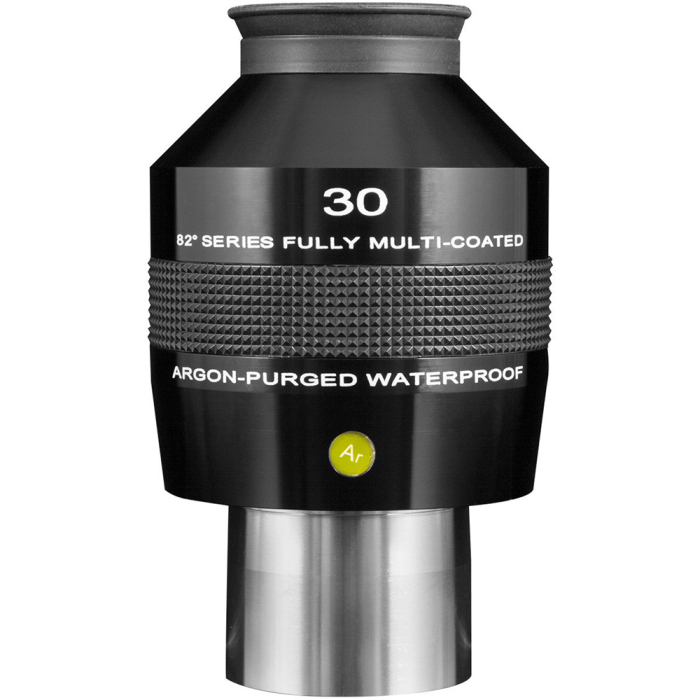

The Explore Scientific 82° Series 30 mm Waterproof Eyepiece
Blending comfort, quality, and value, Explore Scientific offers their 82° Waterproof Eyepiece series, a perfect choice for those seeking a high quality immersive viewing experience! This wide field of view paired with the 30 mm focal length gives way to stunning sights of the Orion Nebula, the Andromeda Galaxy, the Pleiades Star Cluster, and a host of other deep space objects and planets. Thanks to the expert craftsmanship from Explore Scientific, you can expect high contrast, high resolution views, and superior flat field correction across the expansive scope of vision. Suitable for both planetary viewing and deep space observing, the Explore Scientific 82° Series 30 mm Waterproof Eyepiece is wonderful for any astronomy enthusiast!
In addition to a quality optical design, this premium eyepiece is engineered for comfort, including a long eye relief of 15.6 mm. Your eye is relaxed, enabling prolonged observing sessions without eye strain, and offering comfortable viewing for eyeglass wearers. The waterproof, argon-purged body prevents internal fogging for unwavering crisp views for years to come, making this a reliable eyepiece to have at hand! A blackened interior and multicoated optics further enhance performance, ensuring striking views without glare. As the perfect tool for vast, expansive sights and designed with user-experience in mind, it’s easy to see why the Explore Scientific 82° Series 30 mm Waterproof Eyepiece deserves a place within your eyepiece kit!
Explore Scientific 30 mm 82° Eyepiece At a Glance
|
|
|
|
|
|
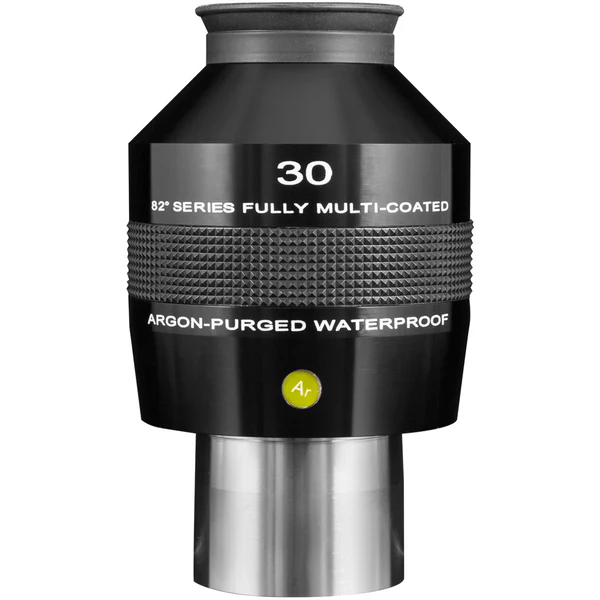
The Perfect Solution for Panoramic Stargazing
This Explore Scientific eyepiece offers stunning, wide field views and is fine-tuned for your comfort. Read on as we take a deeper dive into the aspects of this must have optical accessory!

82° of Excellence
With an aim to deliver an immersive, relaxing observing experience, the Explore Scientific 82° eyepiece series provides next-level nights under the stars. The precision engineered optics give way to stark sights of the cosmos, while the meticulous body design promotes comfort with a long eye relief and adjustable eyecups. Thanks to careful craftsmanship, it’s much easier to observe the night sky for prolonged periods of time, with details emerging that weren’t available at first glance. This wide field of view also further assists with revealing beautiful structure via averted vision. This is where looking slightly to the side of an object as opposed to directly at it helps us view things more clearly, as our peripheral vision is strongest in the dark. With the ingenuity from Explore Scientific, you’re well equipped for beautiful, captivating sights that are sure to impress!
Premier Build Quality
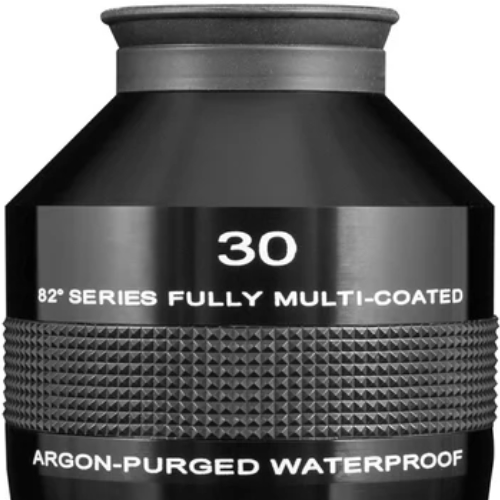
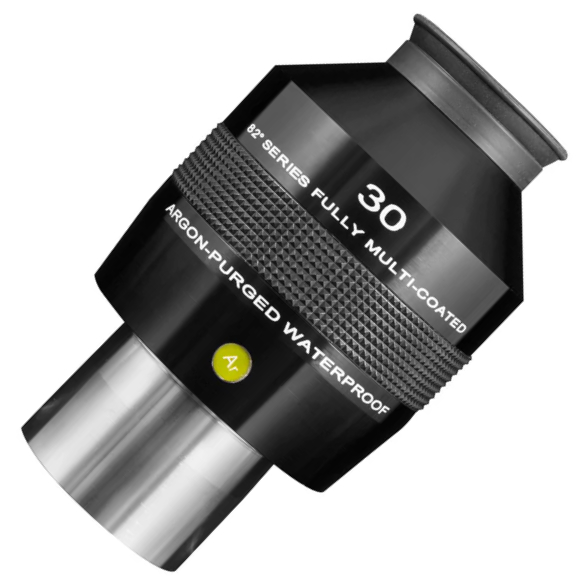
Each Explore Scientific eyepiece within the 82° series is crafted with the utmost care—including precision machined metal lens barrels for outstanding optical performance well into the future. This rugged casing upholds ideal alignment of the internal lenses, while the waterproof, argon-purged design prevents moisture damage even in cold, humid environments. The internal lenses are a combination of low dispersion and high refractive index optical glasses equipped with durable enhanced multilayer deposition (EMD) coatings, giving way to top-tier image quality. All interior surfaces of the eyepiece barrel along with the edges of the lenses themselves are matte black for a significant reduction in internal reflections. Not only will you be able to enjoy stark, high contrast views, but you’ll also benefit from reduced eye strain in the absence of distracting reflections. Furthering comfort, the twistable eyecup can be easily raised or lowered, offering a viewing experience tailored for you.
30 mm of Focal Length
Finding the ideal combination of eyepiece focal length and telescope focal length will help you take full advantage of your telescope’s light gathering power. This ratio, i.e. your system’s magnification, gives insight into what celestial objects can be viewed, as well as how clear the image will be based on your local seeing conditions. Under good seeing conditions, it’s best to capitalize on this still air by utilizing higher magnifications, while lower magnifications help you make the most out of poor seeing. The formula for magnification is as follows: Telescope Focal Length ÷ Eyepiece Focal Length. This Explore Scientific eyepiece has a focal length of 30 mm. When paired with a standard 1200 mm Newtonian, you can expect a magnification of 40x, a low power magnification wonderful for observing vast objects like the beauties within Orion Molecular Cloud Complex, the hydrogen-rich nebulae within Cygnus, our Milky Way core, and plenty more! For a more in-depth look at this topic, be sure to check out our Telescope Eyepiece Guide found within our Astronomy Hub.

Understanding Exit Pupil
As the beam of light exiting your eyepiece, the exit pupil determines how bright the image through your eyepiece will be. We measure the exit pupil by its diameter in millimeters, with the bigger the diameter, the brighter the image. In general, deep sky objects become visible with an exit pupil of 2 mm or greater, with fainter and fainter targets becoming more and more visible as the exit pupil increases. Small exit pupils (or Exit Pupil = Eyepiece Focal Length ÷ Telescope Focal Ratio. This Explore Scientific 82° Series Waterproof Eyepiece has a focal length of 30 mm. When paired with a standard f/6 telescope, the resulting exit pupil will be 5 mm, making this eyepiece a great choice for observing faint deepsky objects!
Frequently Asked Questions
What can I view with the Explore Scientific 30 mm 82° eyepiece?
With a focal length of 30 mm, this low-powered eyepiece is a great choice for observations of sprawling nebulae and large deep-sky objects. For instance, a telescope with a 1200 mm focal length paired with this 30 mm eyepiece will result in a magnification of 40x, ideal for observing the Orion Nebula, the Lagoon Nebula, the Triangulum Galaxy, and more. The wide 82° delivers a highly immersive “space-walking” experience as well for next-level observing sessions!
What is eye relief?
Eye relief refers to the distance your eye must sit from the eyepiece in order to view the full field of view. It’s an important factor in determining the overall comfort of your nights under the stars, especially during extended viewing sessions. Short eye relief (less than 15 mm) can oftentimes feel too crowded, requiring you to press your eye close to the eyepiece. Too long of eye relief, on the other hand, and you might find yourself bobbing and weaving to find the image. Comfortable eye relief is a matter of personal taste, though most will find eyepieces with 10-20 mm easy to use. Eyeglass wearers will appreciate a longer (more than 15mm) eye relief if they like to keep their glasses on while observing.
How do I calculate magnification?
Magnification can be calculated by taking your telescope’s focal length and dividing it by your eyepiece’s focal length. For instance, if we have an 8” 1,200 mm focal length Dobsonian telescope, and we’re using the Explore Scientific 30 mm eyepiece, the magnification will be as follows: 1200/30 = 40x. It’s important to note that magnification influences how bright your image will be, as the higher magnification, the dimmer your image will become (when using the same aperture). Be sure to check out our Ultimate Telescope Eyepiece Guide for more on this topic!
What’s the difference between apparent field of view (AFOV) and true field of view (TFOV)?
Apparent field of view refers to how large the image is to your eye. For reference, a single bare human eye has a field of view of approximately 150°. These Explore Scientific eyepieces offer an 82° AFOV for a well-immersed experience. True field of view, on the other hand, refers to the angular diameter of the “chunk” of the sky you are observing. TFOV is determined by dividing your AFOV by your system’s magnification. For instance, an 8” 1,200 mm focal length Dobsonian paired with the 30 mm Explore Scientific eyepiece will yield a TFOV of 2°. The full disk of the Moon, for example, has an angular diameter of 0.5°. For more on this topic, our comprehensive Ultimate Telescope Guide provides an in-depth look!
Astronomy Hub: Your one-stop-shop for Astronomy Knowledge!
Our Gear Experts have compiled a wealth of information to help you get the most out of your telescope! Below you’ll find links to articles, videos and "how-to" guides. Just one more reason that our Astronomy Hub is a one-stop-shop for all your astronomy and astrophotography needs!
| The Best Telescopes of the Year |
| Best Telescopes For Urban Stargazing |
| What's in the Sky This Month? |