Explore Scientific 68° Argon-Purged Waterproof 16 mm 1.25" Eyepiece
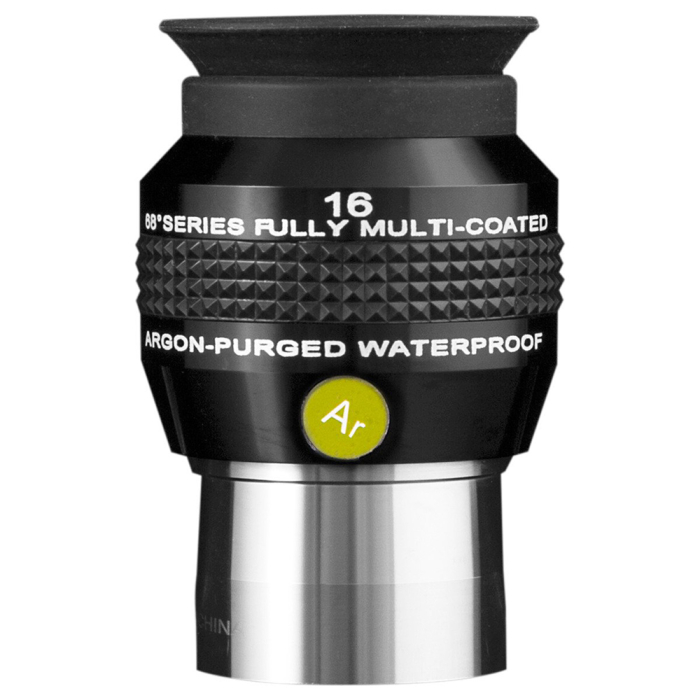

Extreme Wide Field 16mm Eyepiece!
Delve into the world of durable eyepiece design with the Explore Scientific 16 mm 68° series eyepiece! The Explore Scientific 68° eyepiece series uses a combination of low dispersion and high refractive index optical glass, paired with durable multilayer deposition coatings to produce high contrast, high resolution, and superior flat field views!
The Explore Scientific 16 mm eyepiece offers an impressive 11.9 mm eye relief, ensuring comfortable extended viewing sessions. Combined with its 68° apparent field of view, this eyepiece delivers an immersive observational experience. Designed with durability in mind, these eyepieces are argon-purged, making them resistant to water intrusion and capable of withstanding temperature variations. This robust design ensures reliable performance and longevity, allowing for years of dependable use in a variety of environments! In addition to argon-purging, this eyepiece comes equipped with a 1.25" thread for compatible filters. And to round out the features of this high-quality 16 mm 68° eyepiece: Explore Scientific has also included a silicon rubber eyecup for comfortable viewing!
Explore Scientific 68° 16 mm 1.25" Eyepiece At a Glance
|
|
|
|
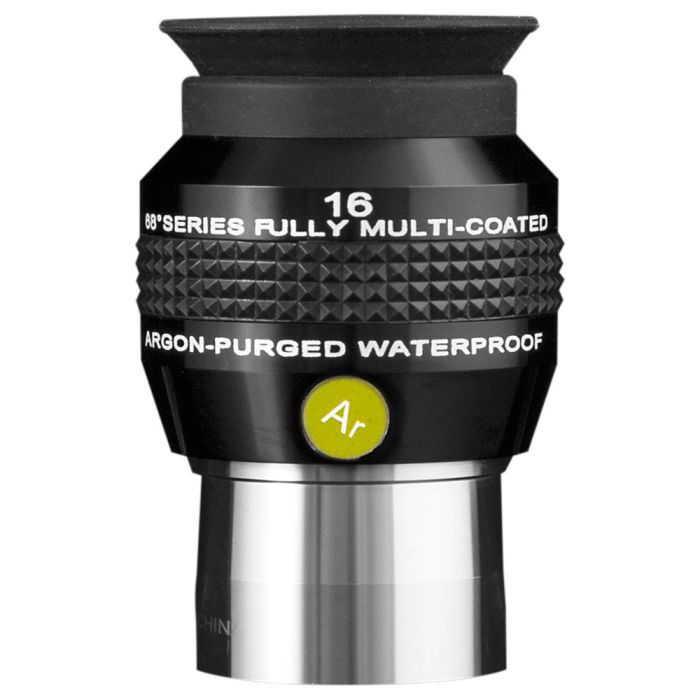
The All-Around Power of Explore Scientific 68° Eyepieces!
Whether it's observing the planets or viewing faint, deep-sky objects, the Explore Scientific 68° series eyepieces are an all-around excellent choice for a variety of astronomical observations!
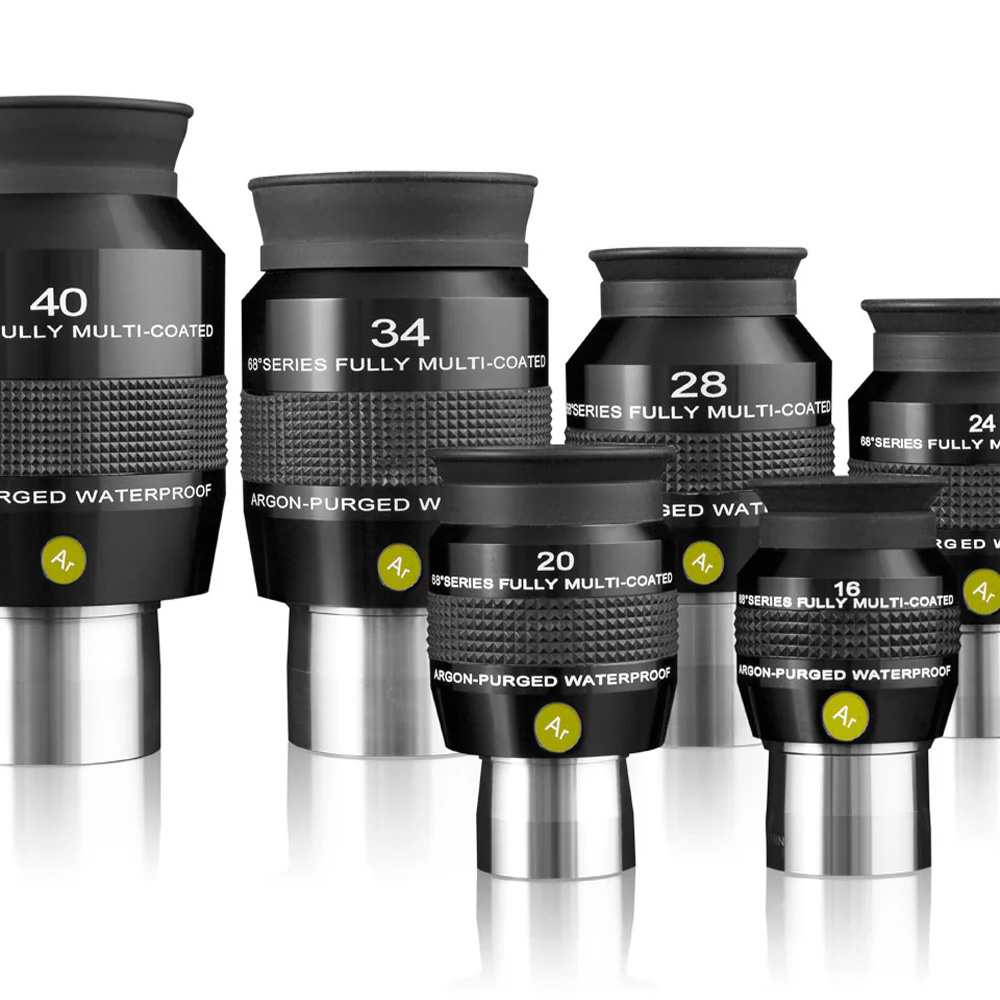
Parfocal Perfection!
The Explore Scientific 68° eyepieces are designed to be parfocal, meaning they share a common focus point regardless of the focal length. This feature makes it incredibly convenient to switch between eyepieces of different focal lengths during your observation session, as only minimal focus adjustments will be needed. This ensures you spend more time observing and less time refocusing. It also makes this Explore Scientific eyepiece an excellent choice for both beginner and experienced astronomers seeking an efficient observing experience!
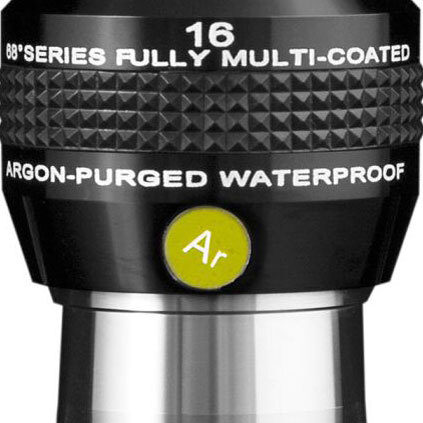
Extended Endurance with Argon-Purging!
While many eyepieces are nitrogen-purged to block moisture, dust, and mold, Explore Scientific enhances durability by argon-purging these 16mm eyepieces. The larger argon atoms form a stronger, more secure seal. Argon atoms are larger than nitrogen atoms and, therefore they are less likely to leak or diffuse their way through the seals over the life of the eyepiece. Additionally, argon cools slower. Being argon-purged buffers the effects of rapid temperature changes in the optics. Argon also has superior inertness when compared to nitrogen (i.e. forming few or no chemical compounds with other elements) that prevents adverse reactions with eyepiece components and extends the longevity of the internal components. It also prevents chemical reactions with other elemental contaminants that may be introduced through a weakened seal. By making the eyepiece body argon-purged, this waterproof eyepiece's internal elements will remain as pristine as the day they were assembled!
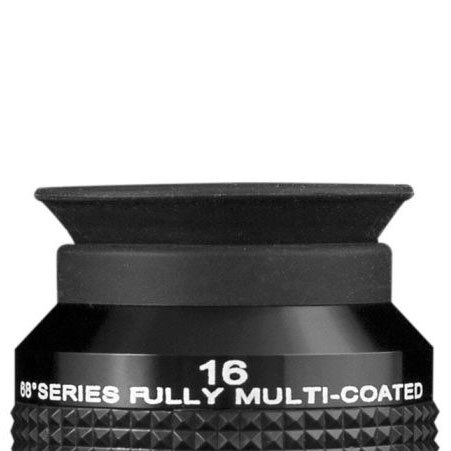
Comfortable Viewing Experience
Each eyepiece will include a removable, soft silicone rubber eyecup for the comfort of the observer, and, as experienced astronomers know, eye comfort is critical when trying to observe at the visual limits of the telescope for visual observations.
Frequently Asked Questions
How do I calculate magnification?
Magnification can be calculated by taking your telescope’s focal length and dividing it by your eyepiece’s focal length. For instance, if we have an 8” 1,200 mm focal length Dobsonian telescope, and we’re using a 16 mm eyepiece, the magnification will be as follows: 1200/16 = ~75x. It’s important to note that magnification influences how bright your image will be, as the higher magnification, the dimmer your image will become (when using the same aperture). Be sure to check out our Ultimate Telescope Eyepiece Guide for more on this topic!
What’s the difference between apparent field of view (AFOV) and true field of view (TFOV)?
Apparent field of view refers to how large the image is to your eye. For reference, a single bare human eye has a field of view of approximately 150°. These wide FOV eyepieces from Explore Scientific offers an 68° AFOV for a well-immersed experience. True field of view, on the other hand, refers to the angular diameter of the “chunk” of the sky you are observing. TFOV is determined by dividing your AFOV by your system’s magnification. For instance, an 8” 1,200 mm focal length Dobsonian paired with a 16 mm eyepiece will yield a TFOV of 0.91°. The full disk of the Moon, for example, has an angular diameter of 0.5°. For more on this topic, our comprehensive Ultimate Telescope Eyepiece Guide provides an in-depth look!
What is exit pupil and why does it matter?
Exit pupil is the diameter of the beam of light that departs your eyepiece. It’s directly tied to the overall brightness of your image, and it’s an important factor to consider when determining which objects are available for observation. This term is analogous to our very own pupils, hence its name. As the pupil within our eye expands, more light is brought into our retina. This same concept is applicable to eyepiece exit pupils, with the larger the exit pupil, the brighter the image. Exit pupil and magnification go hand in hand; as magnification increases, exit pupil decreases, and vice versa. We measure the exit pupil by its diameter in millimeters. To calculate the exit pupil of your eyepiece/telescope combination, use either of the two equations: Exit Pupil = Telescope Aperture (mm) ÷ Magnification or Exit Pupil = Eyepiece Focal Length ÷ Telescope Focal Ratio.
Astronomy Hub: Your one-stop-shop for Astrophotography Knowledge!
Our Gear Experts have compiled a wealth of information to help expand your astrophotography knowledge! Below you'll find links to articles, videos and "how-to" guides. Just one more reason that our Astronomy Hub is a one-stop-shop for all your astronomy and astrophotography needs!
| The Best Telescopes of the Year |
| Best Telescopes For Urban Stargazing |
| What's in the Sky This Month? |
| The Ultimate Telescope Eyepiece Guide |
| The Ultimate Telescope Accessories Guide |