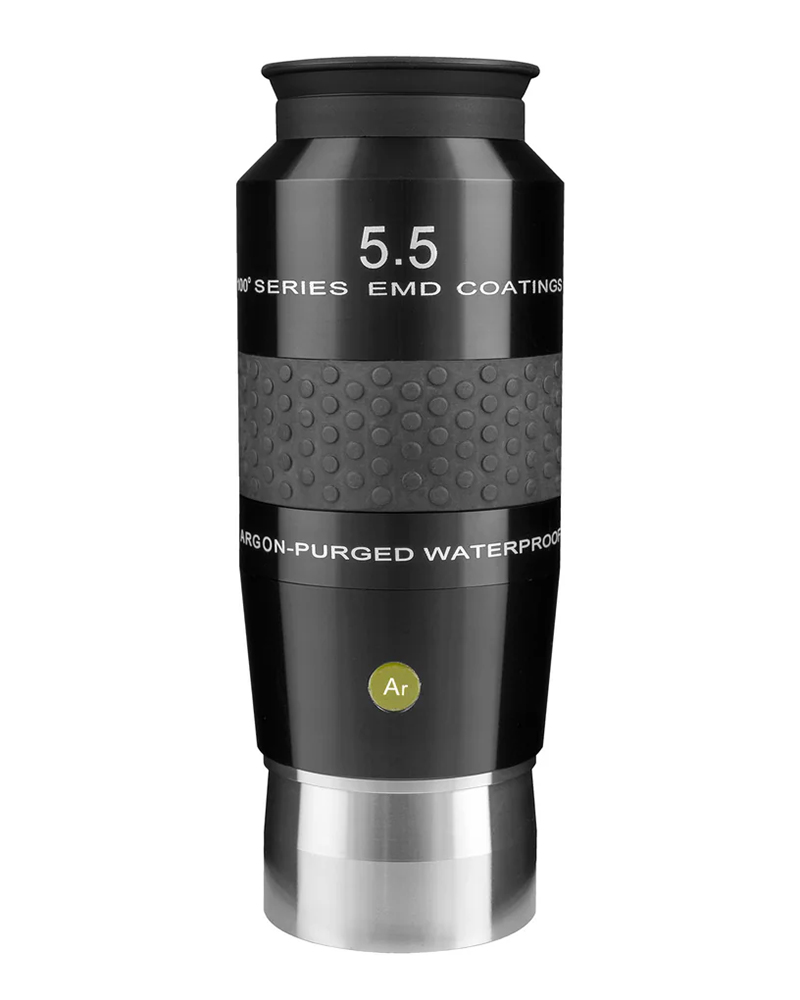
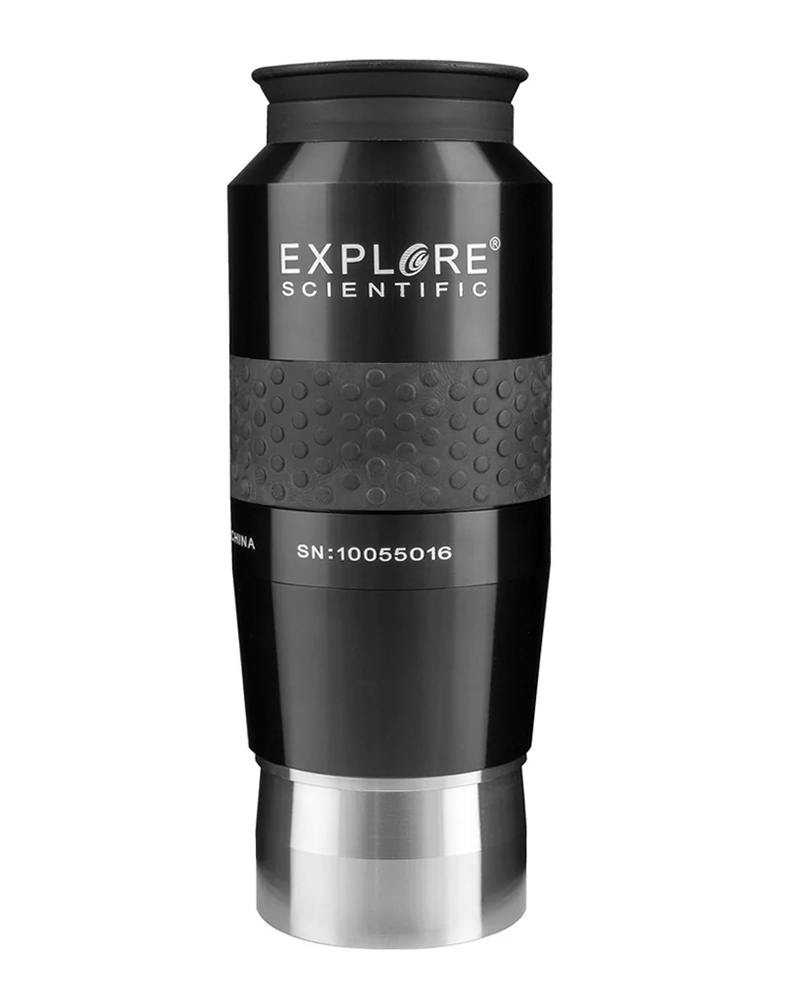
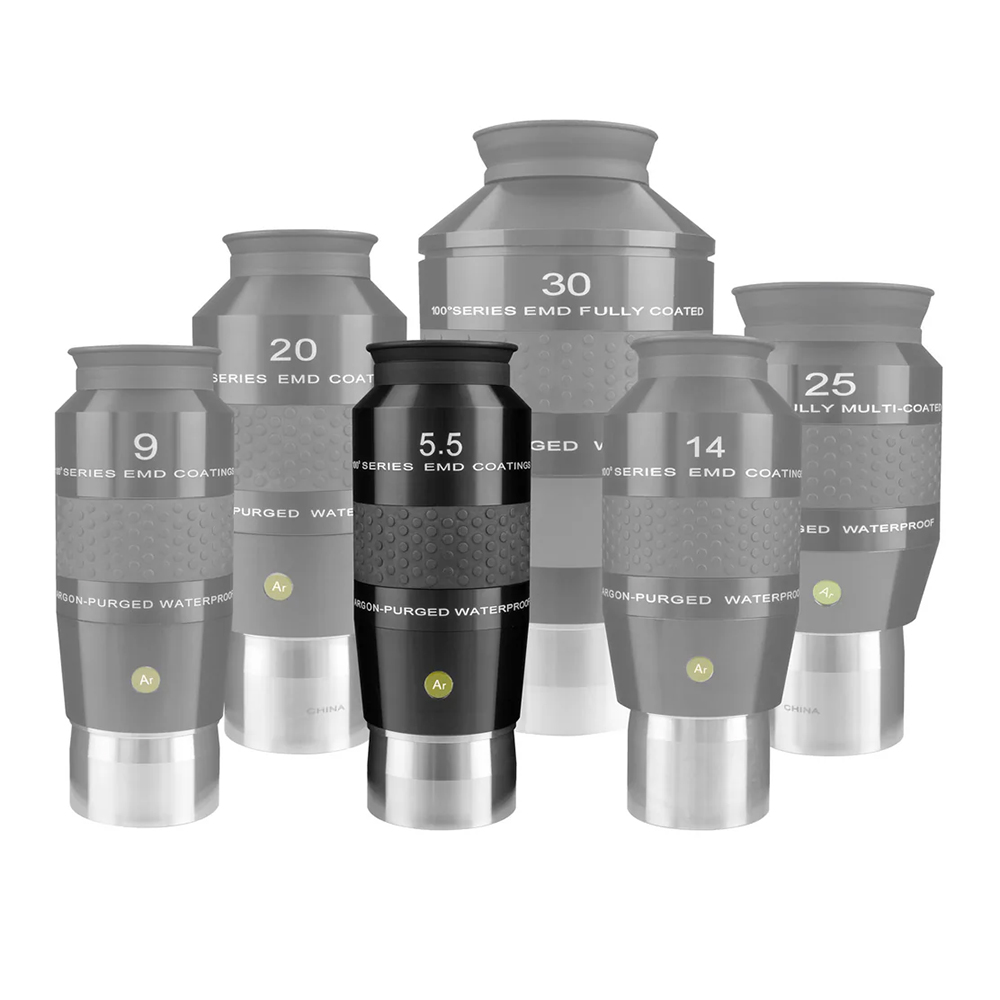
Explore Scientific 100° Argon-Purged Waterproof 5.5 mm 2" Eyepiece


Check out this Ultra-Wide Field of View Eyepiece from Explore Scientific!
With the 100° Apparent Field of View (AFOV) this 5.5 mm eyepiece from Explore Scientific will provide truly immersive views. Featuring advanced EMD (Enhanced Multilayer Deposition) coatings and an argon-purged housing that prevents internal fogging, this eyepiece is well-suited to ensure you experience the full potential of your telescope!
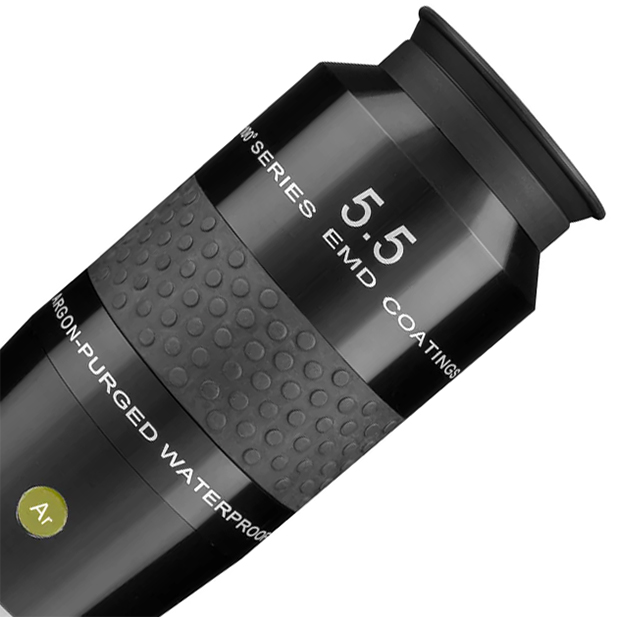
The Explore Scientific 100° Argon-Purged Waterproof eyepieces deliver an incredibly wide 100° Apparent Field of View (AFOV). Each eyepiece in the series features fully multi-coated optics with Enhanced Multilayer Deposition (EMD) coatings applied to every lens surface. These advanced coatings improve light transmission while reducing internal reflections. The eyepiece body is argon-purged and waterproof, which prevents internal fogging while also protecting the internal lens elements from fungus, moisture, and other contaminants. The waterproof design also means this eyepiece is much easier to clean as there is no risk of cleaning solution seeping between the lens elements. The eyepiece barrel is crafted from durable stainless steel and is threaded to accept standard 2-inch eyepiece filters. It also includes a soft rubber eyecup, which blocks stray light while providing a more comfortable viewing experience.
Explore Scientific 100° 5.5 mm 2" Eyepiece At a Glance
|
|
|
|
An Incredibly Comfortable Ultra-Wide Eyepiece
The Explore Scientific 100° series eyepieces will transform your visual astronomy experience, revealing the night sky like never before. Learn more about these premium eyepieces below!
Ultra-Wide 100° AFOV
Enjoy truly immersive views with this ultra-wide eyepiece. At 100° AFOV, you'll enjoy the same level of magnification as a standard 5.5 mm eyepiece while unlocking significantly more space around your target. This provides more than enough room to take advantage of "averted vision", a viewing technique that lets you observe more detail in faint celestial objects by looking slightly beside the target. The ultra-wide AFOV also provides a more comfortable viewing experience by preventing unnecessary strain, allowing you to view for longer periods of time.
Argon-Purged Waterproof Body
The body of the eyepiece is argon-purged and waterproof, preserving the internal elements to remain as pristine as the day they were assembled. The sealed, dry environment is impervious to internal fogging and contaminants such as fungus growing in between the lens elements. The waterproof eyepiece is easier to clean, and there is no risk of cleaning solution migrating from the top of the lens and seeping around edges to be trapped in between elements. To ensure a perfect seal, each eyepiece undergoes rigorous testing, including a 30-minute submersion test in one meter of water.
Frequently Asked Questions
How do I calculate magnification?
Magnification can be calculated by taking your telescope’s focal length and dividing it by your eyepiece’s focal length. For instance, if we have an 8” 1,200 mm focal length Dobsonian telescope, and we’re using a 5.5 mm eyepiece, the magnification will be as follows: 1200/5.5 = ~218x. It’s important to note that magnification influences how bright your image will be, as the higher magnification, the dimmer your image will become (when using the same aperture). Be sure to check out our Ultimate Telescope Eyepiece Guide for more on this topic!
What’s the difference between apparent field of view (AFOV) and true field of view (TFOV)?
Apparent field of view refers to how large the image is to your eye. For reference, a single bare human eye has a field of view of approximately 150°. These Ultra-wide eyepieces from Explore Scientific offers an 100° AFOV for a well-immersed experience. True field of view, on the other hand, refers to the angular diameter of the “chunk” of the sky you are observing. TFOV is determined by dividing your AFOV by your system’s magnification. For instance, an 8” 1,200 mm focal length Dobsonian paired with a 5.5 mm eyepiece will yield a TFOV of 0.46°. The full disk of the Moon, for example, has an angular diameter of 0.5°. For more on this topic, our comprehensive Ultimate Telescope Eyepiece Guide provides an in-depth look!
What is exit pupil and why does it matter?
Exit pupil is the diameter of the beam of light that departs your eyepiece. It’s directly tied to the overall brightness of your image, and it’s an important factor to consider when determining which objects are available for observation. This term is analogous to our very own pupils, hence its name. As the pupil within our eye expands, more light is brought into our retina. This same concept is applicable to eyepiece exit pupils, with the larger the exit pupil, the brighter the image. Exit pupil and magnification go hand in hand; as magnification increases, exit pupil decreases, and vice versa. We measure the exit pupil by its diameter in millimeters. To calculate the exit pupil of your eyepiece/telescope combination, use either of the two equations: Exit Pupil = Telescope Aperture (mm) ÷ Magnification or Exit Pupil = Eyepiece Focal Length ÷ Telescope Focal Ratio.
Astronomy Hub: Your one-stop-shop for Astrophotography Knowledge!
Our Gear Experts have compiled a wealth of information to help expand your astrophotography knowledge! Below you'll find links to articles, videos and "how-to" guides. Just one more reason that our Astronomy Hub is a one-stop-shop for all your astronomy and astrophotography needs!
| The Best Telescopes of the Year |
| Best Telescopes For Urban Stargazing |
| What's in the Sky This Month? |
| The Ultimate Telescope Eyepiece Guide |
| The Ultimate Telescope Accessories Guide |