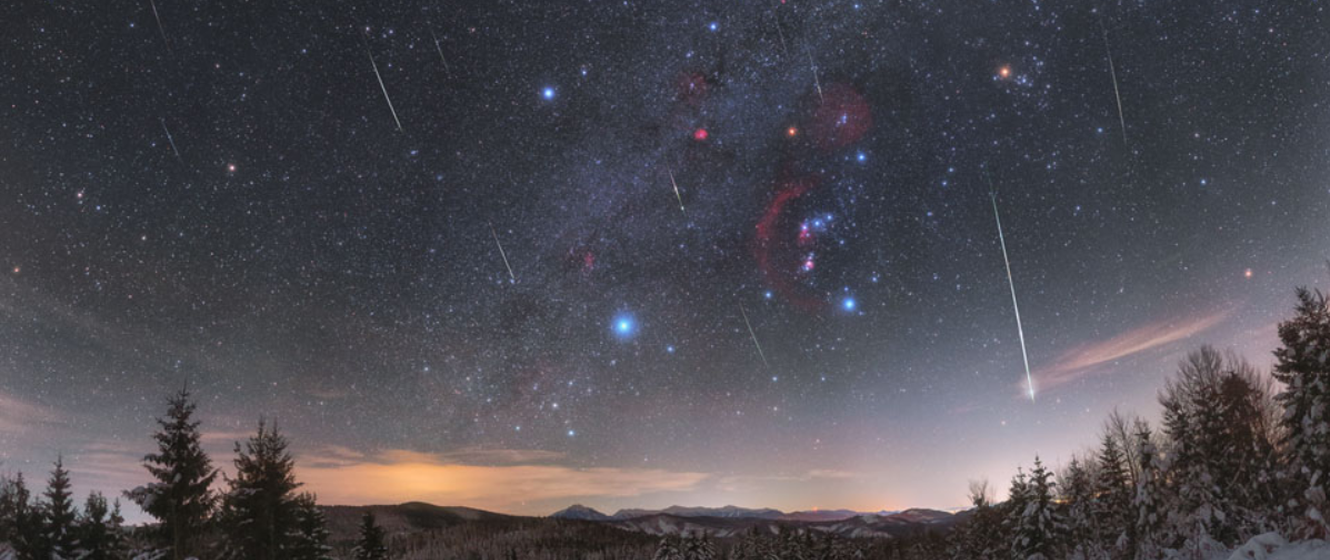
Banner Image Credit: Petr Horálek
Quadrantid Meteor Shower: A Summary

What Is the Quadrantid Meteor Shower?
Many of the major meteor showers have a unique attribute that sets them apart from the rest. In the case of the Quadrantids, its uniqueness lies in its name, as it’s the only shower named for a constellation that no longer exists.
In 1930, the International Astronomical Union officially adopted the 88 constellations we know today, but in the preceding centuries, there were numerous constellations that didn’t make it. One of those was Quadrans Muralis (the Mural Quadrant), a constellation whose name arguably matched the dullness of the stars that formed it. (Its former brightest star, now officially 44 Bootis, is only magnitude 4.7 and has since been named Quadrans in its honor.)
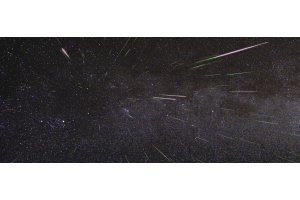
While some of the meteors can be bright (and the shower is known to produce fireballs), around the time of maximum, the majority will be fainter than magnitude three. While dim, this still means the meteors are brighter than any of the stars that once formed the constellation it is named for!
Matters are further complicated by the length of maximum activity. Unlike almost all the other major showers (with the possible exception of the Ursids), maximum activity only lasts six to eight hours, so it’s very important to know when the shower is predicted to reach its peak. It could, for example, reach maximum activity during the day at your location, in which case you might not see much of anything - regardless of how dark your skies might be.
Lastly, the shower has a very high zenith hourly rate of 120, but realistically, you might only see a fraction of that number. You stand a better chance if you’re observing close to the predicted maximum, but otherwise you might only see around 25 under ideal conditions, and less than 15 if the Moon is near full.
So why bother? For starters, its fireballs are typically brighter and last longer than most other showers, although they frequently fail to leave persistent trains. Colors range from white to blue, a result of both the high speed of the meteoroid burning up and the presence of magnesium in its composition.
Additionally, for ardent meteor observers, there’s the challenge of being able to see as many shooting stars as possible, which means some very careful advanced planning. Not only will you need to choose a year when the Moon’s light will not adversely brighten the sky, but you’ll also need a location as far from any lights as possible, and that will also allow you to experience the shower as close to its maximum time as possible. All this, plus the cold wintry conditions of a January night, gives some pause for thought before venturing outside.
A Brief History of the Quadrantids
Unlike some other showers, there isn’t a long observational history associated with the Quadrantids. The first recorded observation is thought to have been by the Italian astronomer Antonio Brucalassi, who noted a multitude of shooting stars in early January 1825. Fourteen years later, two astronomers - Adolphe Quetelet of Belgium and Edward C. Herrick of the United States - independently suggested that the Quadrantids were an annual event, but otherwise the shower has suffered from a serious lack of study.
Radio observations of the shower in 1951 indicated orbital characteristics similar to those of other showers and short period comets, indicating that the parent body was most likely the latter. However, while many showers were known to originate from comets, the actual origins of the Quadrantids remained a mystery until the early 21st century.
In March 2003, the LINEAR automated sky survey discovered the minor planet 2003 EH1. When its orbit was analyzed by Peter Jenniskens, he noted that its orbital elements closely matched those of the Quadrantid meteor stream. He then projected the minor planet’s orbit backwards and found that it had passed relatively close to the Earth in the early 16th century - close enough to shed debris that would then become the Quadrantid meteor stream.
He also speculated that 2003 EH1 might be the remnant of a now-extinct comet, potentially the same as the historical comet C/1490 Y1, observed by Chinese, Korean, and Japanese astronomers in 1490. This comet was seen to break up or vanish, which fits the idea that 2003 EH1 is the comet’s remaining rocky core.
How Can I Observe the Quadrantid Meteor Shower?
Unlike some other meteor showers, such as the Geminids or Leonids, the radiant for the Quadrantids lies in a barren area of sky, nine and a half degrees north of Nekkar, the star that marks the tip of the kite-shaped asterism of Bootes. Fortunately, the stars of the Big Dipper, which can often be used to locate other stars, can also point us towards the Quadrantid’s radiant. Draw a line through Megrez, the star that joins the handle of the dipper to the bowl (and also the faintest star in the group), through Mizar, the second star in the curved handle.
Continue that line for twice that same distance, and you’ll come to the approximate location of the radiant. Alternatively, if Bootes is visible, look at the distance between Megrez and Mizar and then look that same distance from Nekkar towards Polaris.
As noted above, the period of maximum activity is often only six to eight hours, so timing is important. It’s a good idea to check with the International Meteor Organization before making any firm plans. Check out its Calendar page and then look on the left side of the page for a free downloadable copy of its annual guide. The radiant itself doesn’t rise until around 11:30 PM and won’t culminate until about an hour after sunrise, but will be halfway between the horizon and the zenith at roughly two hours before sunrise (some time around 4:30 AM for many North American observers.)
Since these can be faint meteors, you’ll want to be as far away from the lights of any towns or cities as possible. Look to the north-northeast and east-northeast if you’re outside before midnight, and towards the north and east if you’re outside after 2 AM. Lastly, remember, this is January, so wear layers and stay warm!
The Quadrantid 10 Year Forecast
The table below shows the Moon phase and planets that may be visible above the horizon at 4:30 AM on January 4th of each year. It should be noted that (again, as with all meteor showers) the date of the maximum can vary a little from year to year. Also, again, keep in mind that maximum activity may only last for 6 to 8 hours, and the exact timing isn’t typically known until the International Meteor Organization releases its annual report.
With that in mind, although the Quadrantids are often at their best on the evening of the 3rd and in the early hours of the 4th, they can also peak on the evening of the 2nd and in the early hours of the 3rd.
In terms of the rating, if the Moon is below the horizon at that time, then its light won’t drown out the fainter meteors, and the rating is five stars. However, if the Moon is above the horizon, then the rating is based upon the phase, altitude, and distance of the Moon from the radiant at that time.
Lastly, if the Moon is in the western hemisphere and more than half full, it might be best to wait for the Moon to set before stepping outside. If the Moon is waning and half full or a little less, then it’s best not to wait to observe the shower, as the Moon will only rise higher as the night progresses, potentially causing more interference as its altitude increases.


Learn More
Interested in diving deeper into the world of astronomy? Check out our AstronomyHub for a wealth of articles, guides, local resources for planetariums and observatories near you, and more to enhance your stargazing experience.