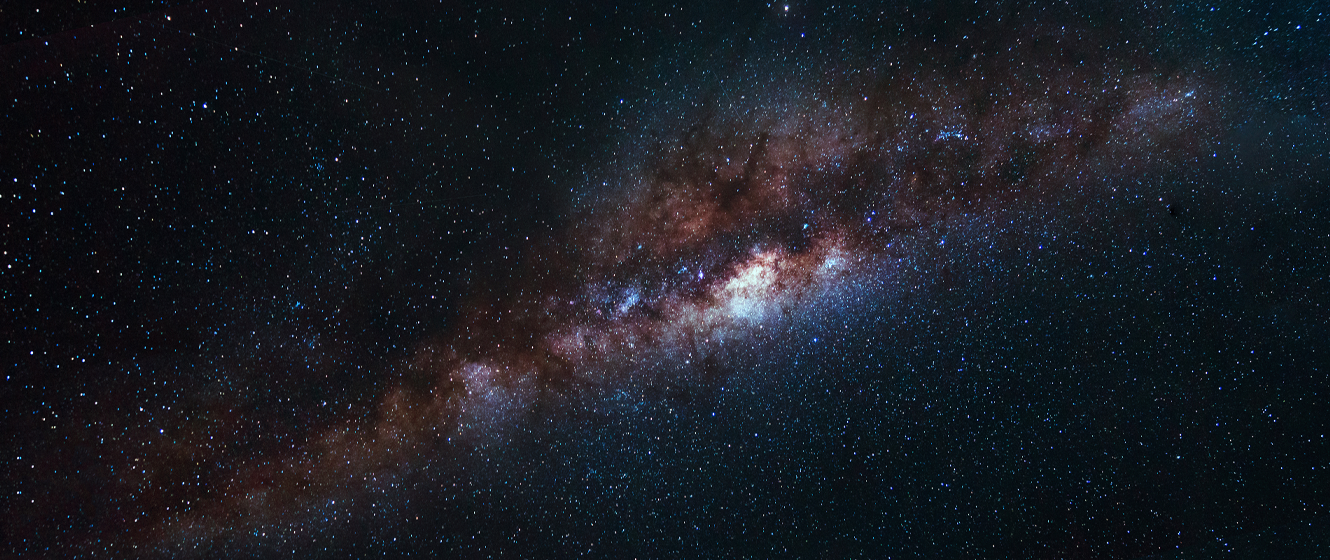
The Milky Way is our home galaxy, composed of over 100 billion stars. It is a “barred” spiral galaxy, one of many trillions that make up our observable universe. The solar system is located along one of the galaxy’s spiral arms, more than halfway from the center in what is known as “Orion’s spur”. The solar system takes roughly 240 million years to complete just one orbit around the Milky Way, completing a cosmic dance with the other billions of stars in the galaxy.
What does the Milky Way Look Like?
It’s thought the Milky Way is roughly 13.6 billion years old and formed shortly after the Big Bang. Astronomers are able to date the Milky Way by looking at the radioactive elements in other stars and globular clusters through a process called “nucleocosmochronology”, which yields the aforementioned value.
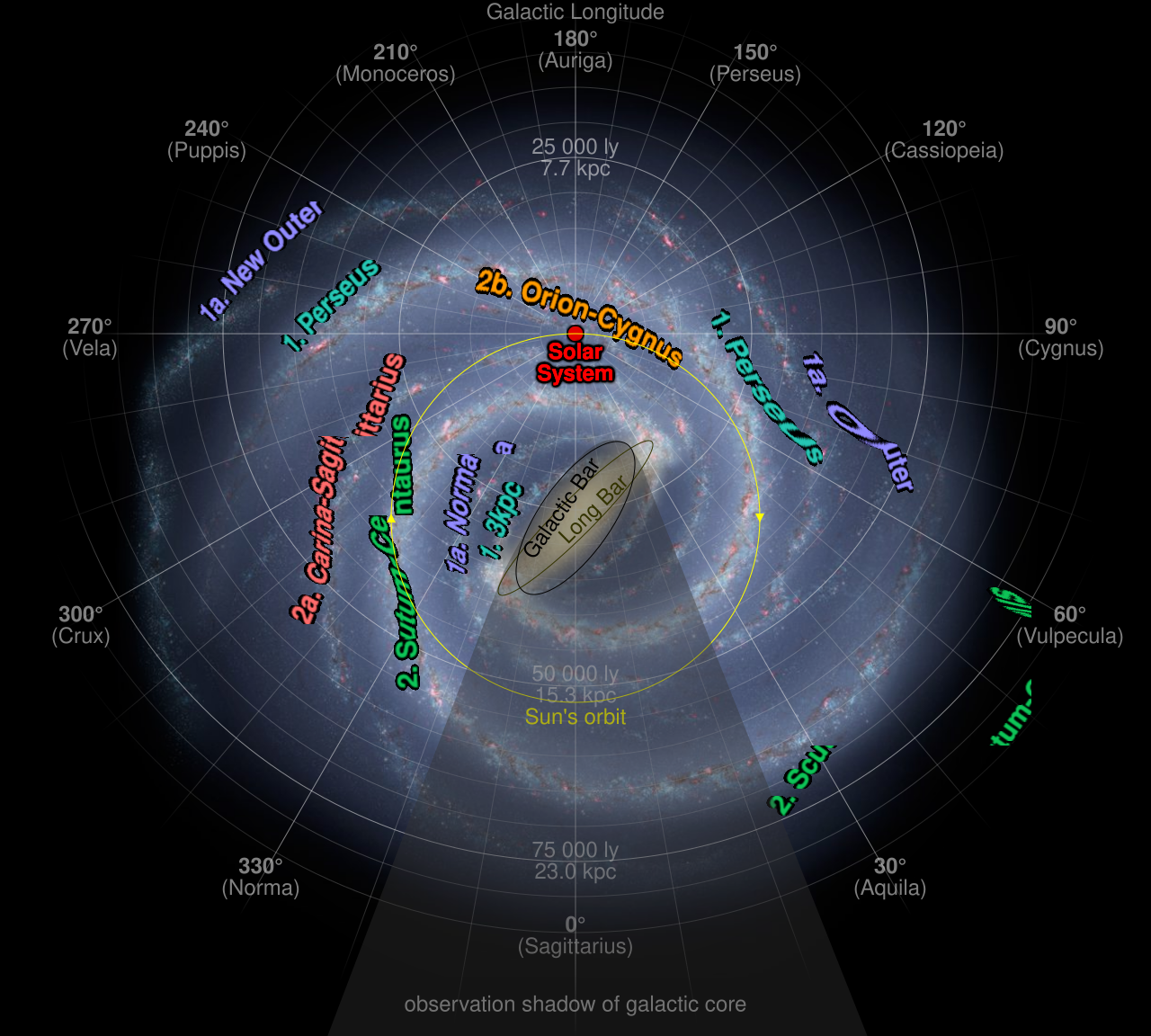
The true appearance of the Milky Way is not totally understood, as it is obviously impossible with current technology to get a look at the Milky Way (after all, we live in it!). It’s thought that the Milky Way has a fairly typical structure for a galaxy, with the galactic center having a barrel-like or “barred” appearance and multiple spiral arms extending outward from the center. The center of the Milky Way is home to an intense radio source known as Sagittarius A*, a supermassive black hole about 4 million times more massive than the Sun. There are thought to be four spiral arms spiraling out away from the galactic center. Our solar system is thought to be within the “Orion-Cygnus” arm, also known as the Orion spur
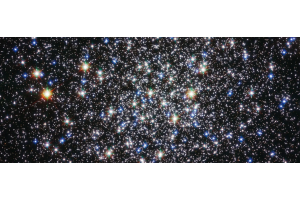
Away from the spiral arms, there is a “halo” surrounding our Milky Way, which is thought to contain “dark” matter as well as very old stars and globular clusters. And then there are multiple “dwarf” galaxies that orbit our own galaxy, similar to how the Moon orbits the Earth. These dwarf galaxies are known as the Magellanic Clouds, two irregularly shaped dwarf galaxies that are members of the local group.
For its barred appearance, the Milky Way is known as a “barred” spiral galaxy. The morphological classification of galaxies was first defined by astronomer Edwin Hubble in 1926, with French Astronomer Gerard de Vaucouleurs expanding upon the classification in 1959. These are typically defined as elliptical galaxies (E), spiral galaxies (S / SB), and lenticular galaxies (S0 / SB0), with irregular galaxies (lm) having no obviously defined shape like the other three classical morphologies.
How to Spot the Milky Way
In the northern hemisphere, your best bet to see the Milky Way is in the summer months. This can be challenging, as the summer months in the northern hemisphere often coincide with rainy seasons, especially in tropical climates. However, those in drier climates (like the American Southwest) are much more likely to experience drier weather ideal for stargazing in the summer. The Milky Way typically rises just after sunset in July, stretching to its greatest height at around midnight. For those in the northern hemisphere, the “core” of the Milky Way can be seen low on the southern horizon in the constellation of Sagittarius. Sagittarius can be easily found, as it takes on a “teapot” appearance in the sky. Those in the southern hemisphere are far more favored to see the Milky Way, with its core stretching overhead in the winter months. Also in the constellation of Sagittarius are two very bright nebulae, the Lagoon and Trifid Nebulae! The Lagoon Nebula is one of the brightest nebulae in the night sky, and the largest one visible to the naked eye. In fact, it spans over 110 light-years across!
Best Astronomy Gear to View the Milky Way
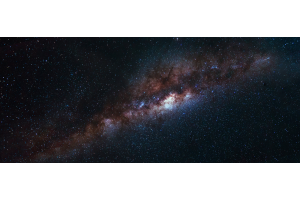
The best gear to view the Milky Way with is one that everyone comes equipped with - the naked eye! To the naked eye, the Milky Way takes on a stunning appearance in the sky, stretching across the sky from Sagittarius to Cygnus. It takes a grey, cloudy-like appearance, resembling spilled milk. The core will appear the most spectacular, taking on a yellow-brown appearance rising above the horizon. Branching rifts will be visible as well across the sky. However, colors will generally be muted, as the spectacular colors one sees in photos are only possible through long exposures. For a more in-depth look at taking photos of the Milky Way, check out our Beginners Guide to Imaging the Milky Way.
A simple pair of binoculars will reveal much more structure and detail in the Milky Way. The Orion 2x54mm Ultra Wide Binoculars are phenomenal for having a wide view of the Milky Way, as these ultra-wide binoculars gather much more light than your naked eyes can while preserving the scale and size that you feel when looking at the Milky Way. For a more detailed survey of the Milky Way, including better views of nebulae, check out the Celestron SkyMaster Pro ED 7x50 Binoculars. These will reveal structure and detail in nebulae such as the Lagoon Nebula, Trifid Nebula, Omega Nebula, as well as globular and open clusters nearby!