Ursid Meteor Shower: A Summary
What Is the Ursid Meteor Shower?
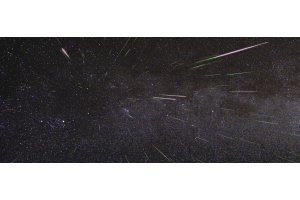
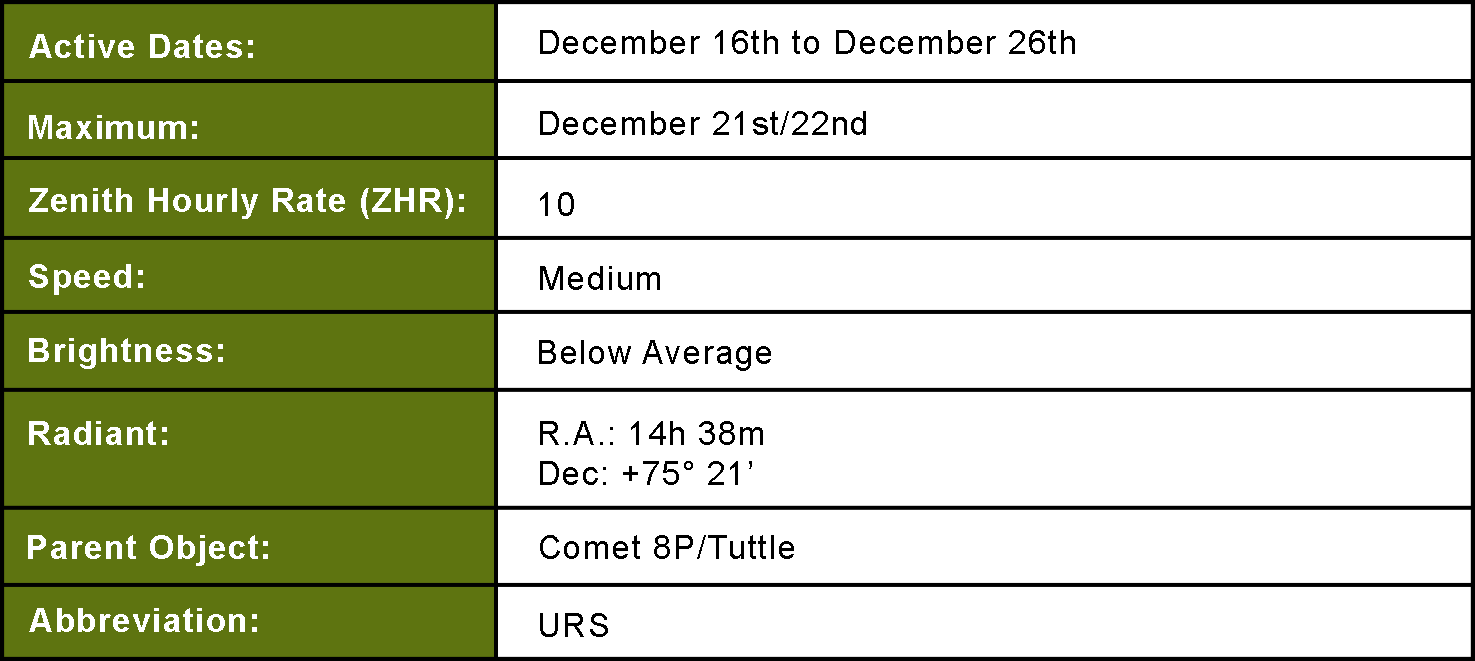
When it comes to the major meteor showers, the Ursids are probably the shower most likely to be overlooked. For starters, with a zenith hourly rate of just 10 (under ideal conditions) it’s the weakest of the major showers. To make matters worse, the shower can be unreliable, with some years being comparatively prolific, while others producing little more than one or two meteors an hour.
On the plus side, the shooting stars are the slowest of the major showers, making them potentially easier to spot, but this is negated by the fact that they’re also among the faintest, with only the Southern delta Aquariids being dimmer. All this, coupled with the fact that it peaks on a long, cold winter night (and at the height of the holiday season too), means that some might choose to be somewhere warmer and more festive instead.
However, it’s not all bad news for the Ursids. It might not be the brightest or most prolific of the meteor showers, but it’s the most northerly, which has its own benefits. With its home constellation of Ursa Minor being circumpolar, you can step outside at almost any time of night and stand a decent chance of seeing a shooting star or two.
A Brief History of the Ursids
Perhaps not surprisingly, the Ursids don’t have a rich observational history like some of the other major showers. The British astronomer William F. Denning, a noted meteor observer, is thought to have discovered the shower at around the start of the 20th century. However, the shower didn’t initially generate a lot of interest, with only the German astronomer Cuno Hoffmeister studying the shower in the years that followed.
That changed on December 22nd 1945, when observers at the Skalnate Pleso Observatory in the Czech Republic recorded meteors appearing at a rate of 169 per hour. This sparked further studies the following year, but observers were disappointed when the shower produced a lackluster 11 meteors an hour. Observations in subsequent years allowed astronomers to refine the location of the radiant, but the zenith hourly rate continued to fluctuate, with some years producing around 20 meteors an hour, while others barely produced any.
Studies from the 1970s onwards also produced mixed results, with observers reporting different rates depending upon their geographical location. This has led to some speculation that the source must be a very compact stream of debris, with the most activity coming within 12 hours of the predicted maximum. The shower was first linked to Comet 8P/Tuttle by the Czech astronomer Antonín Bečvář, who was one of the observers who witnessed the outburst of 1945, and as with the Leonids, the Ursid outbursts are known to be caused by its parent comet as it orbits the Sun. The Leonid outbursts occur roughly once every 33 years, and while the Ursid outbursts are more muted, they can occur more frequently.
The Unusual Nature of the Ursid Outbursts
Comet 8P/Tuttle is a short period comet, and it orbits the Sun once every 13.6 years. You’d therefore be forgiven for thinking the outbursts occur immediately following the comet’s perihelion, when it is closest to the Sun, but that’s not actually the case. Instead, the outbursts have occurred roughly six years later, when the comet is at aphelion, and furthest from the Sun.
Unfortunately, the outbursts don’t always occur as you might expect. For example, while outbursts were seen in 1973 and 1986, there was no obvious outburst in 2000, and in 2007 it was business as usual. However, increased activity was reported in 2020, with some observers reporting activity at double the normal rates, and a burst of activity with several meteors appearing simultaneously.
There’s some good news if you’re hoping for an outburst within the next few years. The last perihelion of 8P/Tuttle was on August 27th, 2021, which means there could be an outburst in either 2027 and/or 2028. Beyond that, the next perihelion is on April 18th, 2035, giving us another possible outburst around 2040.
How Can I Observe the Ursid Meteor Shower?
The radiant of the Ursids - the point from which the meteors appear - is located just a degree and a half west of Kochab, in Ursa Minor, the Little Bear. This is the brighter of the two southern-most stars in the constellation. Ursa Minor itself is not a particularly conspicuous constellation, but it’s easily found thanks to its brightest star, Polaris. As many know, you can find Polaris by drawing a line northward through Merak and Dubhe, the “pointer stars” at the end of the Big Dipper. Once you’ve found Polaris, follow the long curve of faint stars that represents the bear’s tail until you come to Zeta Ursa Minoris. This star is one of four that form a rectangle, representing the body of the bear.
Kochab is the brightest of these and the second brightest in the constellation overall. The radiant is located a degree and a half west of Kochab, but if you want to be even more precise, look for 5 Ursa Minoris, a magnitude 4.2 star roughly three-quarters of a degree west of Kochab. It marks the halfway point between Kochab and the radiant. The radiant (and therefore the shower itself) doesn’t culminate until around 8:30 AM, but with Ursa Minor being a circumpolar constellation, you can still expect to see a few shooting stars in the hours before.
The Ursids have another advantage over many of the other showers; with its maximum occurring so close to the winter solstice, the nights are long and dark, giving you the opportunity to go outside in the early evening hours of the 21st. That said, your best chances will come at around 5:00 AM, when the radiant is a little less than halfway between the horizon and the zenith, and before the sky starts to brighten. Regardless of the time you choose to go outside, you’ll want to look towards the northeast and northwest. You’ll also want to be as far from any lights as possible, as the meteors are not particularly bright.
The Ursid 10 Year Forecast
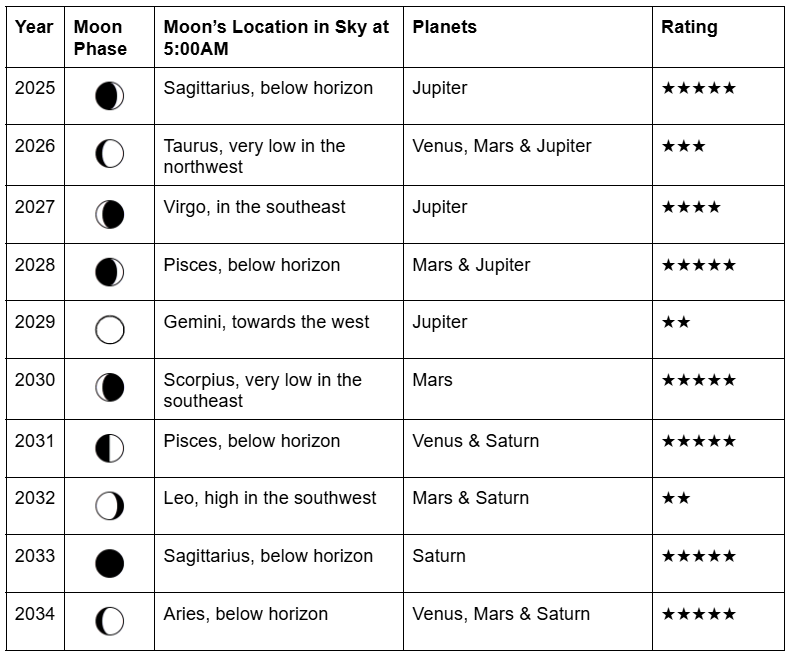
The table below shows the Moon phase and planets that may be visible above the horizon at 5:00 AM on December 22nd of each year. It should be noted that (again, as with all meteor showers) the date of the maximum can vary a little from year to year, and the exact timing isn’t typically known until the International Meteor Organization releases its annual report.
With that in mind, although the Ursids are often at their best on the evening of the 21st and in the early hours of the 22nd, they can also peak on the evening of the 22nd and in the early hours of the 23rd.
The International Meteor Organization (and its counterpart, the American Meteor Society) will also be a valuable resource in 2027 and 2028, when the shower could experience its next outburst. Fortunately, in both those years, the Moon will be a crescent and its light will not significantly brighten the sky, allowing for the fainter meteors to be seen.
Of the two years, 2027 will be better for evening observers as the Moon will have yet to rise, whereas 2028 will be better for morning observers, as the Moon will have set hours before.
In terms of the rating, if the Moon is below the horizon at that time, then its light won’t drown out the fainter meteors, and the rating is five stars. However, if the Moon is above the horizon, then the rating is based upon the phase, altitude, and distance of the Moon from the radiant at that time.
Lastly, if the Moon is in the western hemisphere and more than half full, it might be best to wait for the Moon to set before stepping outside. If the Moon is waning and half full or a little less, then it’s best not to wait to observe the shower, as the Moon will only rise higher as the night progresses, potentially causing more interference as its altitude increases.

Learn More
Interested in diving deeper into the world of astronomy? Check out our AstronomyHub for a wealth of articles, guides, local resources for planetariums and observatories near you, and more to enhance your stargazing experience.