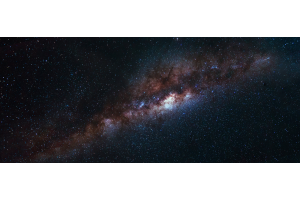
In this episode of What's in the Sky this Month, Teagan reviews some of the beautiful celestial objects you can see in the month of May 2026!
Once In A Blue Moon
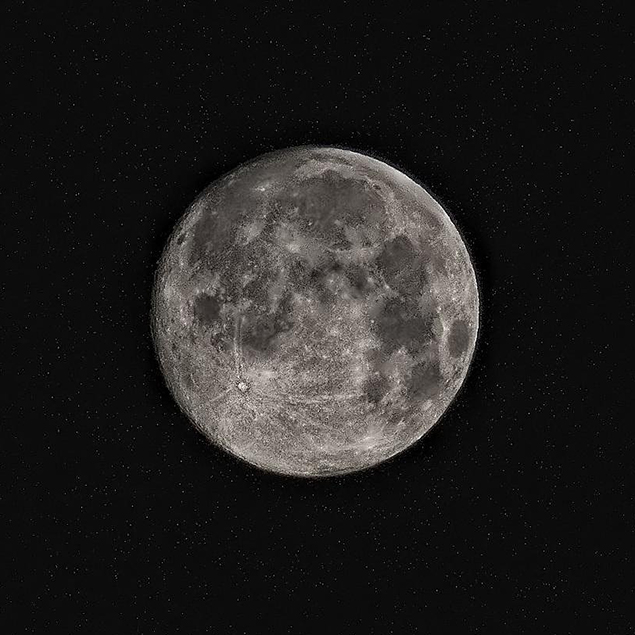
The saying “once in a blue moon” has been around for centuries, describing events so rare they’re almost never seen. The phrase wasn’t born from color at all (although dust and smoke in the atmosphere can occasionally give the Moon a blue hue) and originally the Maine Farmers’ Almanac defined a Blue Moon as being the third full Moon in a season of four. But in 1946, Sky & Telescope magazine mistakenly defined it as the second full Moon in a calendar month. That slip then spread widely and became today’s popular definition.
This year’s Blue Moon appears close to the red star Antares in Scorpius. While blue moons in general can occur every two and a half to three years, blue moons in any given month (such as May) only occur about once every 20 years. Poor February never gets a Blue Moon at all, as it takes 29.5 days for it to run through a complete cycle of phases.
OUR NEAREST NEIGHBORS
Both Uranus and Neptune are too close to the Sun to be visible, but Mercury returns to the evening sky during the last week and should be easily seen by month’s end. Look for it low over the west-northwest about 15 minutes after sunset. Brilliant Venus shines after sunset and is joined by a crescent Moon on the 18th. Jupiter remains visible for much of the evening, with the first ten days of the month providing the last chance to view or image it telescopically, as it will be too low by nightfall later in May. A crescent Moon sits to its lower right on the 19th and then shifts to the other side the following evening. In the morning sky, Saturn and Mars are emerging over the predawn eastern horizon, with Saturn being the easier target. Saturn pulls away from Mars as the month unfolds, while the dimmer red planet lingers in twilight. A crescent Moon floats above Saturn on the 13th and then between the two planets the following morning. Lastly, the Moon turns full in Libra on the 1st, new on the 16th, and then full again - a Blue Moon - in Scorpius on the 31st.
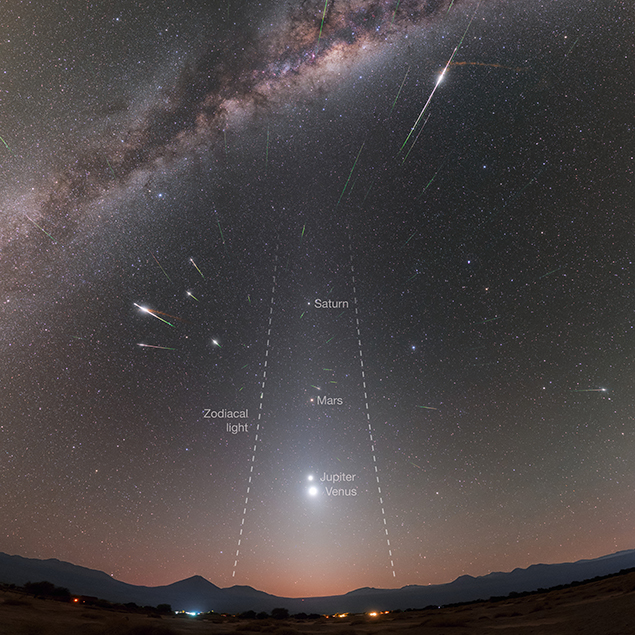
Image credit: ESO/P. Horalek
Eta Aquariid Meteor Shower
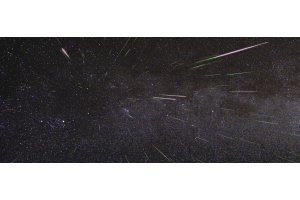
The eta Aquariid meteor shower peaks on the night of May 5-6th. Originating from Halley’s Comet, it produces fast, bright meteors, but this year, a waning gibbous Moon will wash out many of the fainter shooting stars. However, early risers may still catch the occasional bright fireball a few hours before dawn.
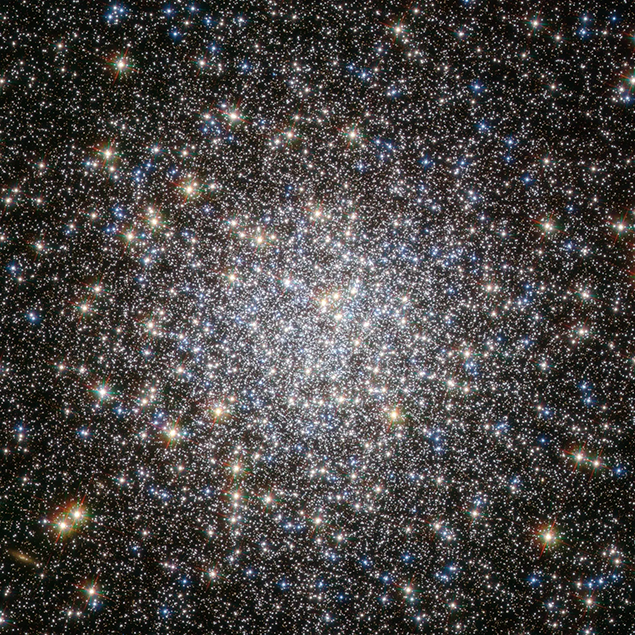
Image credit: ESA/Hubble & NASA
Messier 5
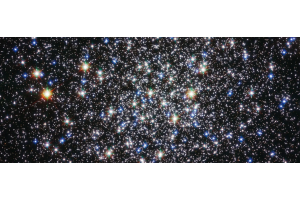
A superb globular cluster in Serpens, M5 can be found near 5 Serpentis. Binoculars show a hazy patch, telescopes resolve a compact core and halo, and imagers - including smart telescopes - capture its intricate chains of stars. Large, bright, and photogenic, M5 ranks among the northern sky’s finest globular treasures.
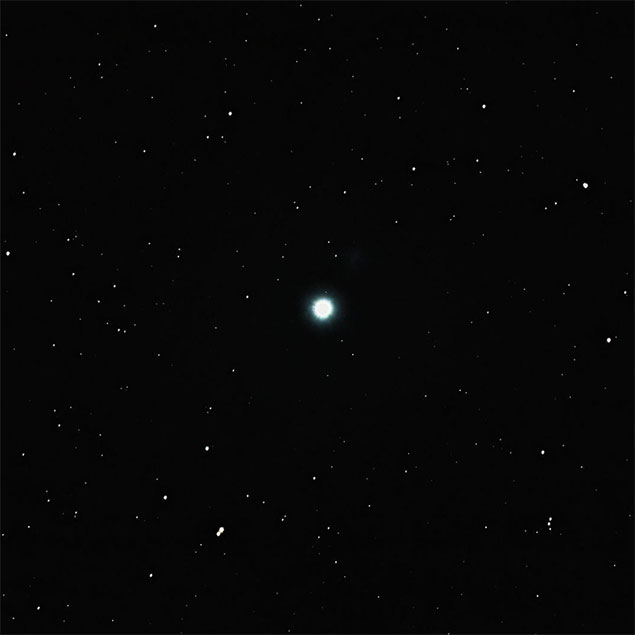
Image credit: Joe Matthews via AstroBin
Alpha Canum Venaticorum - Cor Caroli
Cor Caroli is a fine double that splits easily in almost any telescope. A magnification of just 30x reveals the white primary, which shines about three times brighter than its pale gold companion. A reasonably bright star, it lies 14 degrees south of Alkaid, at the end of the Big Dipper’s handle.
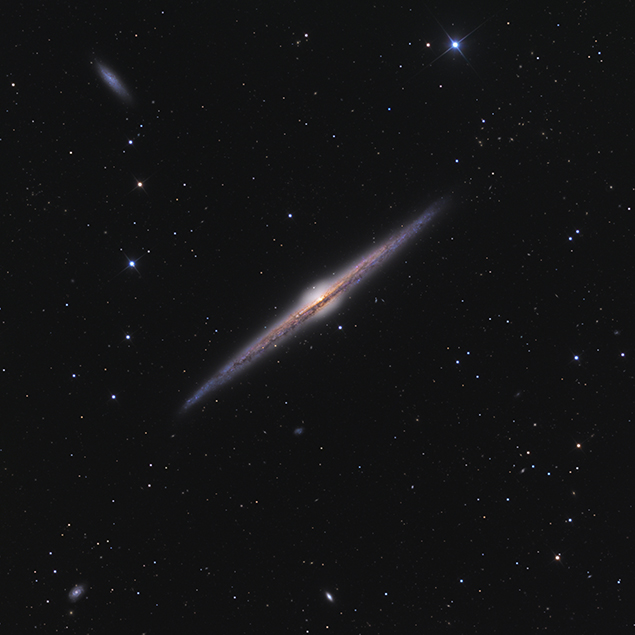
Image credit: Ken Crawford
NGC 4565 - The Needle Galaxy
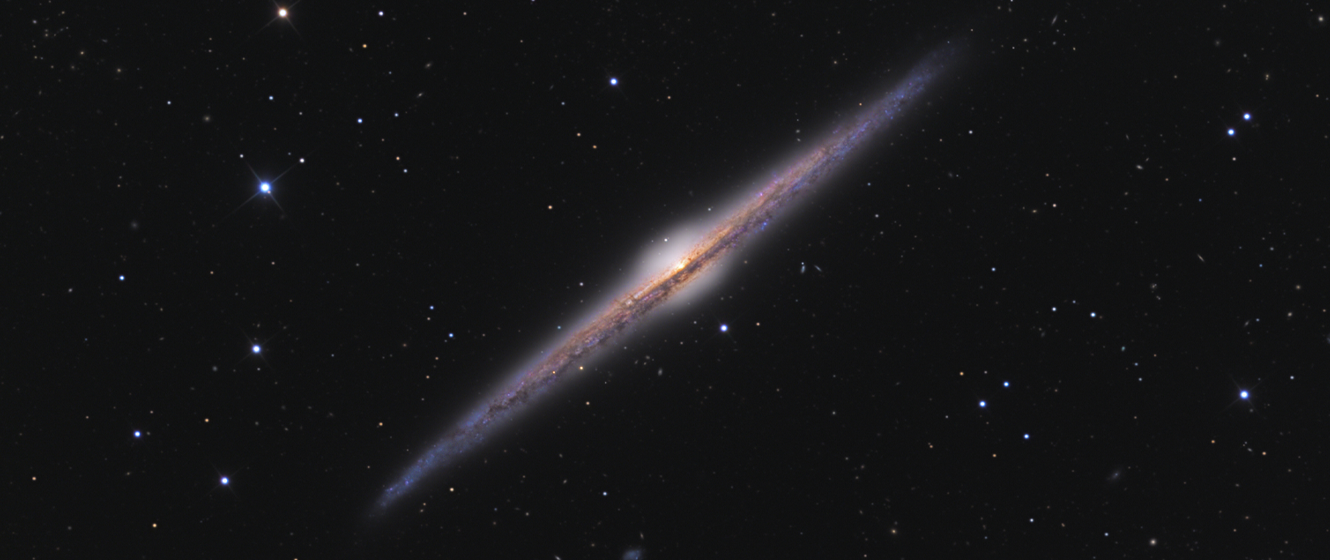
NGC 4565, the famous Needle Galaxy in Coma Berenices, appears in large binoculars as a faint sliver of light, while mid- and large-aperture scopes show a striking, edge-on spindle with a bright, star-like core. A favorite target for astrophotographers, its dramatic dark dust lane stands out beautifully against the thin, glowing disk.
LOOKING BACK
On May 5th, 1702, German astronomer Gottfried Kirch stumbled upon a curious “nebulous star” - what we now know as the globular cluster Messier 5. More than sixty years later, on May 23rd, 1764, Charles Messier added it to his famous catalog of comet-like objects. Today, we know Messier 5 lies roughly 24,500 light-years away and is one of the oldest globular clusters, nearly 13 billion years old, making it almost as old as the Milky Way itself. Observing Messier 5 allows us to see light that has traveled for thousands of years, and to share in discoveries made on similar May nights more than three centuries ago.