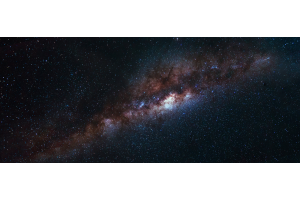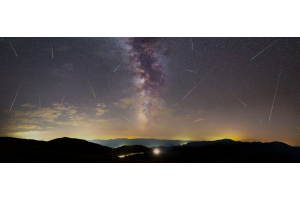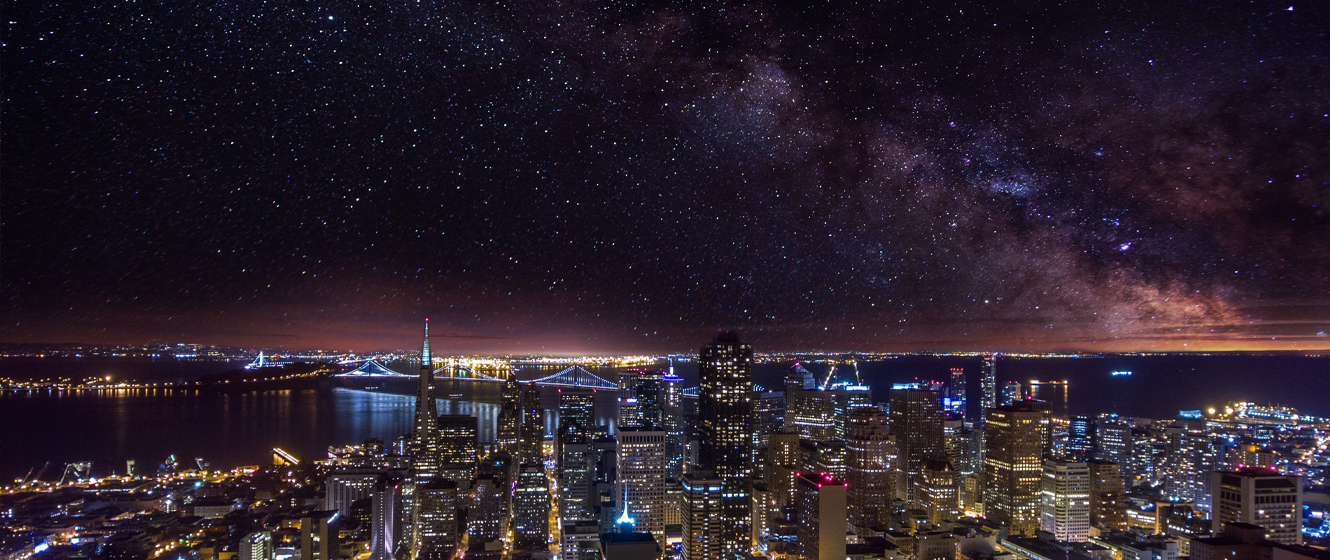
Amateur astronomers dream of seeing the night sky as the ancients once did, free from light pollution, with countless stars and the Milky Way stretching from horizon to horizon. Unfortunately, the reality is that those skies are rare, with a 2016 study estimating that more than a third of the Earth’s population cannot see the Milky Way from their location. Worse still, more recent estimates place that figure much higher, with over 80% of the world’s land surface affected by light pollution.
This is obviously a major problem for amateur astronomy. Stars are lost within the glow of city lights, and even a telescope’s power is muted by the brightened background sky. However, all is not lost. With some realistic expectations, there are still some targets you can seek under suburban skies.
What is the Bortle Scale?
How do you know how good your sky is? How can you easily know what to expect from any given location? Until fairly recently, there was no agreed-upon method for rating the quality of the night sky. Many astronomers would describe their sky in terms of limiting magnitude, which is the faintest star or object you can see with the naked eye. The visibility of the Milky Way would also be a deciding factor.
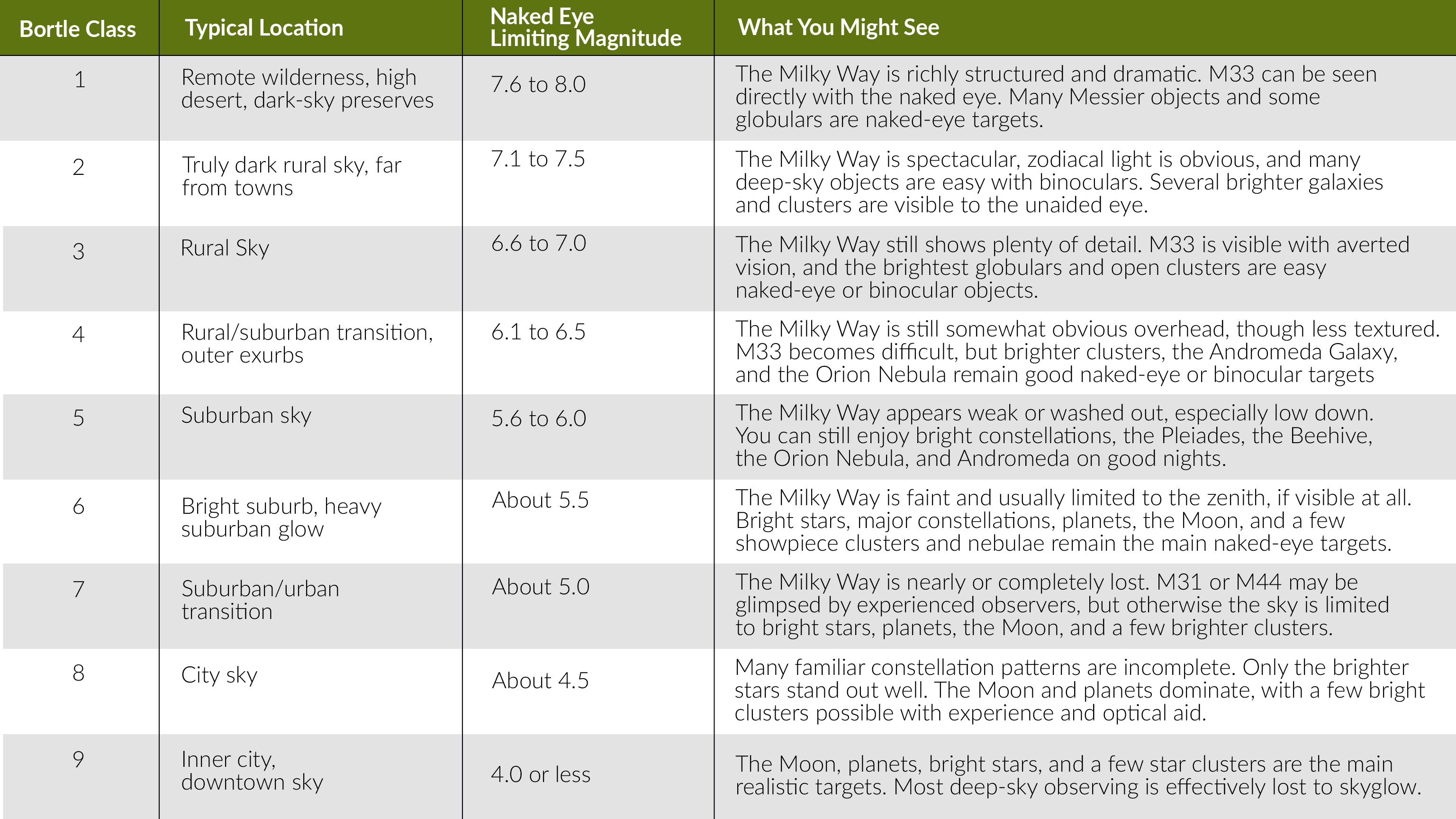
The Bortle Scale is a simple nine-level system that describes how dark the night sky appears, from Class 1 at a pristine dark sky site to Class 9 under the bright glow of an inner city. Created by amateur astronomer John E. Bortle and published in Sky & Telescope magazine in 2001, the scale gives observers a practical way to compare sky conditions from one place to another.
Rather than relying only on measurements, it reflects what you can actually see with your own eyes, including faint stars, the Milky Way, and brighter deep-sky objects. This makes it easy to assess your sky without any equipment.
What Can You See From Suburban Skies?
The Bortle Scale is a good starting point, but light pollution has worsened since it was first introduced, leading some to wonder whether it should be updated. For example, on the Bortle Scale, a suburban sky is rated from 5 to 9, but realistically, being able to see the Milky Way and stars as faint as magnitude 6.0 from suburbia is becoming a rare treat.
However, that’s not to say it doesn’t happen, as nearby buildings and trees can help block out any errant light. In many cases, the quality of the sky will depend upon the size of the town or the city you’re living in, or live near by. For example, there’s a big difference between living on the edge of a town with a hundred thousand people compared to a large city with a million. Such a location could be considered a suburban sky, and therefore #5 on the scale, but the results could be very different.
At first glance, the suburban sky might seem disappointing, but it’s not without its challenges and opportunities. Start by looking up on a moonless night - what can you see? Give your eyes about 20-30 minutes to adjust to the dark (or lack of!), then find the faintest star and estimate its brightness. This will give you a rough idea of where your sky falls on the scale. Keep in mind that conditions will vary from night to night, so it’s worth stepping outside over several nights to get a general sense of the sky for your location.
There are some targets - the Moon being an obvious example - that aren’t too badly affected by light pollution. Skyglow brightens the background sky and reduces contrast, which is why diffuse targets like the Milky Way, faint nebulae, and many galaxies suffer badly in cities. Bright objects, such as the Moon and planets, don’t have that problem as the contrast between the object and the background sky is high. This makes them easy targets for the city dweller. But are the Moon and planets the only things you can see?
The Moon
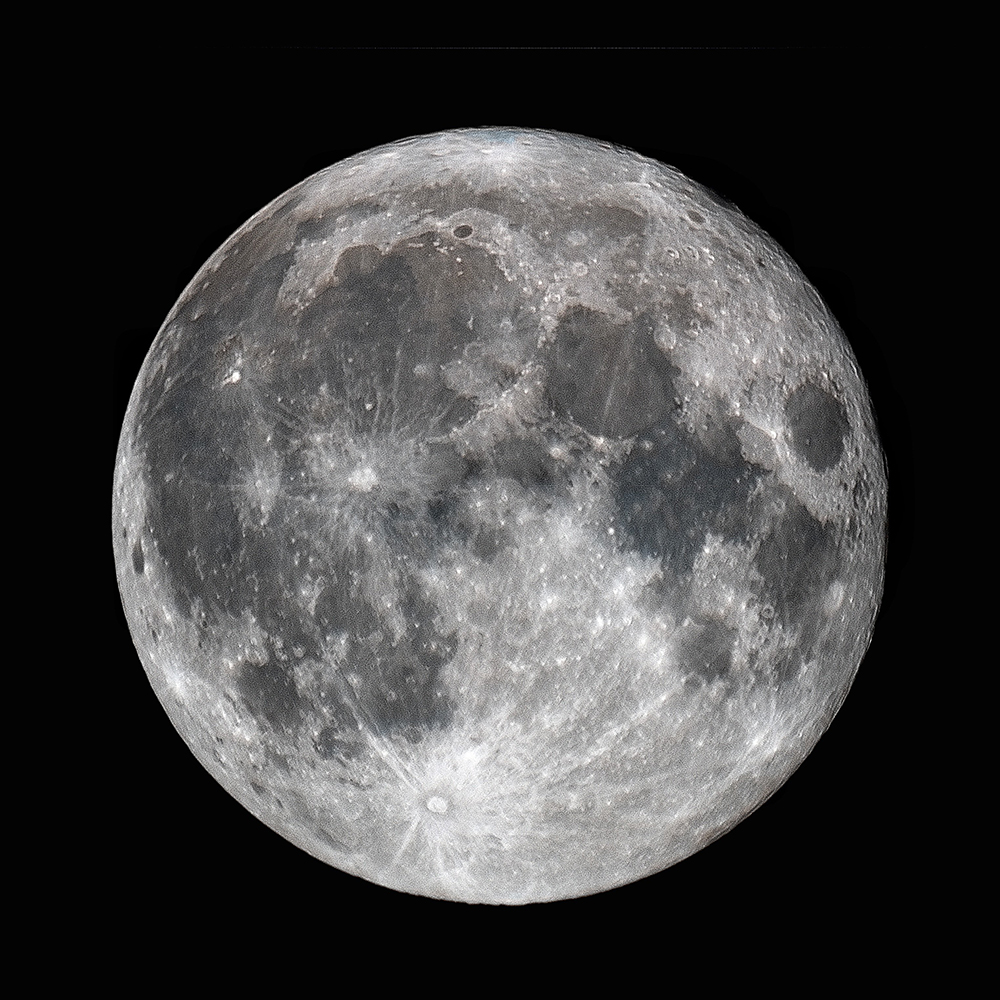
When it comes to the Moon, you really can’t go wrong. Even under the light-polluted skies of an inner city, its features are clearly visible and almost any telescope will provide outstanding views. The only time you might notice a difference is when the Moon is a crescent, with Earthshine illuminating the darkened portion of its surface.
(Earthshine is the phenomenon where reflected light from the sunlit portion of the Earth is reflected back onto the Moon’s surface, allowing features on the unlit portion of the Moon’s surface to be seen.)
While light pollution doesn’t reduce the amount of Earthshine on the Moon, it can reduce your ability to see it. It does this by decreasing the contrast between the background sky and the Moon’s darkened surface. Under a dark sky, Earthshine can be a striking sight, especially with a bright star or planet nearby, but from the city, its effect can be muted.
Otherwise, the Moon is pretty much unaffected, with only local seeing conditions (such as haze or heat rising from nearby buildings) potentially spoiling the view.
Constellations
Depending on your location, identifying even the brightest constellations can be tricky. That said, Orion should be relatively easily seen, even from city skies, and the Big Dipper should also be identifiable. (At magnitude 3.3, Megrez, the star that joins the handle to the bowl, is the faintest star of the group and may prove to be problematic under urban skies.)
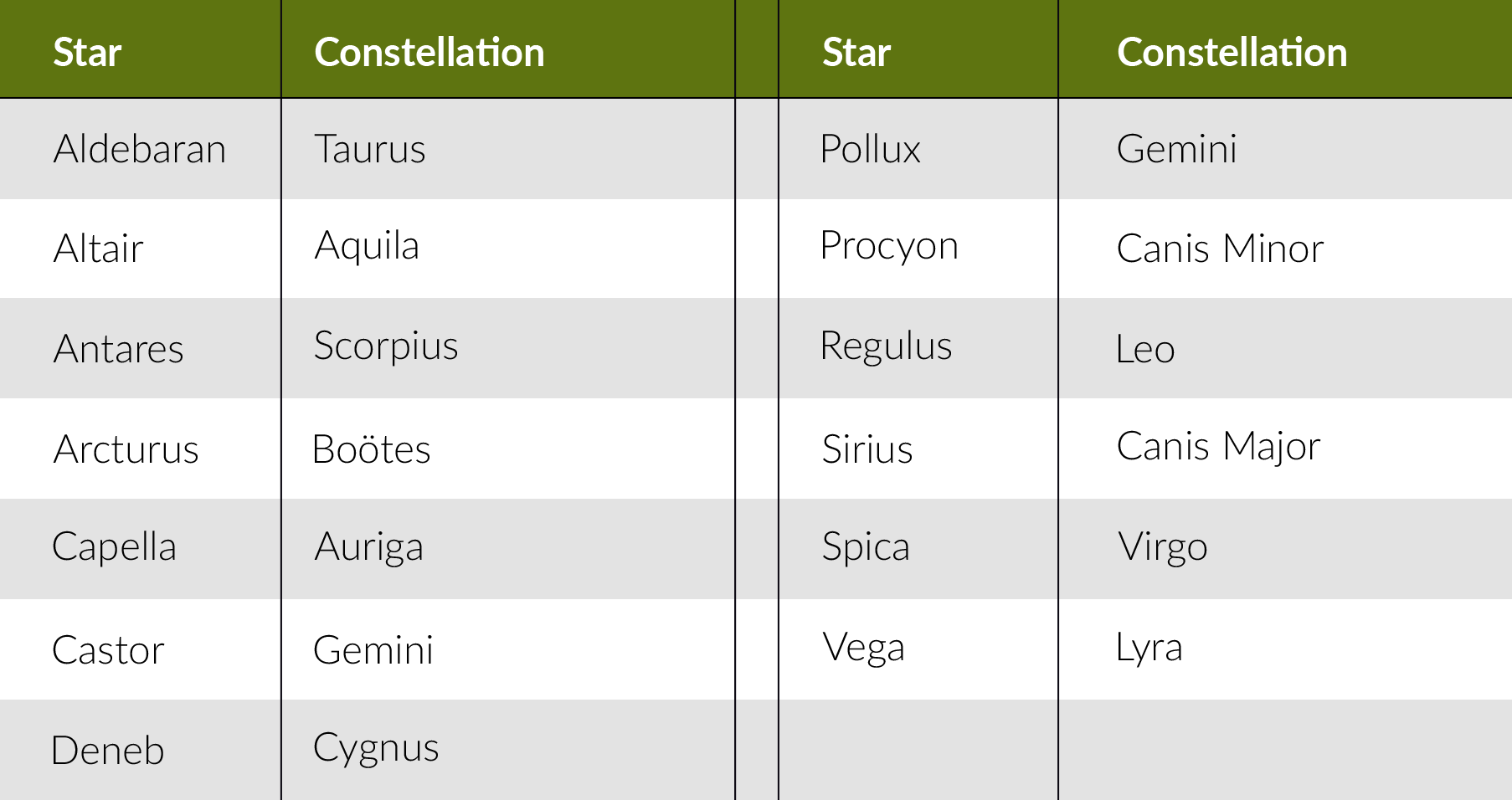
Cassiopeia is another constellation that’s fairly easily identified, while for many others, you may have to be content with simply identifying the constellation’s brightest star. Besides the stars of Orion and the Big Dipper, the stars listed below should be quite apparent.
Be sure to also look for the stars of Ursa Minor. You can, of course, find its brightest star, Polaris, by following the “pointer stars” of the Big Dipper. At magnitude 2.0, Polaris isn’t immediately obvious from urban skies, but once you find it, you can then potentially identify other stars within the constellation. Take a careful look and see which ones are visible. Besides Polaris, the main stars range in brightness from 2.0 for Kochab to magnitude 5.0 for Eta Ursae Minoris, giving you a decent range of magnitudes with which to estimate the limiting magnitude of your sky.
Lastly, if you’re under darker skies and can see the Square of Pegasus, you can also look within the square to see which stars are visible. Again, verifying their brightness with a star chart or app will give you an idea of the limiting magnitude. (Be sure to check back over several nights, as atmospheric conditions can have a noticeable effect on the number of faint stars you can see.)
Deep Sky Objects
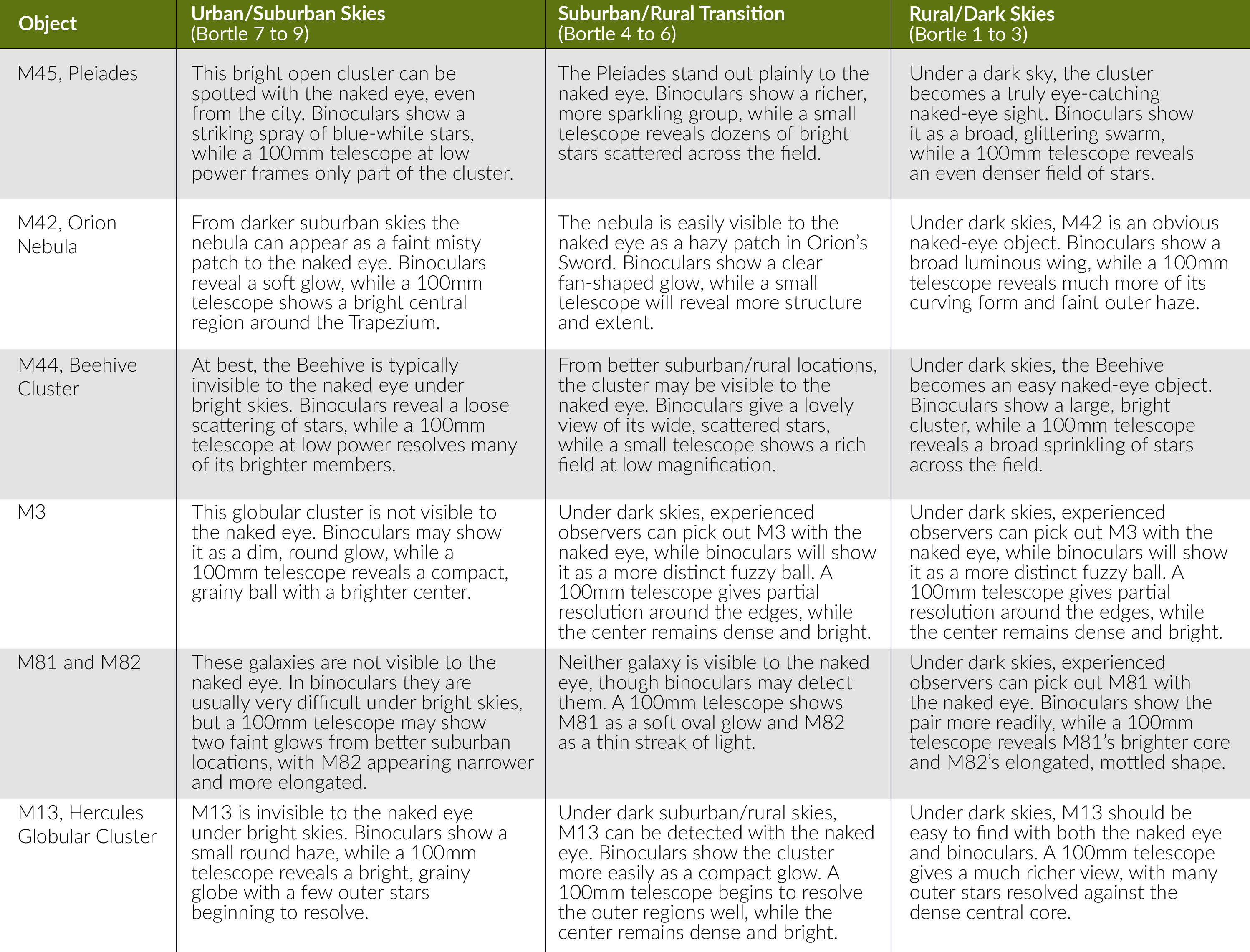
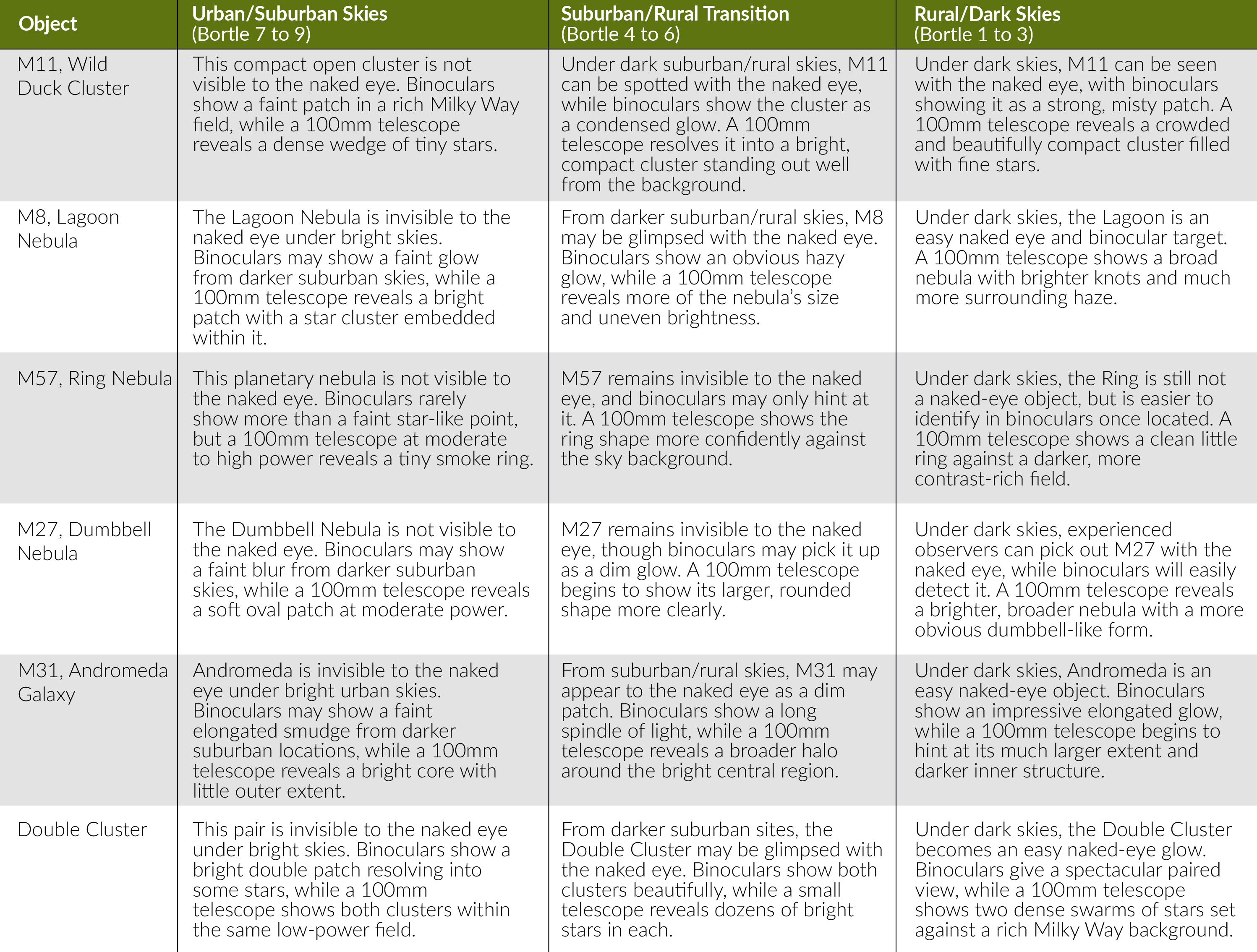
The objects below offer a useful snapshot of what deep-sky observing can look like under different levels of light pollution. Some, such as certain open and globular star clusters, remain rewarding even from suburban and city skies, while others improve dramatically as the sky grows darker.
Bright multiple stars also hold up well under light-polluted skies; for example, showpieces such as Castor, Mizar and Alcor, and Albireo remain attractive targets even from towns and cities. More difficult doubles, especially those with a much fainter companion close to a bright primary, can be more challenging.
Compact objects with brighter, more concentrated light, such as globular star clusters and planetary nebulae, generally hold up better under suburban skies than larger, more diffuse objects such as galaxies and emission nebulae, whose faint outer regions are easily lost in skyglow. Open star clusters often fare well, too, especially the brighter and more compact examples.
The table below provides a brief overview of how some of the sky’s most popular deep sky objects might appear under different skies. The descriptions here are meant as general guidelines rather than strict rules, since transparency, moonlight, object altitude, and observer experience all play a part. Realistically, while many targets can be observed from suburban skies, most will require binoculars or a telescope. It might even be advisable to consider urban stargazing as practice for darker skies; after all, if an object can be found under light-polluted skies, it should be much more apparent from a truly dark location.
What Can Be Done to Fight Light Pollution?
If you’re under light-polluted skies - as many of us are - you might be wondering what you can do about it. Fortunately, all is not lost, as there are a number of things you can do to improve not only your viewing experience, but also your skies in general.
Light Pollution Filters
Light pollution filters can improve contrast under suburban and urban skies by blocking some of the wavelengths associated with common artificial lighting, making certain deep-sky objects stand out more clearly against the background. They are especially useful on emission nebulae, and can also help darken the sky around some brighter clusters and galaxies.
However, they are not a cure-all for heavy skyglow and work best when matched to the right target. Broader filters such as the Optolong L-Pro and Astronomik CLS are the more flexible options, since they suppress common artificial-light wavelengths while still passing much of the visible spectrum, making them better suited to a mix of nebulae, star clusters, and brighter galaxies.
A narrower filter, such as the Optolong UHC, is more specialized, providing a stronger boost on emission nebulae, but it is generally less useful on galaxies.
Regardless, filters tend to offer only modest improvement on galaxies compared with the stronger contrast boost they can provide on emission nebulae, so darker skies still make the biggest difference.
Find a Nearby Dark Sky Observing Location
Finding a darker observing site is easier than it used to be. Online tools such as Light Pollution Map let you compare sky brightness across wide areas, while DarkSky International’s Dark Sky Places directory can help you locate parks, reserves, and other destinations with better night skies. If you do head out alone, be sure to choose a safe, legal location and let someone know where you are going.
A better option is to join a local astronomy club or society. Directories from Sky & Telescope magazine and the Astronomical League can help you find one nearby, and many groups hold regular observing sessions at darker locations where beginners can learn the sky, try different equipment, and observe from better conditions than they may have at home.
Get Involved
If you want to make a difference, organizations such as DarkSky International offer a practical way to turn concern about light pollution into action. DarkSky works to protect the night through public education, advocacy, responsible lighting guidance, and programs such as International Dark Sky Places, which recognizes communities, parks, and protected areas that preserve dark skies through better lighting and ongoing stewardship.
DarkSky also supports a wider network of advocates, chapters, and volunteers working to improve outdoor lighting in their own communities.
You can also start small by using better outdoor lighting at home, supporting dark-sky-friendly policies, joining a local chapter or advocacy group, or donating to support DarkSky’s education and outreach work. Even simple changes, such as using warmer, fully shielded lights only where and when they are needed, can make a meaningful difference over time.
Despite the apparent limitations, even under bright suburban and city skies, the night still has plenty to offer. With realistic expectations and an eye for the targets that shine best through skyglow, urban stargazing can still be a rewarding experience for anyone willing to invest a little time and patience.