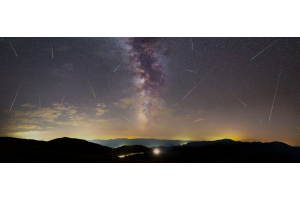
This year, the sky offers us a little of everything - a partial solar eclipse and two lunar eclipses, bright planetary gatherings, both the Perseids and Geminids with little interference from the Moon, and even a couple of rare lunar occultations. Highlights include:
- February 2nd: The just-past Full Moon occults Regulus for much of the eastern U.S. and parts of Canada
- March 3rd: A total lunar eclipse in the pre-dawn hours, with at least part of the eclipse visible across much of North America.
- June 3rd - 15th: Mercury, Venus, and Jupiter cluster low in the west after sunset - it’s an easy evening lineup, with Venus and Jupiter closest on the 8th and 9th.
- August 27th/28th: A deep partial lunar eclipse with nearly 96% coverage. It’s visible across North America but best suited for evening viewing in the west or midwest.
- Pre-dawn in November and into early December: Mars and Jupiter gather near Regulus in Leo, with the Moon joining the scene around November 30th - a gorgeous color-contrast before sunrise.
As an added bonus, many of the year’s prettiest planetary meetups are binocular-friendly pairings that look great in 10x50s.
These events have been compiled with North American observers in mind. While the majority of events can also be seen throughout the rest of the world, it is advisable to check an astronomy app, magazine, or online resource for more specific information relating to your location.
The events are listed as being visible in the pre-dawn sky (AM), in the evening sky (PM), or as being visible all night (AN). Lastly, you’ll also find the dates listed for when the planets are in conjunction with the Sun, which will show as being not visible (NV).
Scroll down to the bottom of this page to download your free PDF highlighting all of the astronomical events in 2026!
JANUARY
January 1 to 31: Saturn Approaches Neptune, While Uranus Drifts From the Pleiades (PM)
Saturn and Neptune have been performing their dance since March of last year, with the pair closest - just barely under a degree apart - in early July. They then drifted apart as Saturn turned retrograde, but have since drawn closer again and start the month 3.4° apart. Two degrees will separate the pair by the 27th, but by this time, faint Neptune will suffer from being closer to the horizon and may be difficult to spot.
An easier target is the pairing of Uranus and the Pleiades, but this time the gap is widening. The month starts with 4.9° between them, and while that distance will widen to 5.1° by month’s end, the two should still fit within the same 10x50 binocular field of view. Fortunately, all these worlds are slow-moving giants, so if you miss this opportunity, you’ll have another chance towards the end of the year.
January 3 & 30: The Full Wolf Moon Close to Jupiter, Castor and Pollux in Gemini (AN)
There’s a bright start to the year with a full Wolf Moon on the 3rd. You’ll find it rising in the east in the early evening, with bright Jupiter just to its right and the twin stars of Castor and Pollux to its upper left. It’s an attractive grouping, and while Jupiter will be easily seen, you might be dazzled by the glare of the Moon as you look for the stars.
The Moon then begins to wane, and appears to the right of the bright star Regulus in Leo late in the evening of the 5th, and then to the left of the star the following night. Come back on the 30th to see a similar sight, when the waxing gibbous Moon returns to Gemini and appears to the upper left of Jupiter and to the right of the twin stars.
January 10: Jupiter at Opposition in Gemini (AN)
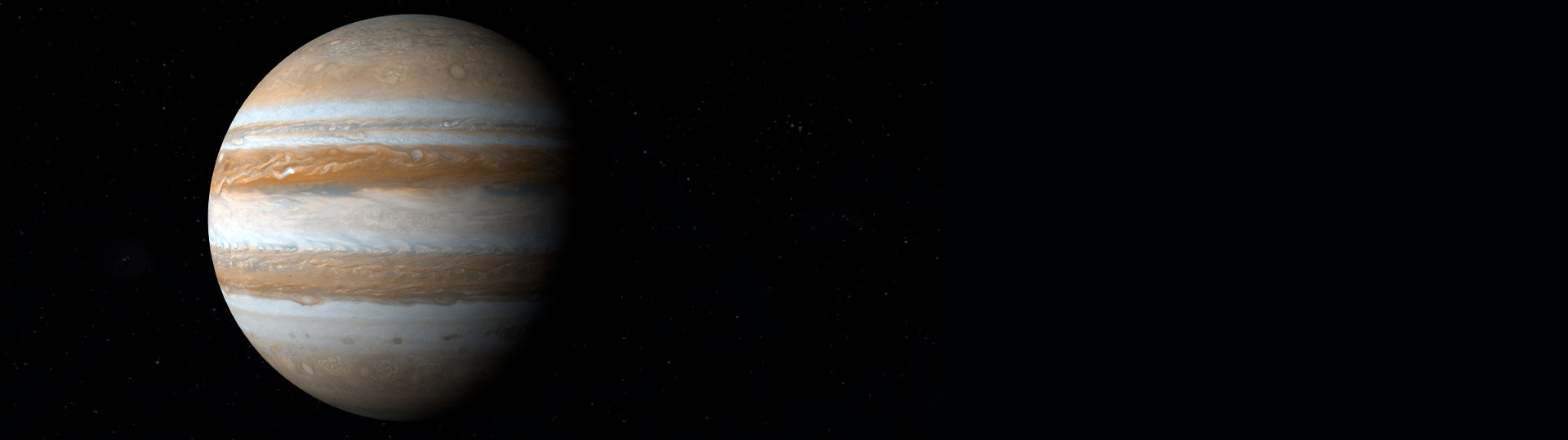
Jupiter reaches opposition in Gemini, to the lower right of Castor and Pollux. This is the ideal time and place for a planet to be at opposition, as the nights are long and Gemini rides high in the sky for northern observers. Opposition occurs when a planet appears opposite the Sun in the sky, so it rises around sunset, is highest and due south near midnight, and sets around sunrise, making it an all-night target. Jupiter is unmistakable as a bright golden “star”, outshining everything in the sky except the Moon.
Binoculars will show the planet’s four largest moons, first spotted by Galileo in January 1610 - 416 years ago this month. A small telescope at low power will reveal dark cloud bands crossing its disc, but to see the Great Red Spot, you’ll most likely need a 150mm aperture scope or larger. A light blue (#80A/#82A) or green (#58) filter can improve contrast.
January 14: The Waning Crescent Moon Appears Close to Antares in Scorpius (AM)
Early risers, venturing outside about 30 - 60 minutes before dawn, will find a slender crescent Moon just 2.5° to the right of Antares, the brightest star in Scorpius. The pair will sit roughly 15 - 20° above the southeastern horizon, offering a great chance to spot a bright summer star in the middle of winter. In myth, Antares marks the Scorpion’s red, beating heart - easy to imagine once you see it glowing beside the Moon.
All Events:
- March 20, 2025 to January 27 - Saturn appears close to Neptune in Pisces, with the gap closing. The month starts with 3.4° between them, closing to two degrees by the 27th, when Neptune slips too close to the Sun to be visible (PM).
- April 13, 2025 to March 31 - Uranus appears close to the Pleiades in Taurus, with the gap widening. The month starts with 4.9° between them.
- January 2/3 - The Quadrantid meteor shower is at its maximum, with a zenith hourly rate of up to 120 (AN). The shower is predicted to reach its maximum at around 21:00 UT on the 3rd, or 16:00 ET. The Moon is full. Best observed in the early hours of the 2nd and 3rd.
- January 3 - Full Wolf Moon in Gemini (AN).
- January 3 - The full Moon appears close to Jupiter, Castor, and Pollux in Gemini (AN).
- January 5 & 6 - The waning gibbous Moon appears close to Regulus in Leo (AM).
- January 6 - Venus is at superior conjunction with the Sun in Sagittarius (NV).
- January 9 - Mars is in conjunction with the Sun in Sagittarius (NV).
- January 10 - Last quarter Moon in Virgo (AM).
- January 10 & 11 - The last quarter Moon appears close to Spica in Virgo (AM).
- January 10 - Jupiter is at opposition in Gemini (AN).
- January 14 - The waning crescent Moon appears close to Antares in Scorpius (AM).
- January 18 - New Moon in Sagittarius (NV).
- January 21 - Mercury is at superior conjunction with the Sun in Capricornus (NV).
- January 22 - The waxing crescent Moon appears close to Saturn and Neptune in Pisces (PM).
- January 23 - Dwarf planet Pluto is in conjunction with the Sun in Capricornus (NV).
- January 25 - First quarter Moon in Aries (PM).
- January 27 - The first quarter Moon appears close to Uranus and the Pleiades in Taurus (PM).
- January 30 - The full Moon appears close to Jupiter, Castor & Pollux in Gemini (AN).
FEBRUARY
February 2: Occultation of Regulus by the Full Moon (AN)
The just-past full Moon briefly hides Regulus for observers across much of the eastern half of the U.S. and parts of Canada. The overall window is from about 8:40 to 10:05 PM ET, with the star vanishing instantly and then returning up to about an hour later, depending on where you are. It’s a good idea to use an app, such as SkySafari or Stellarium, for the precise timing from your location.
With the Moon so close to full, the glare can easily dazzle you, especially through binoculars or a telescope. Fortunately, telescopic observers can use a variable lunar filter to block a lot of the Moon’s light - dialing it down can help to tame the glare without wiping out Regulus.
February 19: Mercury at Greatest Eastern Elongation From the Sun in Pisces (PM)
Mercury becomes visible from about the 5th onwards, shining low over the west-northwestern horizon after sunset. With an elongation of only 18° by the 19th, it won’t stay in a good spot for long - expect roughly two to three weeks of relatively easy viewing before it sinks deeper into twilight. As a rule, start looking about 15 minutes after sunset; around the 19th it sets roughly an hour and a half after the Sun and sits about 13° above the horizon.
The best help comes the evening before. On the 18th, Mercury sits just 0.5° to the upper right of a thin crescent Moon, a close conjunction well worth a look. If the sky is still bright, binoculars will make Mercury much easier to pick out. You may also notice Saturn higher up, with Venus lower and closer to the horizon - keep an eye on all three, as they draw closer together toward the end of the month.
February 23: Grazing Occultation of the Pleiades by the First Quarter Moon in Taurus (PM)
We’re treated to a second occultation this month, when on the evening of February 23rd, the Moon slides to the north of the Pleiades. For some observers across North America (particularly Canada) it will occult a number of the cluster’s stars. The overall window runs from about 10:00 PM to 12:15 AM ET (7:00 - 9:15 PM PT), though the exact disappear/reappear times depend heavily on your location. As before, it’s a good idea to use an app for precise timing from where you’ll be observing.
With the Moon roughly 45% illuminated, the glare will still be bright through a telescope. As before, a variable lunar filter can help, but the stars of the Pleiades are much fainter than Regulus and you’ll erase a lot of the cluster. The best compromise is leaving the filter off and nudging the illuminated portion of the Moon just out of the field of view. The tradeoff is that you may catch stars disappearing, but miss their reappearances.
February 26 & 27: Mercury, Venus and Saturn in Pisces (PM)
If you’ve been watching Mercury low in the west-northwest this month, you’ve likely noticed Venus below it and Saturn a little higher and slightly to its left. A good time to start tracking all three is the 18th, when the crescent Moon appears beside Mercury (see above). If Saturn is unfamiliar, look the following evening, when the Moon hangs just to the upper right of the ringed planet.
Check back each evening about 15 minutes after sunset to watch Mercury and Saturn sink deeper into twilight, while Venus rises to meet them. Mercury and Venus are closest on the 26th and 27th, when a little more than 4.5° separates them. Mercury will sit to the upper right of Venus, but binoculars may be needed to pick it out, as it will have faded noticeably since it first became visible earlier in the month.
All Events:
- April 13, 2025 to March 31 - Uranus appears close to the Pleiades in Taurus, with the gap closing. The month starts with 5.1 degrees between them (PM).
- February 1 - Full Snow Moon in Cancer (AN).
- February 2 - The full Moon appears occults Regulus in Leo for much of the United States and parts of Canada (PM).
- February 4 - Uranus resumes prograde motion in Taurus (PM).
- February 7 - The waning gibbous Moon appears close to Spica in Virgo (AM).
- February 9 - Last quarter Moon in Libra (AM).
- February 11 - The waning crescent Moon appears close to Antares in Scorpius (AM).
- February 17 - An annular eclipse of the Sun. Visible from Antarctica.
- February 17 - New Moon in Aquarius (NV).
- February 18 - The waxing crescent Moon appears close to Mercury in Aquarius (PM).
- February 19 - The waxing crescent Moon appears close to Saturn in Pisces (PM).
- February 19 - Mercury is at greatest eastern elongation in Pisces, 18 degrees from the Sun (PM).
- February 23 - The first quarter Moon appears close to Uranus & the Pleiades in Taurus (PM).
- February 24 - First quarter Moon in Taurus (PM).
- February 26 - Mercury begins retrograde motion in Pisces (PM).
- February 26 - The waxing gibbous Moon appears close to Jupiter in Gemini (PM).
- February 27 - Mercury appears close to Venus in Pisces (PM).
- February 27 - The waxing gibbous Moon appears close to Castor and Pollux in Gemini (PM).
MARCH
March 2 to 10: Venus Appears Close to Saturn in Pisces (PM)
From the 2nd to the 10th, Venus and Saturn share the low western horizon after sunset, but they’ll be a tricky pair; both sit only about 8° above the horizon and Saturn is far fainter than Venus. Venus will be easier to spot, and with binoculars you can start scanning for Saturn from about 15 minutes after sunset. Without binoculars, you may want to wait closer to 30 minutes. Regardless, you’ll need to be quick as the pair won’t be visible for long.
The two will fit within the same 10x50 binocular field from the 2nd, with Saturn to the upper left of Venus. The gap then closes quickly, with the pair closest on the 7th and 8th, when they’re about 1° apart. Saturn hangs just left of Venus on the 7th, and then to the lower left on the 8th. After that, Saturn becomes challenging and will likely disappear into the twilight around the 10th.
March 3: Total Lunar Eclipse in Leo (AM)
In the morning hours of March 3rd, the Moon slips into the Earth’s shadow for a total lunar eclipse, with at least part of the eclipse visible across much of the U.S. and Canada. The penumbral phase begins at 3:44 AM ET (00:44 PT) with the partial phase starting at 4:50 AM ET (1:50 AM PT). East coast observers will most likely miss totality, as it begins at 6:04 AM ET (3:04 AM PT) - close to, or after, moonset for many.
For those further west, mid-eclipse occurs at 6:33 AM ET (3:33 AM PT), with the Moon halfway along the body of Leo, the Lion, and sinking in the west-southwest. Totality then ends at 7:02 AM ET (4:02 AM PT), with the partial phase ending at 8:17 AM ET (5:17 AM PT). At that time, the Moon will be low in the west and the sky will be brightening before dawn. (For the record, the second and final penumbral phase ends at 9:23 AM ET, 6:23 AM PT.)
This is a fairly deep total eclipse, with an umbral magnitude around 1.15 - well inside the darkest portion of Earth’s shadow. Exactly how dark and what shade of coppery orange you’ll see will vary, and frequently depends upon conditions in the Earth’s atmosphere.
March 19 & 20: The Waxing Crescent Moon Appears Close to Venus in Pisces (PM)
On March 19th and 20th, the waxing crescent Moon will appear close to Venus low in the west shortly after sunset. It’s best to start looking about 15 - 20 minutes after sunset, and although the sky might still be bright, Venus should be easy to spot. The two are closest on the 19th, when about 6.0° separates them - close enough to fit within a 10x50 binocular field of view - with the Moon to the lower right of Venus.
On the 20th, the Moon shifts to the upper right of Venus and the gap widens to 9.5°. Lastly, realistically, you’ve probably only got about 30 minutes after sunset to catch them on the 19th, while the Moon’s higher position on the 20th stretches that window to roughly 45 minutes after sunset.
March 25 & 26: The First Quarter Moon Appears Close to Jupiter, Castor and Pollux in Gemini (PM)
On the 25th, the Moon reaches first quarter in Gemini, with brilliant Jupiter to its left and the twin stars of Castor and Pollux to its upper left. Look high in the south-southwest around 9 PM local time.
By the following night, the Moon has slipped past Jupiter and appears just below Pollux, with Castor to its upper right and Jupiter to its lower left. Pollux will fit within the same 10x50 binocular field of view, but Castor will sit just outside it.
Other Events:
- April 13, 2025 to March 31 - Uranus appears close to the Pleiades in Taurus, with the gap closing. The month starts with 4.9 degrees between them and then closes to 4.6 degrees by the end of the month. (PM).
- March 1 - The full Moon appears close to Regulus in Leo (AN).
- March 2 - 10 - Venus and Saturn appear close to one another in Pisces. The pair are closest on the 7th and 8th (PM).
- March 3 - Full Worm Moon in Leo (AN).
- March 3 - Total lunar eclipse. Visible from Antarctica, Asia, Australia, North America and South America.
- March 6 - The waning gibbous Moon appears close to Spica in Virgo (AM).
- March 7 - Mercury is at inferior conjunction with the Sun in Pisces (NV).
- March 10 - Last quarter Moon close to Antares in Scorpius (AM).
- March 11 - Last quarter Moon in Ophiuchus (AM).
- March 11 - Jupiter resumes prograde motion in Gemini (PM).
- March 17 - The waning crescent Moon appears close to Mercury in Aquarius (AM).
- March 18 - New Moon in Pisces (NV).
- March 19/20 - The waxing crescent Moon appears close to Venus in Pisces (PM).
- March 20 - Mercury resumes prograde motion in Aquarius (AM).
- March 22 - The waxing crescent Moon appears close to Uranus and the Pleiades in Taurus (PM).
- March 22 - Neptune is in conjunction with the Sun in Pisces (NV).
- March 25 - Saturn is in conjunction with the Sun in Pisces (NV).
- March 25 - First quarter Moon in Gemini (PM).
- March 25/26 - The first quarter Moon appears close to Jupiter, Castor and Pollux in Gemini (PM).
- March 29 - The waxing gibbous Moon appears close to Regulus in Leo (PM).

APRIL
April 15 to 22: Mercury, Mars and Saturn in Pisces (AM)
From April 15th to 22nd, Mercury, Mars, and Saturn gather very low in the eastern sky before sunrise, but this is a challenging catch: you’ll need binoculars, a very clear eastern horizon, and a small window of roughly 15 - 20 minutes before sunrise. The good news is that from start to finish, you can track the changing lineup in a single 10x50 binocular field. Mercury has passed its greatest western elongation (April 3rd) but still hangs on in morning twilight, and on the 15th a very slender crescent Moon appears about 4° above it.
Mars sits a few degrees to Mercury’s left and is still faint and low after emerging from the Sun’s glare. If you return each morning, the Mercury-Mars gap closes by the 17th, and Saturn may become visible just a couple of degrees to the lower left of Mars. The trio tightens as Saturn rises and Mercury sinks, with a particularly nice alignment on the 20th, before Mercury slips to the left of Mars and Saturn on the 21st and 22nd, and then disappears into twilight around the 23rd.
April 18 to 28: The Waxing Crescent Moon and Venus Appear Close to the Pleiades in Taurus (PM)
Step outside shortly after sunset on the 18th and you’ll find the crescent Moon to the lower right of Venus above the western horizon. The two will just barely fit within the same 10x50 binocular field of view. On the 19th, the Moon hops to the other side and appears well above Venus, with the Pleiades sitting in between.
Keep your eye on Venus after that. From the 20th to the 27th, it will be the turn of Venus and the Pleiades will share the same field of view, with the pair closest on the 23rd and 24th, when about 3.5° separates them. For the best view, wait roughly 45 minutes after sunset so the sky darkens enough to appreciate the faint stars of the cluster.
April 21/22 - The Lyrid Meteor Shower at Maximum (AN)
The Lyrid meteor shower is predicted to reach its maximum around mid-afternoon on the 22nd, which means it’ll be at its best on the evening of April 21st and into the early hours of the 22nd. The Moon is a waxing crescent and sets around midnight on the 21st, with Lyra itself rising at around 11PM. The radiant sits near brilliant Vega, in the Lyra/Hercules area of the sky, and will be better placed after midnight as the constellation rises higher.
For your best chances, don’t stare straight at the radiant as you’ll typically see more meteors by looking about 45 - 90 degrees away from it. Under ideal conditions the Lyrids can produce around 18 meteors per hour, but a more realistic expectation is closer to 10 - 20, depending on how dark your sky is and the altitude of the radiant. Lyrids are fairly swift, and while many are modestly bright, the shower can produce the occasional fireball.
April 25: Occultation of Regulus by the Waxing Gibbous Moon in Leo (PM)
We’re treated to two occultations of Regulus this year. The first occurred on February 2nd, with the second arriving on April 25th. As before, the event favors the eastern U.S., while observers in Canada (and much of the western U.S.) may see a close pass instead of an actual disappearance. The overall window is roughly 8:05 to 10:00 PM ET, but the exact timing can vary with location. As always, it’s a good idea to check an app or software for confirmation.
Regulus will blink out behind the Moon’s dark limb and later reappear from the bright side, which may be harder to catch against the glare from the Moon. It’s worth starting a few minutes early, since both the disappearance and reappearance are instantaneous, and you won’t want to miss it! Binoculars can help, and a small telescope may be even better; as before, a variable lunar filter can tame the glare without completely wiping out Regulus.
All Events:
- April 1 - Full Pink Moon in Virgo (AN).
- April 2 - The full Moon appears close to Spica in Virgo (AN).
- April 3 - Mercury is at greatest western elongation in Aquarius, 28 degrees from the Sun (AM).
- April 6 - The waning gibbous Moon appears close to Antares in Scorpius (AM).
- April 9 - Last quarter Moon in Sagittarius (AM).
- April 11 - 27 - Mercury and Mars appear close to one another in Pisces. The pair are closest on April 20th and 21st, when 1.7 degrees will separate them (AM).
- April 14 - 29 - Mars and Saturn appear close to one another in Pisces. The pair are closest on April 19th and 20th, when 1.25 degrees will separate them. (AM).
- April 15/16 - The waning crescent Moon appears close to Mercury and Mars in Pisces (AM).
- April 16 - 24 - Mercury and Saturn appear close to one another in Pisces. The pair are closest on April 20th, when half a degree will separate them. (AM).
- April 17 - New Moon in Pisces (NV).
- April 18/19 - The waxing crescent Moon appears close to Venus and the Pleiades in Taurus (PM).
- April 20 - 27 - Venus appears close to the Pleiades in Taurus. The pair are closest on the 23rd and 24th, when 3.5 degrees will separate them (PM).
- April 21/22 - The Lyrid meteor shower is at its maximum, with a zenith hourly rate of up to 18 (AN). The shower is predicted to reach its maximum at 19:40 UT on the 22nd, or 14:40 ET. The Moon is a waxing crescent. Best observed in the early hours of the 22nd.
- April 22 - The waxing crescent Moon appears close to Jupiter, Castor, and Pollux in Gemini (PM).
- April 23 - First quarter Moon in Cancer (PM).
- April 25 - The waxing gibbous Moon appears close to Regulus in Leo (PM).
- April 29 - The full Moon appears close to Spica in Virgo (AN).
MAY
May 13 to 15: The Waning Crescent Moon Appears Close to Saturn and Mars in Pisces (AM)
If you haven’t been able to spot Mars or Saturn in the predawn twilight, the waning crescent Moon is on hand to help you find them - but you’ll need to step outside about 30 minutes before sunrise. On the 13th, the Moon hangs about 5.5° to the upper right of Saturn, placing both within the same 10x50 binocular field of view.
The next morning, the Moon appears between the ringed planet and Mars, sitting about 11° to the left of Saturn and 6.8° to the upper right of Mars. Finally, come back on the 15th to see the Moon about 9.2° to the left of Mars. It’s a fairly wide group, but if you’re up early to walk the dogs or head off to work, it’s definitely worth a quick look
May 18 to 20: The Waxing Crescent Moon Appears Close to Venus, Jupiter, Castor and Pollux in Gemini (PM)
For three nights, the waxing crescent Moon teams up with Venus, Jupiter, and the twin stars Castor and Pollux for a great evening lineup. It should look best about 45 minutes after sunset, once the sky is dark enough for the stars to show clearly. On the 18th, the two-day-old Moon sits just to the right of Venus, with Jupiter to the upper left of the pair. The Moon and Venus can make a particularly nice sight in 10x50 binoculars.
On the 19th, the Moon shifts between Venus and Jupiter, sitting a little closer to Jupiter than to Venus. This should be a good time to look for Earthshine, when sunlight reflected off Earth softly illuminates the Moon’s night side, making the unlit portion faintly visible against the twilight sky. On the 20th, the Moon moves to the upper left of Jupiter and lines up roughly parallel with Castor and Pollux, giving observers a wide, but well-balanced grouping.
May 21: The Waxing Crescent Moon Appears Close to the Beehive Cluster in Cancer (PM)
This one is really for binocular observers. The Beehive sits at the center of Cancer, the Crab, but both the stars of the constellation and the cluster itself are faint, and moonlight will likely wash them out to the naked eye. Meanwhile, a telescope view is usually too tight to fit both the Moon and the Beehive comfortably within the same field of view.
The Moon sits about 5.4° to the upper left of the Beehive. Center the Moon in 10x50 binoculars, then nudge the view slightly to the lower right until the Moon is just outside the field. Give your eyes a few minutes to re-adjust, and with a little patience the Beehive should appear in the lower right of the view. It also sits roughly parallel to Asellus Australis (magnitude 3.9), a handy marker star near the southeastern edge of the crab’s shell.
May 30 & 31: The Full Moon Appears Close to Antares and a Blue Moon in Scorpius (AN)
On the first day of the month we had the Full Flower Moon, a name inspired by spring blooms across North America. On the 30th, the almost-full Moon will skim low across the southern sky. As the sky darkens, Antares - the star marking the beating heart of Scorpius the Scorpion - should be visible to the naked eye, even from suburban skies, but you may need to look carefully as the Moon is bright and dazzling. At moonrise, Antares should appear just to the upper left of the Moon.
Stick around until 1:45 AM PT (4:45 AM ET) and you’ll catch the Moon turning full for the second time this month - a Blue Moon. Unfortunately, it won’t actually look blue, unless something highly unusual happens. For example, after the 1883 eruption of Krakatoa, fine ash and aerosols scattered light in strange ways, and observers reported occasional blue or greenish Moons along with vivid sunsets.
All Events:
- May 1 - Full Flower Moon in Libra (AN).
- May 4 - Waning gibbous Moon close to Antares in Scorpius (AM).
- May 5/6 - The eta Aquariid meteor shower is at its maximum, with a zenith hourly rate of up to 50 (AN). The shower is predicted to reach its maximum on the 6th. The Moon is a waning gibbous. Best observed in the early hours of the 6th.
- May 9 - Last quarter Moon in Capricornus (AM).
- May 13 - Waning crescent Moon appears close to Saturn in Pisces (AM).
- May 14/15 - Waning crescent Moon appears between Mars and Saturn in Pisces (AM).
- May 14 - Mercury is at superior conjunction with the Sun in Taurus (NV).
- May 15 - Waning crescent Moon appears close to Mars in Aries (AM).
- May 15 - Dwarf planet Ceres is in conjunction with the Sun in Taurus (NV).
- May 16 - New Moon in Aries (NV).
- May 18 - Waxing crescent Moon appears close to Venus in Taurus (PM).
- May 19 - Waxing crescent Moon appears between Venus and Jupiter in Gemini (PM).
- May 19 - June 7 - Jupiter appears close to Pollux in Gemini. The pair are closest from May 24th to June 2nd, when 6.3 degrees will separate them. (PM).
- May 20 - Waxing crescent Moon appears close to Jupiter, Castor and Pollux in Gemini (PM).
- May 21 - The waxing crescent Moon appears close to the Beehive Cluster in Cancer (PM).
- May 22 - The first quarter Moon appears close to Regulus in Leo (PM).
- May 22 - Uranus is in conjunction with the Sun in Taurus (NV).
- May 23 - First quarter Moon in Leo (PM).
- May 26 - The waxing gibbous Moon appears close to Spica in Virgo (PM).
- May 30 - The full Moon appears close to Antares in Scorpius (AN).
- May 31 - Full Blue Moon in Scorpius (AN).

JUNE
June 3 to 15: Mercury, Venus and Jupiter in Gemini (PM)
This is a great chance to catch elusive Mercury in the evening twilight. Step outside about 30 minutes after sunset and look low over the western horizon for Venus and Jupiter. Venus is the brighter of the two and sits to the lower right of Jupiter. You may also notice the stars Castor and Pollux above Venus and to the upper right of Jupiter.
Venus and Jupiter fit comfortably within the same 10x50 binocular field. Draw an imaginary line down through Jupiter and Venus and you may catch Mercury glinting near the horizon. Mercury will be fainter than Venus or Jupiter, but brighter than Castor or Pollux.
Over the following evenings, Venus and Jupiter draw closer while Mercury climbs a little higher, but also grows fainter. Venus and Jupiter are closest on the 8th and 9th, when a little over 1.5° separates them. The gap then widens, with your last good chance to fit both in the same binocular view coming around the 15th.
June 15 to 17: Mercury, Venus, Jupiter, and the Waxing Crescent Moon in Gemini (PM)
Here’s a great little “Mercury finder” for the evening twilight. The planet reaches its greatest distance from the Sun in the sky on the 15th. On that date, about 30 minutes after sunset, look low towards the west-northwest; Mercury will be only about 12° above the horizon, so an unobstructed view is a must. If you draw an imaginary line through Venus and Jupiter and keep going, you should come to Mercury, sitting at roughly half the altitude of Venus.
If locating Mercury proves to be tricky, come back the following evening at the same time and use the crescent Moon as a signpost: the Moon appears to the right of Jupiter and about the same distance directly above Mercury. By the next night, the Moon shifts to the upper left of Venus, creating an easy, unmissable string of worlds to follow down toward the horizon.
June 18 to July 3: Mercury and Jupiter in Gemini (PM)
Mercury continues to put on a show in the evening twilight shortly after sunset, and this time it teams up with Jupiter. From the 18th through to the first few evenings in July, the two appear within the same 10x50 binocular field of view, making this a nice follow-on to the Venus/Jupiter pairing.
You may be able to spot them about 30 minutes after sunset at the start of the run, but as the days pass you’ll find Mercury dipping closer to the horizon and growing dimmer. That means you’ll want to start looking a little sooner after sundown, and you’ll definitely want binoculars to help pull Mercury out of the twilight. The two are tightest from the 23rd to the 26th, with Mercury becoming especially challenging by late June and into the first few days of July.
June 23 to July 5: Mars Appears Close to the Pleiades in Taurus (AM)
Mars creeps past the Pleiades in the morning twilight, but this pairing will most certainly be a challenge. For starters, you’ll want to be outside about an hour before sunrise for the sky to be dark enough for the cluster to be visible. Even then, the Pleiades may be tricky without binoculars at the start, and a clear, unobstructed view low toward the east-northeast will be important.
On the 23rd, the Pleiades sit only about 14° above the east-northeastern horizon, but the view improves as the days pass, with the cluster roughly 10° higher by July 3rd. Mars and the Pleiades fit within the same 10x50 binocular field throughout, with Mars passing to the lower right of the cluster. The pair are closest on June 29th, when about 4.4° separates the pair.
All Events:
- May 19 to June 7 - Jupiter appears close to Pollux in Gemini. The pair are closest from May 24th to June 2nd, when 6.3 degrees will separate them. (PM).
- June 3 - 15 - Venus, Jupiter and Pollux appear close together in Gemini. Venus appears between Jupiter and Pollux on June 8th and 9th, when 1.7 degrees will separate Venus and Jupiter, and roughly five degrees will separate Venus from Pollux (PM).
- June 8 - Last Quarter Moon in Aquarius (AM).
- June 10 - The waning crescent Moon appears close to Saturn in Pisces (AM).
- June 12 - The waning crescent Moon appears close to Mars in Aries (AM).
- June 14 - New Moon in Taurus (NV).
- June 14 - 25 - Venus appears close to the Beehive Cluster in Cancer. The two are closest on June 19th, when 0.7 degrees will separate them (PM).
- June 15 - Mercury is at greatest eastern elongation in Gemini, 24 degrees from the Sun (PM).
- June 16 - The waxing crescent Moon appears close to Mercury and Jupiter in Gemini (PM).
- June 17 - The waxing crescent Moon appears close to Venus in Gemini (PM).
- June 18 - July 3 - Mercury and Jupiter appear close to one another in Gemini. The two are closest on June 23rd and 24th, when 0.8 degrees separate them (PM).
- June 19 - The waxing crescent Moon appears close to Regulus in Leo (PM).
- June 21 - First quarter Moon in Virgo (PM).
- June 23 - The waxing gibbous Moon appears close to Spica in Virgo (PM).
- June 23 - July 5 - Mars appears close to the Pleiades in Taurus. The two are closest on June 29th, when 4.4 degrees will separate them (AM).
- June 26/27 - The waxing gibbous Moon appears close to Antares in Scorpius (PM).
- June 29 - Full Strawberry Moon in Sagittarius (AN).
JULY
July 4 to 14: Venus Appears Close to Regulus in Leo (PM)
Venus puts on a fine show as it passes Regulus in Leo, shining brilliantly above the western horizon from just a few minutes after sunset. To easily pick up Regulus, you’ll most likely want to wait until about 45 minutes after sunset, when the sky has darkened sufficiently. On the first evening, the pair sit about 18° above the horizon at that time, with Venus to the lower right of the star.
Over the following nights, Venus slips by Regulus, with the two remaining close enough to share the same 10x50 binocular field of view until the 14th. They are closest on the 9th, when about 0.9° separates them and Venus has moved to the upper right of the star. It’s worth coming back on the 16th to see the crescent Moon just to the left of Regulus, and then again the following night when the Moon has shifted a little way to the left of Venus.
July 8 to 13: Mars Appears Close to Aldebaran in Taurus (AM)
Step outside at about 45 minutes before sunrise on the 8th and you can find Mars over the eastern horizon, with Aldebaran glinting almost directly below it. About 6.25° separates the two, allowing the pair to fit within the same 10x50 binocular field of view. Both are roughly the same brightness (with Aldebaran being slightly brighter), and both shine with a coppery hue, giving you a good opportunity to compare the star and planet side by side.
The pair are joined by the crescent Moon on the 10th, which appears to the upper left of Mars, while Mars itself sits to the upper left of Aldebaran, forming a neat line. The Moon and Mars may share the same 10x50 binocular field, but you won’t be able to fit all three together. Mars and Aldebaran are closest on the 12th and 13th, when 5.4° separates them, still comfortably within the same field of view, and they remain within that view until roughly the 18th.
July 20 & 24: The Moon Appears Close to Spica and Antares (PM)
You’ll need to be outside at around 10 PM local time to catch this pair of summer lineups. On the 20th - the 57th anniversary of the first manned Moon landing - you can find the first quarter Moon about 3° to the lower left of Spica, the brightest star in Virgo. The pair sit low over the southwestern horizon and can be enjoyed with the naked eye, with both the Moon and Spica fitting comfortably within a 10x50 binocular field of view.
Four nights later, on the 24th, look low over the southern horizon to find the waxing gibbous Moon about the same distance from Antares, the coppery heart of Scorpius. Once again, the Moon sits to the lower left of the star, giving a similar but warmer-toned pairing, but with both the Moon and Antares remaining within the same 10x50 binocular field.
July 27: Dwarf Pluto at Opposition in Capricornus (AN)
Pluto reaches opposition in Capricornus, sitting opposite the Sun in the sky and remaining visible for much of the night. Thanks to its distance and size, Pluto doesn’t vary much in brightness and typically sits around magnitude 15, far beyond naked-eye or binocular reach and appearing as nothing more than a tiny, star-like point low in the southern sky. To spot it you’ll need detailed star charts or a good app (such as SkySafari or Stellarium) that can plot Pluto against the background stars.
Visually, this is an advanced target. Under dark rural skies, experienced observers can sometimes glimpse Pluto with a 200 mm (8-inch) telescope, but most will likely need at least a 250 - 300 mm (10–12-inch) instrument.
All Events:
- June 18 - July 3 - Mercury and Jupiter appear close to one another in Gemini, with the gap widening. The month starts with 5.4 degrees between them (PM).
- June 23 - July 5 - Mars appears close to the Pleiades in Taurus, with the gap widening. The month starts with 4.7 degrees between them (AM).
- July 4 - July 14 - Venus appears close to Regulus in Leo. The two are closest on July 9th, when 1.0 degrees will separate them (AM).
- July 7 - Last quarter Moon in Pisces (AM).
- July 7 - The last quarter Moon appears close to Saturn in Pisces (AM).
- July 7 - Neptune begins retrograde motion in Pisces (AM).
- July 8 - 18 - Mars appears close to Aldebaran in Taurus. The two are closest on July 13th, when 5.3 degrees will separate them (AM).
- July 10 - The waning crescent Moon appears close to the Pleiades in Taurus (AM).
- July 11 - The waning crescent Moon appears close to Mars and the Pleiades in Taurus (AM).
- July 12 - Mercury is at inferior conjunction with the Sun in Gemini (NV).
- July 14 - New Moon in Gemini (NV).
- July 14 - August 6 - Uranus appears close to the Pleiades in Taurus, with the gap widening. The two are closest from July 14th to 16th, when 5.9 degrees will separate them (AM).
- July 16 - The waxing crescent Moon appears close to Venus and Regulus in Leo (PM).
- July 17 - The waxing crescent Moon appears close to Venus in Leo (PM).
- July 20 - The first quarter Moon appears close to Spica in Virgo (PM).
- July 21 - First quarter Moon in Virgo. (PM)
- July 23 - Mercury resumes prograde motion in Gemini (AM).
- July 24 - The waxing gibbous Moon appears close to Antares in Scorpius (PM).
- July 25 - Saturn begins retrograde motion in Pisces (AM).
- July 26 - Dwarf planet Pluto is at opposition in Capricornus (AN).
- July 27 - Full Buck Moon in Capricornus (AN).
- July 29 - Jupiter is in conjunction with the Sun in Cancer (NV).
- July 30/31 - The Southern Delta Aquariid meteor shower is at its maximum, with a zenith hourly rate of up to 25 (AN). The shower is predicted to reach its maximum on July 31st. The Moon is a waning gibbous. Best observed in the early hours of the 31st.
AUGUST
August 12: Partial Solar Eclipse
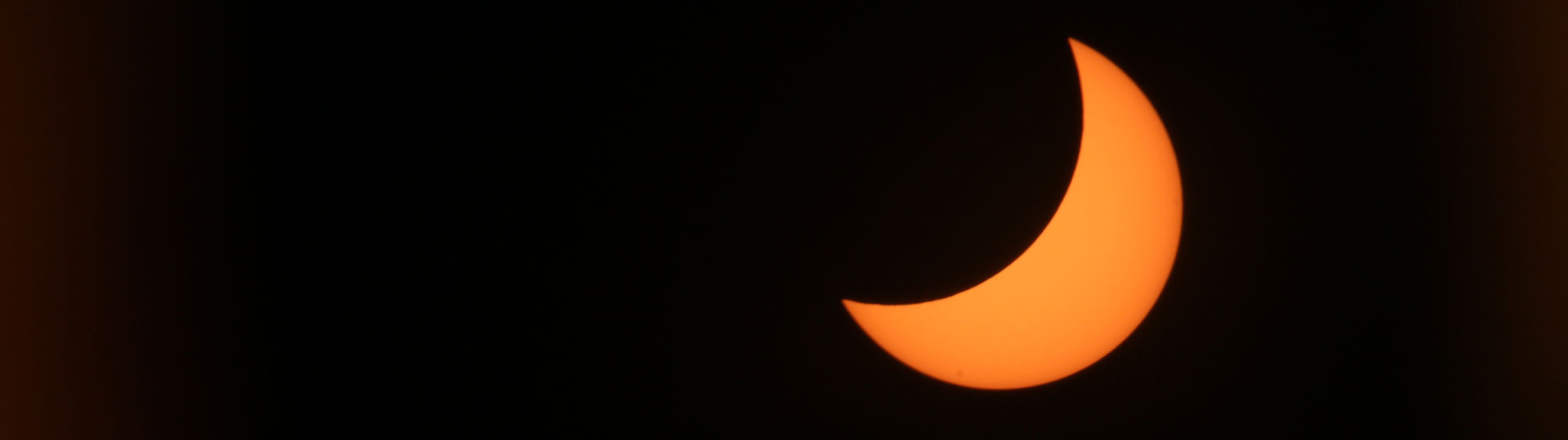
Few celestial events are as inspiring as a total solar eclipse. On this day the Moon passes directly between Earth and Sun, casting a narrow path of totality across the Arctic, eastern Greenland, western Iceland, and northern Spain. Observers in the northern half of North America will see a partial eclipse, but it’s still worth a look: from the northern and northeastern U.S. states and Canada, the Sun may show a small “bite” missing around 12 – 3 PM Eastern Time, with coverage typically in the 10 – 30% range and somewhat higher in far northeastern Canada.
As always, use proper solar filters or eclipse glasses whenever any part of the Sun remains visible. For naked-eye observers, a simple pinhole projector or binocular/telescope projection can let you watch the Moon’s shadow creep across the solar disc. Lastly, check a website or an app, such as timeanddate.com, SkySafari, or Stellarium, for the precise timing and maximum coverage from your location.
August 12/13: The Perseid Meteor Shower at Maximum (AN)
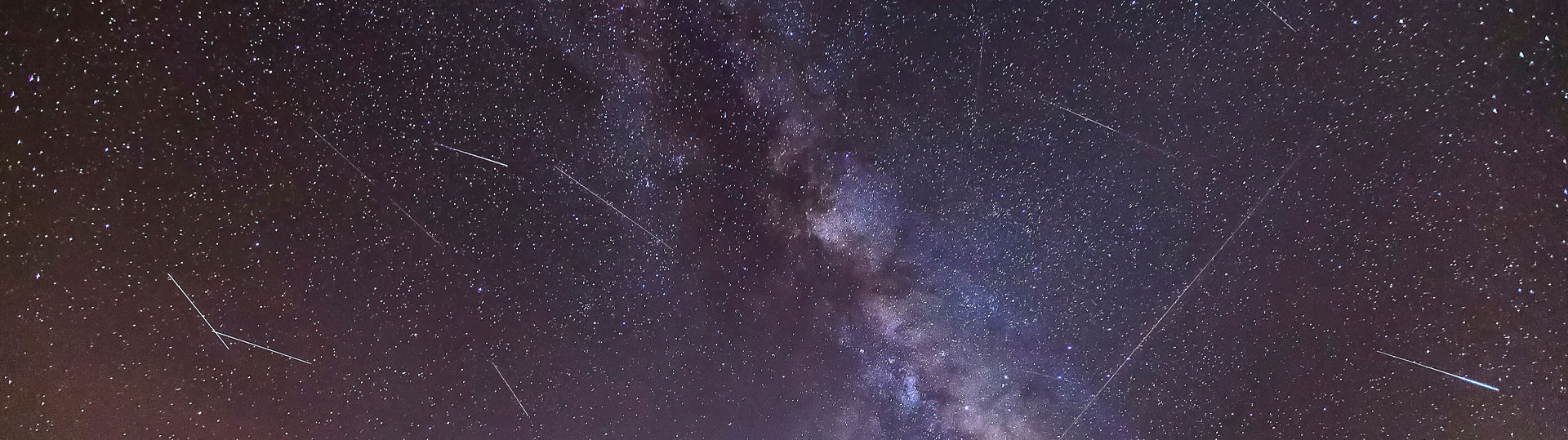
The Perseids reach their maximum in the early hours of the 13th, and this year promises an unusually good show. That’s thanks to the Moon, which turns new the same day, so there’s no moonlight to brighten the sky. If you can, it’s worth getting as far away from town and city lights as possible, as the combination of dark skies and no Moon can allow you to see far more shooting stars than if you’d stayed at home.
Under ideal conditions, the Perseids can produce around 100 meteors an hour, but your actual count will depend on how dark your sky is and how high the radiant climbs. The constellation Perseus, from which the meteors appear to originate, rises in the northeast around midnight, with the best opportunities coming roughly between 3 AM and 5 AM, when Perseus is highest before dawn. Don’t forget your telescope, as you’ll also find Saturn glowing to the south.
August 15: Venus at Greatest Elongation From the Sun in Virgo (PM)
Venus reaches its greatest eastern elongation from the Sun today, placing it at its greatest distance from the Sun in the evening sky. The planet itself is unmissable, and you’ll find it shining brilliantly over the west-southwestern horizon from about 15 minutes after sunset. On this particular evening, a thin crescent Moon hangs roughly 4° to the lower right of Venus, with the pair easily fitting within the same 10x50 binocular field of view.
Return the following evening to see the Moon a little way to the left of the planet, with Spica glinting to the upper left of the Moon. If the star isn’t easily seen at first, wait another 15 - 30 minutes for the sky to darken. Keep your eye on Venus and Spica over the following days, as the gap between the two will gradually decrease; the pair sit within the same binocular field of view from about the 25th onward and are closest on September 1st.
August 27/28: Partial Lunar Eclipse in Aquarius (AN)
This is a deep eclipse with nearly 96% coverage - about as good as a partial gets - across North America. Unlike a solar eclipse, a lunar eclipse is safe to observe with the naked eye, and with the best part arriving before midnight in the west (and just after midnight in the east), it’s a good reason to step outside and enjoy the show.
The penumbral stage begins at 9:24 PM ET (6:24 PM PT), with the partial phase starting at 10:34 PM ET (7:34 PM PT) as the Moon enters the umbra and begins to take on a coppery tint. Mid-eclipse occurs at 12:13 AM ET (9:13 PM PT); the partial phase ends at 1:52 AM ET (10:52 PM PT); and the penumbral phase ends at 3:02 AM ET (12:02 AM PT). Around mid-eclipse, look for Saturn in the southeast, brightening as it heads toward its October 4th opposition.
Other Events:
- July 14 - August 6 - Uranus appears close to the Pleiades in Taurus, with the gap widening. The month starts with 6.4 degrees separating them (AM).
- August 2 - Mercury is at greatest western elongation in Gemini, 19 degrees from the Sun (AM).
- August 3/4 - The waning gibbous Moon appears close to Saturn in Pisces (AM).
August 5th: Last quarter Moon in Aries (AM).
- August 5 - Last quarter Moon in Aries (AM).
- August 7 - The waning crescent Moon appears close to Uranus and the Pleiades in Taurus (AM).
- August 9 - The waning crescent Moon appears close to Mars in Taurus (AM).
- August 10 - The waning crescent Moon appears close to Castor and Pollux in Gemini (AM).
- August 11 - The waning crescent Moon appears close to Mercury in Cancer (AM).
- August 12 - Total eclipse of the Sun. Visible from southwestern Europe, eastern Greenland, and western Iceland.
- August 12 - New Moon in Leo (NV).
- August 12/13 - The Perseid meteor shower is at its maximum, with a zenith hourly rate of up to 100 (AN). The shower is predicted to reach its maximum from 02:00 UT to 04:00 UT on the 13th, or from 22:00 ET on the 12th to 00:00 ET on the 13th. The Moon is new. Best observed in the early hours of the 13th.
- August 15 - The waxing crescent Moon appears close to Venus in Virgo (PM).
- August 15 - Venus is at greatest eastern elongation in Virgo, 46 degrees from the Sun (AM).
- August 16 - The waxing crescent Moon appears close to Venus and Spica in Virgo (PM).
- August 17 - The waxing crescent Moon appears close to Spica in Virgo (PM).
- August 19 - First quarter Moon in Libra (PM).
- August 20 - The first quarter Moon appears close to Antares in Scorpius (PM).
- August 25 - September 9 - Venus appears close to Spica in Virgo. The two are closest on September 1st, when 1.5 degrees will separate them (PM).
- August 27 - Full Sturgeon Moon in Aquarius (AN).
- August 27 - Mercury is at superior conjunction with the Sun in Leo (NV).
- August 28 - Partial eclipse of the Moon. Visible from Africa, Antarctica, Europe, North America and South America.
SEPTEMBER
August 25 to September 9: Venus Appears Close to Spica in Virgo (PM)
Venus has been drawing closer to Spica, and the pair will fit within the same 10x50 binocular field of view from August 25th through to September 9th. They’re closest on the 1st, when 1.5° separates them, with Spica hanging to the upper right of Venus. Plan to look 30 - 45 minutes after sunset, once twilight fades enough for Spica to appear, and choose a spot with a clear west-southwestern horizon.
After the 1st, the gap widens each evening, and by the 9th the pair will no longer share the same binocular view. Step outside on the 13th to catch a thin crescent Moon between Venus and Spica, and check again the following night when the Moon has shifted to the upper left of Venus. By this time, Spica will be a little way to the right of Venus, and scanning the sky with binoculars may help to locate it.
September 3 to 8: The Moon’s Pre-dawn Tour Through Taurus and Gemini (AM)
From the 3rd through the 8th, the Moon performs a tour of the pre-dawn sky, hopping from one landmark to the next. First up is the Pleiades on the 3rd, when a nearly last-quarter Moon sits about 1° to the cluster’s upper right. The problem is glare: the Moon’s brightness can wash out the Pleiades, so plan to be outside an hour before dawn if you want to try your luck.
The tour resumes on the 6th, with a slender crescent Moon hovering about 5° above Mars low in the east; the pair fits comfortably in a 10x50 binocular view. On the 7th, the Moon forms a tidy line with Castor and Pollux in Gemini, with the spacing between them nearly even. The finale is Jupiter on the 8th: step out about 30 minutes before sunrise to see the Moon shining about 3.5° above the brilliant planet in brightening twilight.
September 13 to 21: Mars Appears Close to Pollux in Gemini (AM)
Shortly after the Moon completes its pre-dawn tour, Mars begins a mini tour of its own near Pollux in Gemini. The only downside is timing: plan to be outside about 45 minutes before sunrise, otherwise Pollux can get lost in the brightening twilight. On the 13th, Mars sits to the left of Pollux and then slides to a position below it over the following weeks.
This isn’t a close pass, but it’s a useful one. Mars and Pollux are closest on the 16th, 17th, and 18th, when about 5.9° separates them - an easy fit within the same 10x50 binocular field of view. Better yet, they shine at the same brightness (magnitude 1.2), offering a perfect side-by-side comparison: Pollux’s slightly yellowish light against Mars’s warmer, coppery hue.
September 25: Neptune is at Opposition in Pisces (AN)
Neptune reaches opposition on the 25th, rising at sunset and staying up throughout the night. At magnitude 7.8 it’s within reach of 10x50 binoculars from darker skies, but it won’t look like a planet, but rather a faint sapphire “star.” Its subtle blue color and often steady, untwinkling light can give it away, but because it sits among the dim background stars of Pisces, it’s essential to verify its position with a chart or app.
Unfortunately, you won’t see a disc without the use of a telescope and a magnification of roughly 150 - 200x. It’s also too tiny to reveal any surface details, and some might find the view a little disappointing. However, it’s worth remembering that this is the most distant planet in our solar system, and its light has taken over four hours to reach us!
All Events:
- August 25 - September 9 - Venus appears close to Spica in Virgo, with the gap closing. The month starts with 1.5 degrees between them and the two are closest on September 1st, when 1.5 degrees will separate them (PM).
- September 3 - The last quarter Moon appears close to the Pleiades in Taurus (AM).
- September 4 - Last quarter Moon in Taurus (AM).
- September 6 - The waning crescent Moon appears close to Mars in Gemini. (AM).
- September 7 - The waning crescent Moon appears close to Castor and Pollux in Gemini. (AM).
- September 8 - The waning crescent Moon appears close to Jupiter in Cancer. (AM).
- September 10 - New Moon in Leo (NV).
- September 10 - Uranus begins retrograde motion in Taurus (AM).
- September 13 - 21 - Mars appears close to Pollux in Gemini. The two are closest on September 17th and 18th, when 5.9 degrees will separate them (AM).
- September 13 - The waxing crescent Moon appears between Spica and Venus in Virgo (PM).
- September 14 - The waxing crescent Moon appears close to Venus in Virgo (PM).
- September 17/18 - The waxing crescent Moon appears close to Antares in Scorpius (PM).
- September 18 - First quarter Moon in Ophiuchus (PM).
- September 25 - Full Harvest Moon in Pisces (AN).
- September 25 - Neptune is at opposition in Pisces (AN).
- September 26 - The full Moon appears close to Saturn in Pisces (AN).
- September 30 - October 23 - Mars appears close to the Beehive Cluster in Cancer. The two are closest on October 11th, when 7 arcminutes will separate them (AM).

OCTOBER
October 4: Saturn at Opposition in Cetus (AN)
Saturn is at its best in early October and can be found in the constellation Cetus. Look for it about 90 minutes after sunset; it will be low in the east and will appear as a solitary, pale-yellow “star” with a steady glow. If there’s any doubt, check again on the 23rd and 24th, when the Moon sits to Saturn’s upper right one night and then to its upper left the next.
Binoculars won’t add much, but a small telescope transforms the view. At 30x the rings are obvious and Titan usually shows as a tiny point nearby; this year the rings look fairly narrow, but still stand out well. Increase to 100x and more moons - for example, Rhea, Tethys, and Dione - begin to appear, and Cassini’s Division may also be glimpsed when the air is steady. For subtle cloud detail, try a #80A blue, #21 orange, or #58 green filter to boost contrast.
October 6: Occultation of Jupiter by the Waning Crescent Moon in Leo (AM)
On October 6th, the waning crescent Moon occults Jupiter in the predawn sky for parts of North America. The path is narrow and favors the eastern half of the continent, where the Moon and Jupiter appear higher above the horizon; it’s therefore best to simulate the view from your location using an app first. Not only will you get an idea of what you can expect to see, but you’ll also be able to get precise timings.
The disappearance and reappearance of Jupiter generally fall roughly from 4:15 to 5:45 AM ET (1:15 - 2:45 AM PT), depending on your location. Jupiter slips behind the Moon’s bright limb and then emerges from the dark limb, which is often the more photogenic moment. A small telescope or binoculars can help to enhance the view, but be sure to choose a spot with a clear eastern horizon; some locations see Jupiter’s disappearance very low, and the west coast may miss the occultation entirely.
September 30 to October 23: Mars Appears Close to the Beehive Cluster in Cancer (AM)
Mars makes a predawn pass through the Beehive Cluster (M44) in Cancer, but it’s an early one: the Beehive is fairly faint, so you’ll want to be outside about 90 minutes before sunrise, while the sky is still dark enough to pick it out. Mars first slips into the same 10x50 binocular view as the cluster on September 30th, but you’ll probably want to wait until after the 4th, once the Moon has passed last quarter and its light isn’t brightening the sky.
The 5th is a challenge, as the Moon skims the northern edge of the Beehive and the cluster’s stars will be drowned out by moonlight. After that, the Moon moves on, and the best views arrive from the 10th through the 12th, when Mars stays within a degree of the Beehive. It passes closest on the 11th, just 7 arcminutes away, giving binocular and telescopic observers the best chance to see Mars among the cluster’s stars.
October 12: Mercury at Greatest Eastern Elongation in Libra (PM)
Mercury reaches greatest eastern elongation on October 12th, but this is a challenging apparition: although the planet sits about 25° from the Sun, it hugs the west-southwestern horizon. Mercury begins to edge into the evening sky around the 5th, but even near its best it may only climb about 5 - 7° above the horizon. It will be relatively bright, but haze can still hide it, so start scanning around 15 minutes after sunset, once the Sun is fully down, and use binoculars to pick it out.
The 12th brings a signpost: a thin, two-day-old crescent Moon hangs to Mercury’s lower left, with both fitting within the same 10x50 binocular field of view. Once you’ve found the tiny planet, keep watching and see how long it stays visible each evening before it sinks from view - realistically, it may only be about a week.
All Events:
- September 30 - October 23 - Mars appears close to the Beehive Cluster in Cancer. The month starts with 5.8 degrees between them, and the two are closest on October 11th, when 7 arcminutes will separate them (AM).
- October 3 - Last quarter Moon in Gemini (AM).
- October 3 - 9 - Mercury and Venus appear close together in Virgo. The two are closest on October 6th when 5.1 degrees will separate them. (PM).
- October 3 - Venus begins retrograde motion in Virgo (PM).
- October 4 - The last quarter Moon appears close to Castor and Pollux in Gemini (AM).
- October 4 - Saturn is at opposition in Cetus (AN).
- October 5 - The waning crescent Moon appears close to Mars and the Beehive Cluster in Cancer (AM).
- October 6 - The waning crescent Moon occults Jupiter in Leo (AM).
- October 7 - The waning crescent Moon appears close to Regulus in Leo (AM).
- October 10 - New Moon in Virgo (NV).
- October 12 - The waxing crescent Moon appears close to Mercury in Libra (PM).
- October 12 - Mercury is at greatest eastern elongation in Libra, 25 degrees from the Sun (PM).
- October 12 - The waxing crescent Moon appears close to Antares in Scorpius (PM).
- October 16 - May 17, 2027 - Uranus appears close to the Pleiades in Taurus, with the gap closing. The two are closest from January 14th to March 6th, 2027, when 4.5 degrees will separate them (AM).
- October 18 - First quarter Moon in Sagittarius (PM).
- October 21/22 - The Orionid meteor shower is at its maximum, with a zenith hourly rate of up to 20 (AN). The shower is predicted to reach its maximum on the 21st. The Moon is a waxing gibbous. Best observed in the early hours of the 22nd.
- October 23/24 - The waxing gibbous Moon appears close to Saturn in Pisces (PM).
- October 24 - Mercury begins retrograde motion in Libra (PM).
- October 24 - Venus is at inferior conjunction with the Sun in Virgo (NV).
- October 25 - Full Hunter’s Moon in Aries (AN).
- October 27 - January 28, 2027 - Jupiter appears close to Regulus in Leo, with the gap closing. The two are closest from December 8th to December 17th, when 3.2 degrees will separate them (AM).
- October 30 - December 4 - Mars and Jupiter appear close together in Leo, with the gap closing. The two are closest on November 15th and 16th, when 1.2 degrees will separate them. (AM).
- October 31 - The last quarter Moon appears close to Castor and Pollux in Gemini (AM).
NOVEMBER
October 30 to December 16: Mars Appears Close to Jupiter and Regulus in Leo (AM)
Mars, Jupiter, and Regulus in Leo put on an all-month morning show, high over the southern horizon. From October 30th onward, Mars and Jupiter share the same 10x50 binocular field of view, and at first the trio looks evenly spaced, with Jupiter between Mars and Regulus. Jupiter is by far the brightest, while Regulus is just a little dimmer than Mars, making this a great brightness-and-color comparison in the pre-dawn sky.
A waning crescent Moon appears just to the right of Mars on the 2nd and then below Regulus on the 3rd. Mars then steadily closes the gap with Jupiter while Jupiter inches toward Regulus. By the 12th, all three fit in a 10x50 view, and Mars is closest to Jupiter on the 15th and 16th, with just 1.2° between them.
On the 22nd the three almost form an isosceles triangle, with Mars 2.6° from Jupiter and 2.3° from Regulus. Mars is closest to Regulus on the 25th and 26th (1.7°), and by then it should clearly outshine the star. The finale comes on the 30th, when the last-quarter Moon hangs to the lower right of the trio, with all four fitting within the same 10x50 binocular field of view.
November 1 to December 2: Venus Appears Close to Spica in Virgo (AM)
Venus puts on its own all-month show near Spica, the brightest star in Virgo, low over the east-southeastern horizon. From the 1st onward, the two fit within the same 10x50 binocular field of view, but it’s challenging: at 30 minutes before sunrise they sit only about five degrees above the horizon, so an unobstructed view is a must.
The view improves with the passing days as the pair emerges from the Sun’s glare. The thin crescent Moon hangs to the lower right on the 7th, with all three fitting within the same 10x50 binocular field of view. By then, Venus sits about 1.25° from Spica and roughly level with it, but the closest views come from the 8th through the 10th, when the gap shrinks to about 1.2°. Venus then swings around Spica over the next ten days before the separation widens quickly, with the last shared-field view coming on December 2nd.
November 17/18: The Leonid Meteor Shower at Maximum (AN)
The Leonids peak on the night of November 17th - 18th, but the timing is awkward: forecasts place the strongest activity in the early evening on the east coast, before Leo has risen, and while it’s still daylight in the west. Under ideal conditions, the Leonids can produce about 15 meteors an hour, but with the radiant below the horizon and a first quarter Moon in the sky, most observers should expect roughly 5 - 10 until later in the night.
A better plan is to wait until after midnight, when Leo is climbing in the east and the Moon is low or setting, with the best opportunity usually around 4 AM, when the radiant is much higher. Leonids are fast meteors (around 44 miles per second, or 70 km/s), and the shower has a reputation for occasional bright streaks and persistent trains. As with any shower, it’s best to look away from the radiant (toward the south or northeast) so you’re catching longer trails - and while you’re out there, don’t forget to check out the tight grouping of Mars, Jupiter, and Regulus too.
November 25: Uranus at Opposition in Taurus (AN)
Uranus reaches opposition in Taurus on November 25th, a great location for northern hemisphere observers. Under clear, dark skies, experienced observers may spot it with the naked eye, but binoculars make the task easier, and a star chart or app will confirm your target. The Pleiades can act as a handy marker, as Uranus stays within the same binocular field of view as the cluster, starting with a separation of 6.1° on the 1st, closing to 5.3° by month’s end and 4.7° by the end of the year. Its steady, aquamarine light helps it stand out from the background stars.
Telescopically, Uranus begins to look like a tiny disk at around 50x (sometimes lower), and with 250 mm of aperture or more, subtle atmospheric markings may be possible when the air is steady. A 15 yellow filter is sometimes recommended to tease out faint contrast.
All Events:
- October 30 - December 4 - Mars and Jupiter appear close together in Leo, with the gap closing. The month starts with 5.6 degrees between them and the pair are closest on November 15th and 16th, when 1.2 degrees will separate them. (AM).
- October 27 - January 28, 2027 - Jupiter appears close to Regulus in Leo, with the gap closing. The month starts with 5.8 degrees between them and the pair are closest from December 8th to December 17th, when 3.2 degrees will separate them (AM).
- October 16 - May 17, 2027 - Uranus appears close to the Pleiades in Taurus, with the gap closing. The month starts with 6.1 degrees between them and the pair are closest from January 14th to March 6th, 2027, when 4.5 degrees will separate them (AN).
- November 1 - December 2 - Venus appears close to Spica in Virgo. The two are closest from November 8th to 11th, when 1.2 degrees will separate them (AM).
- November 1 - Last quarter Moon in Cancer (AM).
- November 2/3 - Last quarter Moon close to Jupiter and Regulus in Leo. (AM).
- November 4 - Mercury is at inferior conjunction with the Sun in Libra (NV).
- November 7 - Waning crescent Moon close to Venus and Spica in Virgo. (AM).
- November 9 - New Moon in Libra (NV).
- November 12 - December 4 - Mars appears close to Regulus in Leo, with the gap closing. The two are closest on November 25th and 26th, when 3.2 degrees will separate them (AM).
- November 13 - Mercury resumes prograde motion in Virgo (AM).
- November 14 - Venus resumes prograde motion in Virgo (AM).
- November 17 - DetFirst quarter Moon in Capricornus (PM).ils
- November 17/18 - The Leonid meteor shower is at its maximum, with a zenith hourly rate of up to 15 (AN). The shower is predicted to reach its maximum at 23:45 UT on the 17th, or 19:45 ET. The Moon is at first quarter. Best observed in the early hours of the 18th.
- November 20 - Mercury is at greatest western elongation in Libra, 20 degrees from the Sun (AM).
- November 20 - The waxing gibbous Moon appears close to Saturn in Pisces (PM).
- November 24 - Full Beaver Moon in Taurus (AN).
- November 25 - Uranus is at opposition in Taurus (AN).
- November 28 - December 21 - Saturn and Neptune appear close together in Pisces, with the gap closing. The pair are closest from December 2nd to 17th, when 6.4 degrees will separate them. (AM).
- November 30 - Last quarter Moon close to Mars, Jupiter, and Regulus in Leo. (AM).
DECEMBER
October 27 to January 28, 2027: Jupiter Appears Close to Regulus in Leo (AM)
Jupiter has been creeping up on Regulus since October and starts the month about 3.4° from the star. You’ll also find Mars about 2.6° from Regulus, with all three fitting within the same 10x50 binocular field of view. Step outside about 45 - 60 minutes before sunrise and look toward the southwest. Take the opportunity to compare the colors - coppery Mars, white Regulus, and golden Jupiter - especially since Mars is moving away quickly and the three will no longer fit within the same field after the 3rd.
Jupiter continues to draw closer to Regulus, with the pair closest from December 11th to 14th, when about 3.2° separates them. Jupiter begins retrograde motion on the 12th, after which the gap widens again, reaching about 3.8° by New Year’s Eve. Look for a waning gibbous Moon to the right of the pair on the 27th, and then below Mars the following morning.
November 28 to December 21: Saturn Appears Close to Neptune in Pisces (PM)
Saturn and Neptune’s graceful dance now comes to an end, and with Saturn gradually pulling away, this is your last chance to catch the pair within the same 10x50 binocular field of view - at least until Saturn swings back around in 2060.
The two drift into the same binocular view on November 28th and then, thanks to Saturn’s retrograde motion, edge closer together, reaching their minimum separation on December 10th. This isn’t a close pass, with about 6.4° between them, but it’s still a satisfying, twice-in-a-lifetime, two-planets-in-one-view challenge. Use a star chart or app to identify Neptune, since the only other bright, star-like object nearby will be Saturn itself. Saturn then resumes prograde motion and quickly moves away, with your last chance to spot both within the same field of view coming on December 21st.
December 4 & 5: The Waning Crescent Moon Appears Close to Venus and Spica in Virgo (AM)
Following its close pass by Spica last month, Venus has been drifting away from the star, but early morning observers have another reason to see them together on the 4th and 5th, when a thin crescent Moon joins the scene low toward the southeast. The view is best at about 45 - 60 minutes before sunrise, while the sky is still dark enough for Spica to stand out.
Step outside on the 4th and you’ll see the Moon to the right of Spica, with both fitting within the same 10x50 binocular field of view, while brilliant Venus shines to the lower left of the pair. The following morning, the Moon hangs below Venus, making it easy to compare the view from one day to the next. Keep your eye on the Moon as it slides lower; with a clear, unobstructed view of the southeastern horizon, you might catch it low down and to the right of Mercury on the 7th.
December 13/14: The Geminid Meteor Shower at Maximum (AN)
The Geminids peak on the morning of December 14th, with the strongest activity around 9:00 AM ET (6:00 AM PT), so it’s best to watch the night before. Under ideal dark skies, the shower’s zenithal hourly rate is about 150, but most observers should expect far fewer - often a few dozen an hour from a dark site, and fewer from suburbs. A crescent Moon sets early, leaving the late-night hours completely Moon-free.
Gemini rises a few hours after sunset, and while meteors can show up at almost any time, the best window is after midnight, with the radiant highest around 2:00 AM. Geminids are medium-speed meteors, arriving at about 22 miles per second (35 km/s); they’re often bright and tend to be yellow, with the shower producing occasional fireballs. For longer streaks, look away from the radiant toward the south or northeast - and if you’re out late, don’t miss Mars and Jupiter crowding Regulus.
All Events:
- November 1 - December 2 - Venus appears close to Spica in Virgo, with the gap widening. The month starts with 5.4 degrees between them (AM).
- November 12 - December 4 - Mars appears close to Regulus in Leo, with the gap widening. The month starts with 2.7 degrees between them (AM).
- October 30 - December 4 - Mars and Jupiter appear close together in Leo, with the gap widening. The month starts with 5.5 degrees between them. (AM).
- October 27 - January 28, 2027 - Jupiter appears close to Regulus in Leo, with the gap closing. The month starts with 3.4 degrees between them and the pair are closest from December 8th to December 17th, when 3.2 degrees will separate them (AM).
- November 28 - December 21 - Saturn and Neptune appear close together in Pisces, with the gap closing. The month starts with 6.5 degrees between them and the pair are closest from December 2nd to 17th, when 6.4 degrees will separate them. (PM).
- October 16 - May 17, 2027 - Uranus appears close to the Pleiades in Taurus, with the gap closing. The month starts with 5.3 degrees between them and the pair are closest from January 14th to March 6th, 2027, when 4.5 degrees will separate them (PM).
- December 1 - Last quarter Moon in Leo (AM).
- December 4/5 - The waning crescent Moon appears close to Venus and Spica in Virgo (AM).
- December 8 - New Moon in Ophiuchus (NV).
- December 10 - Saturn resumes prograde motion in Cetus (PM).
- December 12 - Neptune resumes prograde motion in Pisces (PM).
- December 13 - Jupiter begins retrograde motion in Leo (AM).
- December 13/14 - The Geminid meteor shower is at its maximum, with a zenith hourly rate of up to 150 (AN). The shower is predicted to reach its maximum at 14:00 UT on the 14th, or 09:00 ET. The Moon is a waxing crescent. Best observed in the early hours of the 14th.
- December 16 - First quarter Moon in Pisces (PM).
- December 17 - The first quarter Moon appears close to Saturn in Pisces (PM).
- December 22/23 - The Ursid meteor shower is at its maximum, with a zenith hourly rate of up to 10 (AN). The shower is predicted to reach its maximum on the 22nd. The Moon is full. Best observed in the early hours of the 23rd.
- December 23 - Full Cold Moon in Gemini (AN).
- December 27 - The waning gibbous Moon appears close to Jupiter and Regulus in Leo (AM).
- December 28 - The waning gibbous Moon appears close to Mars in Leo (AM).
- December 31 - The last quarter Moon appears close to Spica in Virgo (AM).
Free Printable Astronomical 2026 Calendar PDF

Note: This is a large file and may take a moment to load. If you are unable to print the PDF from your browser, we suggest opening it in a PDF program.