Update March 2026: Unfortunately, Artemis II experienced several technical issues during its testing, and the launch has been delayed to no earlier than April 1st, 2026. First, a hydrogen leak plagued a wet dress rehearsal, similar to what happened during Artemis I. After replacing the seals in a hydrogen umbilical, the second wet dress rehearsal showed improved performance. However, after the second test, a helium flow issue developed on the second stage of the rocket, prompting a rollback to the Vehicle Assembly Building. These two issues have resulted in a delay to April. Tune back in for more updates!
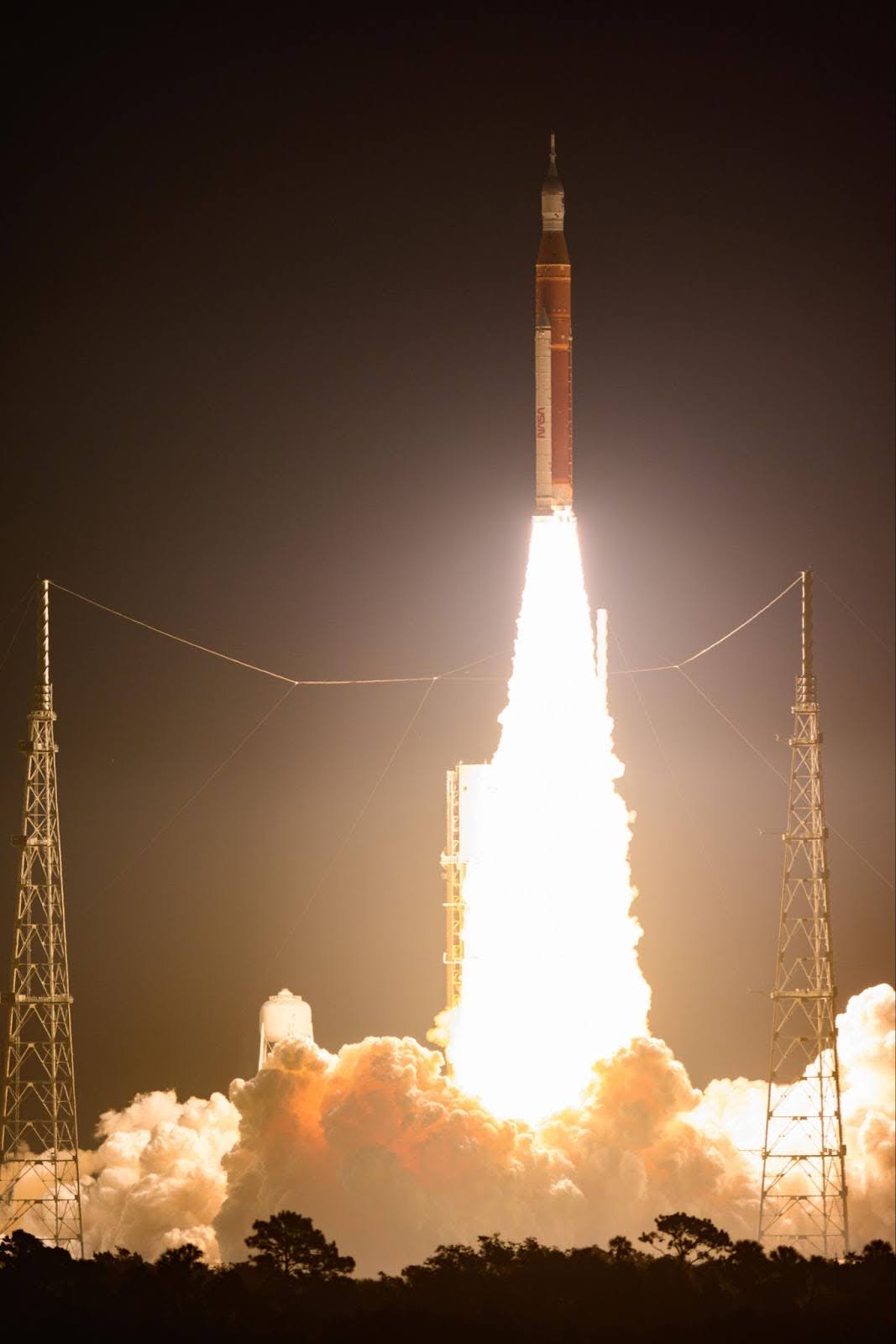
As the calendar flips to 2026, we quickly begin to approach the biggest space mission of the year, arguably one of the biggest of the decade - the launch of NASA’s Artemis II mission! For the first time since 1972, humans will travel beyond Earth's orbit and head to the Moon. Four astronauts, three Americans and one Canadian, will launch from Kennedy Space Center’s historic Launch Complex 39B on the Space Launch System (SLS) rocket. The mission will mark the second in the Artemis program, following the first, which took place in November 2022 with an uncrewed Orion capsule orbiting the Moon for nearly a month. This mission will demonstrate Orion’s capability to carry crew for an extended period of time and serve as the certification flight of Orion ahead of the next mission – Artemis III – which will land on the Moon as early as 2028.
The mission profile for Artemis II involves a multi-day flight that takes Orion around the Moon on a “fly-by” trajectory, using the Moon’s gravity to slingshot around the Moon and return to the Earth without any powered entry into Earth orbit. This will allow the crew to safely visit the Moon and continuously keep abort modes on the table, critical for this mission’s purpose of validating Orion’s crew-carrying capability. Artemis II will also validate modifications made to the ground support equipment to support crew launches, such as the new emergency egress system on the Mobile Launcher (ML) 1. Launching no earlier than February 2026, Artemis II will fly roughly due east out of Kennedy Space Center and first enter into a 24-hour “checkout” orbit that will take the capsule over 40,000 miles away from the Earth. Shortly after, Orion will perform checkouts of its rendezvous capability, manual fly capability, and environmental life support system. After this, assuming all is well, Orion will raise its orbit to intercept the moon in a maneuver known as “Trans Lunar Injection” and head towards the Moon.
Five days later, Orion will enter the lunar sphere of influence and fly around the Moon at a distance of roughly 3,000 miles. From this angle, the Orion crew will observe more of the Moon than ever seen before by astronauts during the Apollo mission, with the north and south polar regions of the Moon visible. They will briefly enter radio blackout as they fly around the far side of the Moon, before sweeping around the far side and heading home. Several days later, Orion will enter the Earth’s atmosphere at a speed of over 25,000 miles per hour, or Mach 32. During re-entry, Orion’s ablative heatshield will experience temperatures nearly 5,000 degrees Fahrenheit before safely splashing down in the Pacific Ocean to be recovered by the US Navy.
The mission's four-person crew consists of NASA astronauts Reid Wiseman (commander), Victor Glover (pilot), and Christina Koch (mission specialist), along with Jeremy Hansen (mission specialist) from the Canadian Space Agency. This team is one of the most well-trained in history, with Wiseman, Glover, and Koch all having prior experience serving as astronauts onboard the International Space Station, and have been in rigorous training since April 2023. Among the crew are several notable firsts – Christina Koch will become the first woman to ever leave Earth orbit, Victor Glover the first African American, and Jeremy Hansen the first non-American to do so.

After the conclusion of this mission, NASA will turn its attention to launching Artemis III. This will be the first mission to actually land on the Moon, scheduled to land in the lunar south pole, not far from Shackleton crater. Two astronauts will descend to the lunar surface on the SpaceX Starship Human Landing System (HLS). This will lead up to efforts including building a permanent lunar base on the Moon, lunar reactors, and other key efforts that will enhance our capability to send astronauts to Mars in the future. Stay tuned for more updates about the Artemis program!
References
National Aeronautics and Space Administration. (n.d.). Artemis II.
https://www.nasa.gov/mission/artemis-ii/
National Aeronautics and Space Administration. (n.d.). Our Artemis crew.
https://www.nasa.gov/feature/our-artemis-crew/
National Aeronautics and Space Administration. (2023, January 27). Artemis II map.
https://www.nasa.gov/image-article/artemis-ii-map-2/
National Aeronautics and Space Administration. (n.d.). NASA’s first flight with crew important step on long-term return to the Moon, missions to Mars.
https://www.nasa.gov/missions/artemis/nasas-first-flight-with-crew-important-step-on-long-term-return-to-the-moon-missions-to-mars/
National Aeronautics and Space Administration. (n.d.). Send your name with Artemis II.
https://www3.nasa.gov/send-your-name-with-artemis/

Learn More
Interested in diving deeper into the world of astronomy? Check out our AstronomyHub for a wealth of articles, guides, local resources for planetariums and observatories near you, and more to enhance your stargazing experience.