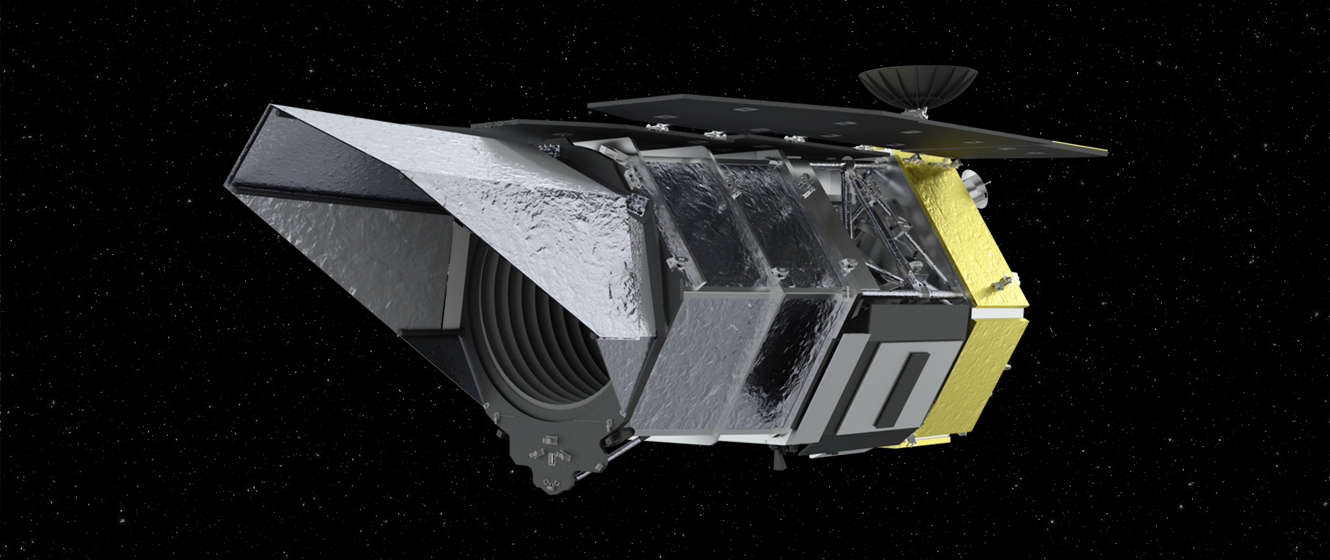
It’s time to get excited about a new space telescope! NASA’s Nancy Grace Roman Space Telescope has been officially announced to launch on August 30th, 2026, from Kennedy Space Center on a SpaceX Falcon Heavy. This new telescope will share an orbit with the James Webb Space Telescope and will help astronomers gather a more complete understanding of the universe in both near-infrared and visible light (similar to the Hubble Space Telescope).
In the past few years, we’ve had so many revolutionary new space technologies that have dramatically changed our understanding of the universe. Most recently, we’ve had the James Webb Space Telescope, a massive near-infrared telescope that has given us an unprecedented glimpse into the universe. But Roman has an ultra-wide field-of-view in comparison to James Webb, giving astronomers the ability to capture more galaxies, stars, and nebulae in a single image. This is primarily due to its much “faster” optics, as the Roman telescope boasts a f/7.9 focal ratio compared to James Webb’s f/20 and Hubble Space Telescope’s f/24.
This ultra-wide field of view (FOV) will help astronomers map dark energy and dark matter more effectively, capturing wide images of the night sky. Roman’s much wider FOV will also allow more exoplanets to be potentially captured at once. In essence, you can think of Roman as a “big picture” telescope that will help astronomers capture large areas of the universe in one go, where James Webb will capture detailed follow-up data of the most interesting Roman discoveries. Used in tandem, the two will bring the most complete image of the universe to date.
What Is the Nancy Grace Roman Space Telescope?
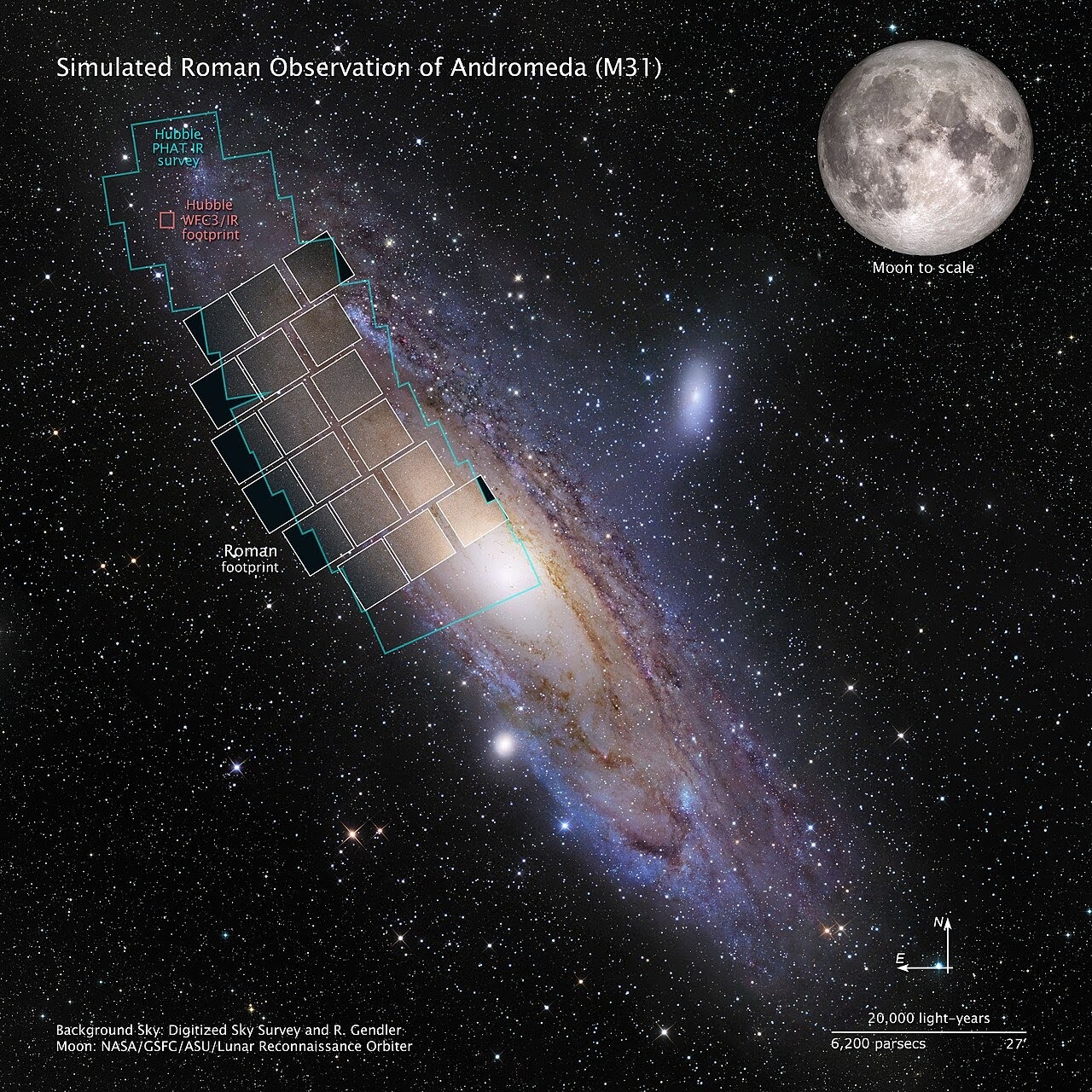 (Simulation showing the massive FOV of the Roman telescope in comparison to imagery from the Hubble Space Telescope’s WFC camera)
Click to Enlarge Image
(Simulation showing the massive FOV of the Roman telescope in comparison to imagery from the Hubble Space Telescope’s WFC camera)
Click to Enlarge Image
NASA’s next major space observatory (formerly the Wide Field Infrared Survey Telescope, or WFIRST) was renamed in 2020 after Dr. Nancy Grace Roman (1925–2018), NASA’s first Chief of Astronomy and widely known as the “mother of the Hubble Space Telescope.” Some key physical characteristics include a primary mirror of 2.4 meters (7.9 feet) in diameter — the same size as Hubble’s. This is owing to the fact that both Roman and Hubble share a common origin story, as both mirrors were created by the National Reconnaissance Office. Additionally, the primary mirror is ~80% lighter than Hubble’s, which reduces the mass of the overall telescope and enables smaller rockets than the Space Shuttle that launched Hubble, such as SpaceX’s Falcon Heavy.
 (Former NASA Chief Dr. Nancy Grace Roman, serving as NASA’s first Chief of Astronomy in the 1960s and 70s, serves as the telescope’s namesake)
Click to Enlarge Image
(Former NASA Chief Dr. Nancy Grace Roman, serving as NASA’s first Chief of Astronomy in the 1960s and 70s, serves as the telescope’s namesake)
Click to Enlarge Image
Roman comes equipped with two main scientific instruments: the Wide Field Instrument (WFI), an ~300 megapixel near-infrared camera for wide-field imaging and slitless spectroscopy, enabling a field of view at least 100 times larger than Hubble’s. And a Coronagraph Instrument technology demonstration for high-contrast direct imaging, blocking starlight to reveal exoplanets and planet-forming disks in both visible and near-infrared wavelengths. Nancy Grace Roman will operate in a quasi-halo orbit around the Sun-Earth L2 Lagrange point, approximately 1 million miles (1.5 million km) from Earth. This is the same exact orbit used by James Webb, and is much more useful for near-infrared imaging, as the Earth’s infrared radiation can disrupt and distort views. Roman is managed by NASA’s Goddard Space Flight Center, with key contributions from NASA’s Jet Propulsion Laboratory (JPL), the Space Telescope Science Institute (STScI), and industry partners including Ball Aerospace and L3Harris.
Why Is the Roman Space Telescope Important?
Roman will help investigate the accelerating expansion of the universe and the nature of dark energy, which is thought to make up more than 60% of the energy of our entire universe. Roman will use gravitational lensing, type Ia supernovae, galaxy clustering, and redshift surveys to map matter distribution and trace how dark energy has evolved over cosmic time. This is why Roman, like JWST, is primarily a “near-infrared” telescope. Light from distant galaxies is generally shifted closer to the infrared region of the electromagnetic spectrum. This is due to the expansion of the universe increasing the further we look out to the edge of time. Roman will enable astronomers to gauge whether dark energy is constant or changing, or whether gravity deviates from general relativity on the largest scales. If so, this may require a new “rewrite” of our understanding of Einstein’s theories.
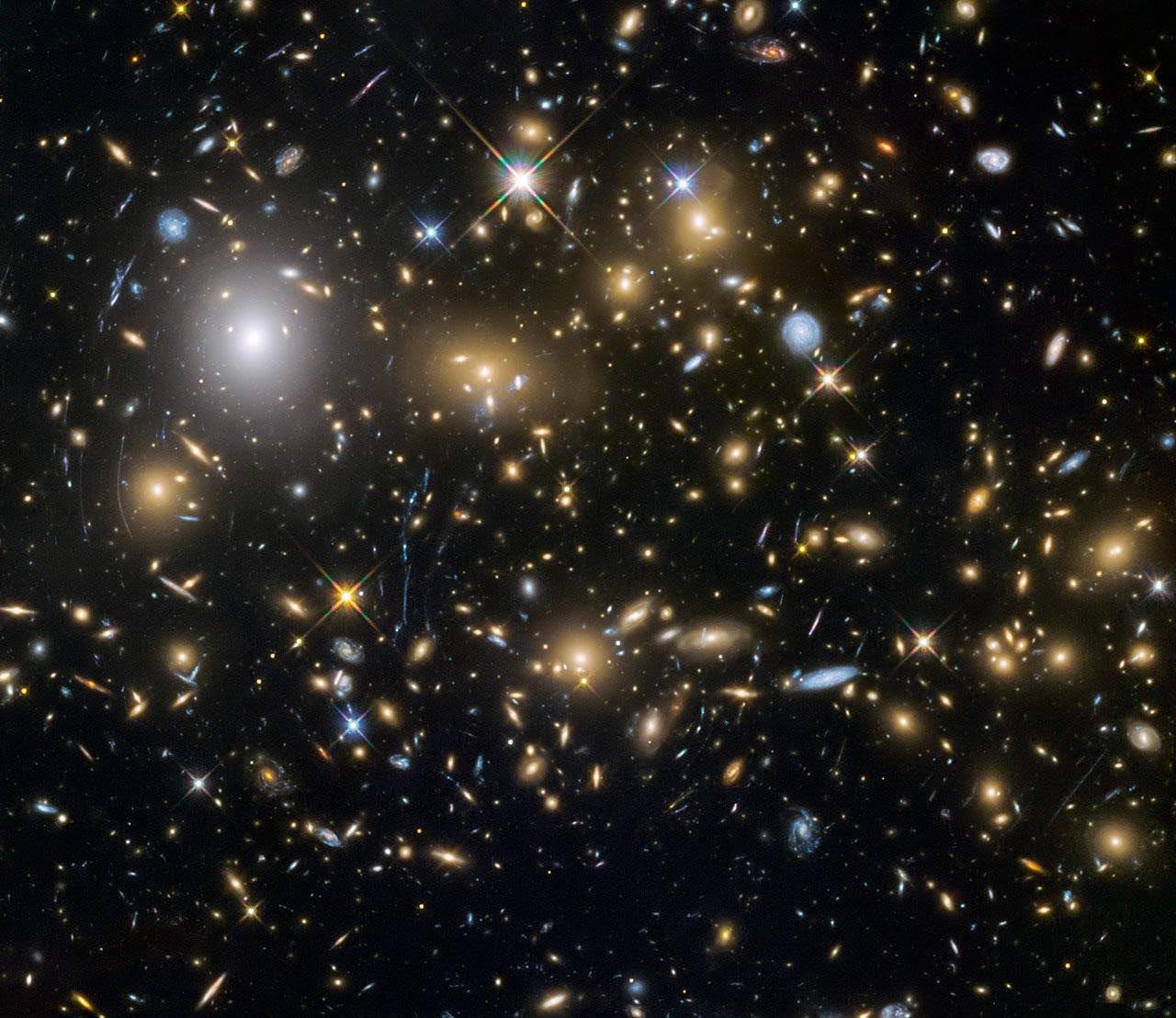 (An ultra-deep field image of gravitational lensing taken by the Hubble Space Telescope. Nancy Grace Roman will be able to provide even deeper insights and a wider field-of-view)
Click to Enlarge Image
(An ultra-deep field image of gravitational lensing taken by the Hubble Space Telescope. Nancy Grace Roman will be able to provide even deeper insights and a wider field-of-view)
Click to Enlarge Image
Additionally, the data Roman collects will provide new key insights into how planets form outside our solar system and aid in the search for habitable planets. The biggest feature will be its ability to directly image extrasolar planets. Most extrasolar planets are found through more indirect detections - either through gravity tugging the parent star, or through transits blocking the light from the parent star. Few extrasolar planets have actually been directly imaged, owing to the fact that stars tend to wash out the light from the relatively dim extrasolar planets. Roman’s new Coronagraph Instrument (CGI) will block the light from the bright stars, revealing potentially new extrasolar planets. This demonstrator will serve as a proof-of-concept for the Habitable Worlds Observatory, which is scheduled to launch in the 2040s. Roman will provide insight into extrasolar planets in both near-infrared and visible. Near-infrared will give astronomers the ability to view hot dust and gases around young stars, known as the “accretion” disk, unlocking key insights into how planets form around stars. Visible light imagery will enable direct color images of planets of all shapes and sizes.
Roman will launch on August 30th, 2026, aboard a SpaceX Falcon Heavy rocket from historic Launch Complex 39A. Roman is scheduled to ship to Kennedy Space Center in a matter of weeks to begin launch processing. When Roman reaches its final orbit, it is planned to operate for roughly 5 years with potential for mission extensions (pending funding and the spacecraft propellant). Stay tuned for launch and be on the lookout for Roman’s awesome images!
Sources
- https://science.nasa.gov/mission/roman-space-telescope/
- https://science.nasa.gov/mission/roman-space-telescope/why-the-roman-space-telescope/
- https://science.nasa.gov/mission/roman-space-telescope/frequently-asked-questions/
- https://science.nasa.gov/blogs/roman/2026/06/03/hello-world-nasa-shares-new-home-for-roman-space-telescope-updates/
- https://www.nasa.gov/missions/roman-space-telescope/nasa-completes-nancy-grace-roman-space-telescope-construction/