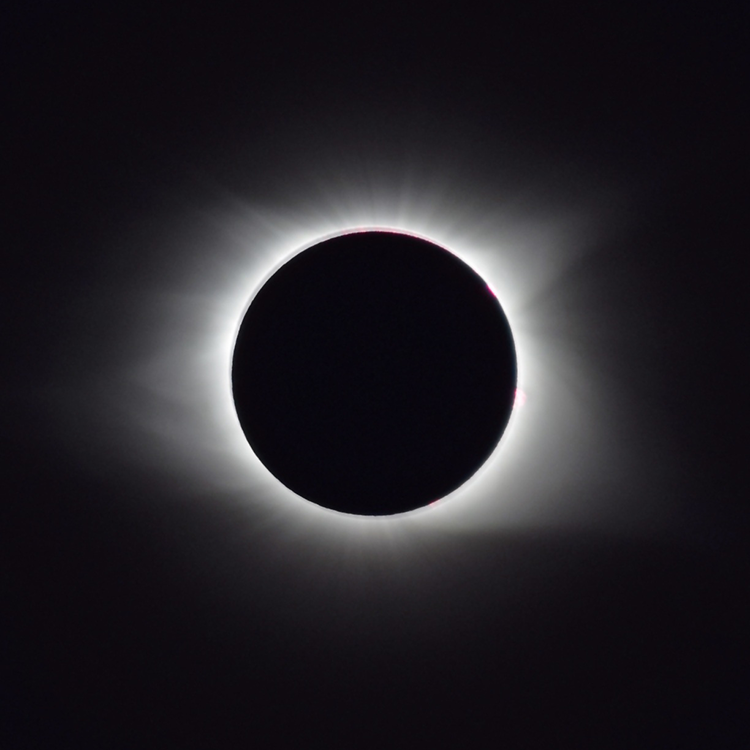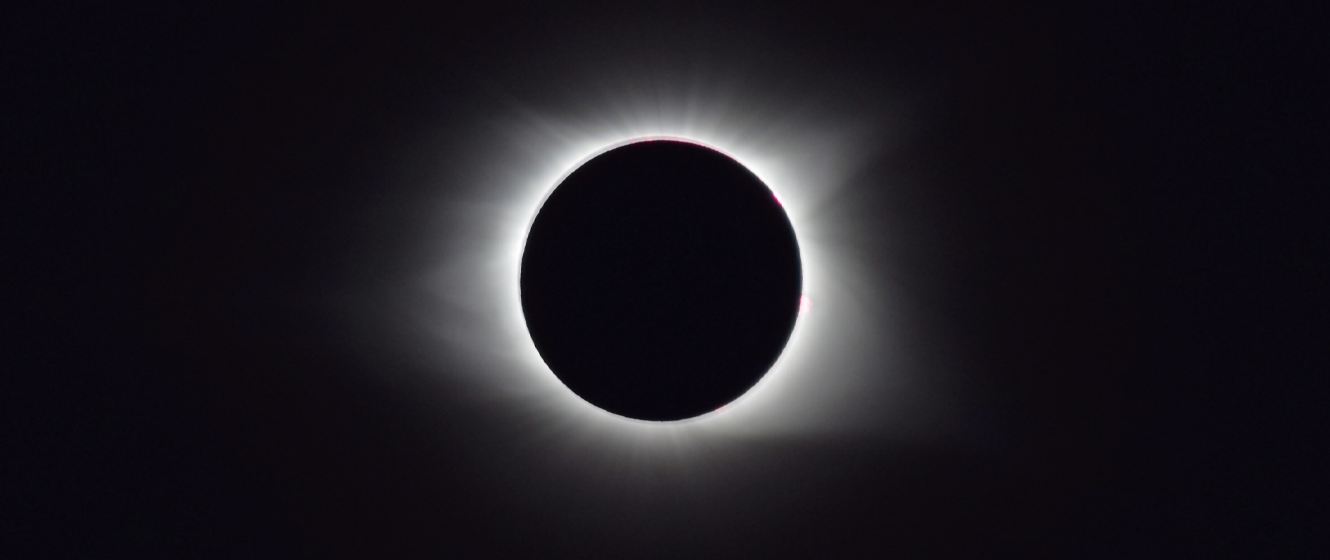
As almost any amateur astronomer will tell you, a total solar eclipse is probably the #1 must-see astronomical phenomenon - and not just for space enthusiasts. Nothing in nature beats the awe and spectacle of watching our own Moon pass in front of the Sun, plunging the landscape into darkness in the process.
(If you’d like to learn more about solar eclipses, check out our collection of dedicated articles here.)
In most cases, totality typically lasts two to three minutes, but on August 2nd, 2027, we’ll be treated to an eclipse with totality potentially lasting an outstanding 6 minutes and 23 seconds. But is this the longest? What are some of the most notable eclipses in history? And where can you see the 2027 eclipse for yourself?
Is the 2027 Eclipse the Longest?
Although totality for the August 2027 eclipse is more than twice the length of most eclipses, it’s not the longest eclipse. In fact, there are plenty that have lasted longer.
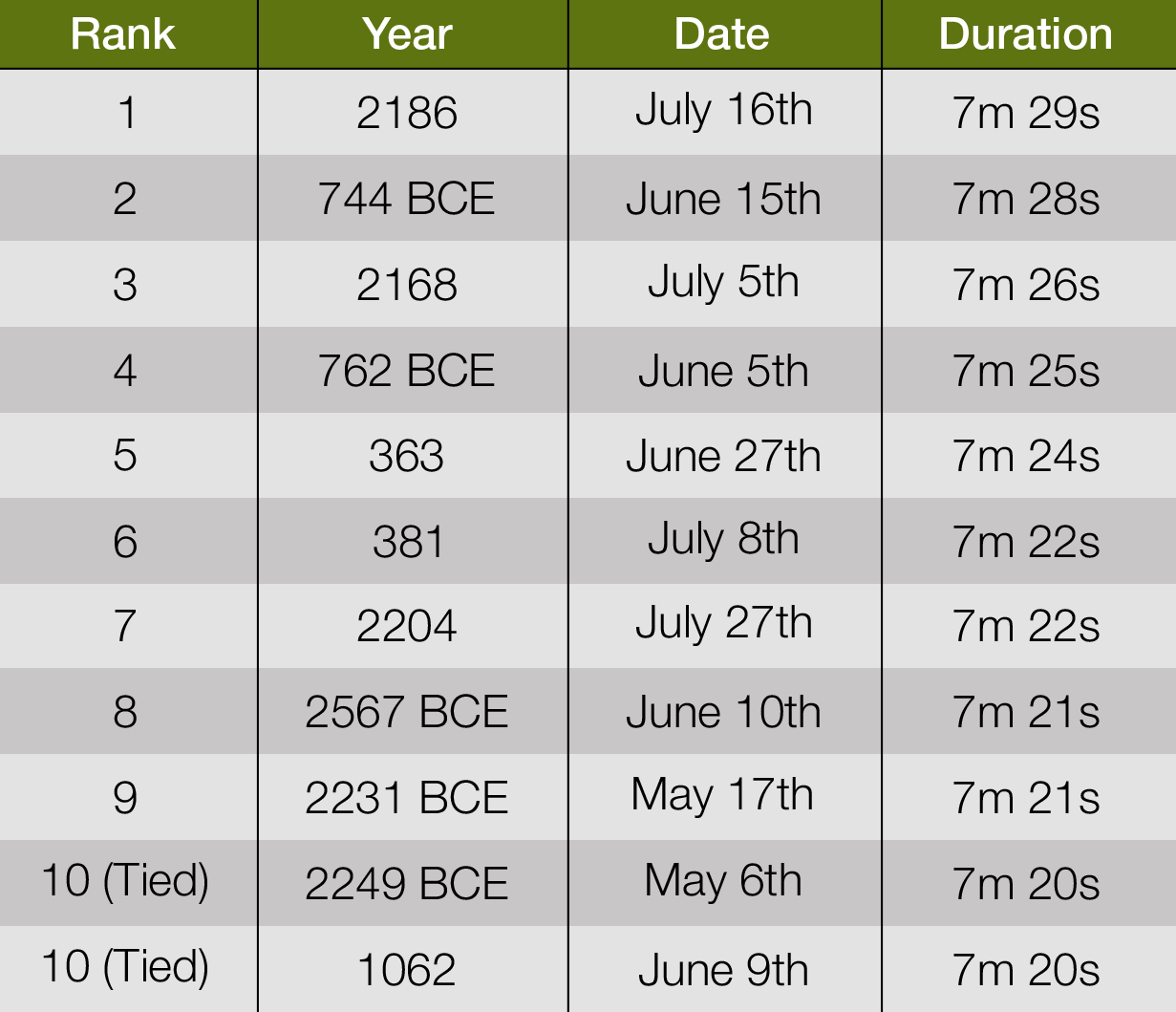
Take a look at NASA’s Eclipse Page, and you’ll find a database of both lunar and solar eclipses spanning five thousand years. That’s a lot of eclipses, but few come close to the theoretical maximum duration of 7 minutes 30 seconds, and none of the top 10 longest occur this century.
In terms of the eclipses this century, the eclipse of July 22nd, 2009 was the longest, with a potential totality of 6 minutes and 39 seconds. The eclipse of 2027 comes in second, just six seconds shorter, while the upcoming eclipse on August 12th, 2045, is predicted to last 6 minutes and 6 seconds.
What Are Some of the Most Notable Eclipses in Recent History?
The Eclipse That Led to the Discovery of Helium
At its greatest duration, the total solar eclipse of August 18th, 1868, lasted about 6 minutes 47 seconds. During that eclipse, the French astronomer Pierre Janssen observed a strange yellow spectral line in the Sun’s chromosphere, which the British solar physicist Norman Lockyer later recognized as evidence of a then-unknown element: helium. Helium is the first and only element discovered in space before it was found on Earth.
The Eclipse That Was Chased Across a Continent
The June 30th, 1973 total solar eclipse had a maximum duration of about 7 minutes 4 seconds - making it impressive by any standards. But what’s truly impressive is that scientists flew aboard the supersonic aircraft Concorde and raced along the Moon’s shadow over Africa. This allowed the Sun to remain eclipsed and extended their view of totality to about 74 minutes, redefining what it means to be an “eclipse chaser” in the process.
The Eclipse That Helped Make Einstein World-Famous
The total solar eclipse of May 29th, 1919, had a maximum totality of about 6 minutes and 51 seconds, and the British astrophysicist Arthur Eddington had one single goal: to test Einstein’s theory that mass (and the gravity that results from it) bends light. As luck would have it, the Sun would be passing across the Hyades star cluster during the eclipse. The theory was that the Sun’s mass would bend the light of the stars, causing them to appear in a slightly different position.
To test the theory, photographs were taken of the cluster at night, months before the eclipse, with the plan to use them as “control” photographs for the experiment. The cluster was photographed again during the eclipse, and when the images were compared, the stars appeared slightly out of place. The Sun’s mass had, indeed, bent their light. The result became the most famous eclipse experiment in history and helped launch Einstein’s general theory of relativity into public fame.
The Eclipse That Only Four People Saw
While all these eclipses are notable, none of them compares to (arguably) the greatest eclipse in modern history. The Artemis II lunar mission was full of firsts and memorable events, with one highlight being the eclipse of the Sun that the four astronauts witnessed shortly after making their closest approach to the Moon on April 6th, 2026.
At that time, at an altitude of approximately 4,000 miles above its surface, the Moon appeared roughly the same size as a basketball held at arm’s length, making this the first time humans had seen the whole of the Moon from the dark side. (The Apollo astronauts flew over the Moon at an altitude of 60 to 70 miles, so they only saw the dark side close up.)
As the astronauts passed around the Moon, the Moon passed in front of the Sun, giving the crew the opportunity to witness a solar eclipse lasting almost 54 minutes. During the eclipse, the crew was lucky enough to spot the planets Venus, Mars, and Saturn, flashes resulting from meteoroids striking the lunar surface, an eerie halo surrounding the Moon, and the dark side faintly illuminated by reflected light from the Earth.
Where To See the August 2027 Total Solar Eclipse
The total solar eclipse of August 2nd, 2027 may not be the longest in history, or even the longest this century, but few eclipses combine so many advantages. Lasting up to 6 minutes 23 seconds at maximum, and crossing populated regions of Spain, North Africa, and the Middle East, it will cut a path of totality home to more than 85 million people, making it one of the most accessible long-duration eclipses in modern times.
The eclipse path starts in the mid-Northern Atlantic, with Tangier and Gibraltar among the first locations to experience totality. The path skims across northern Morocco, Algeria, Tunisia, and Libya before passing through Egypt, from the northwest to the southeast.
Greatest eclipse occurs just southeast of Luxor, the location of ancient Thebes and home of the monumental temple of Karnak and the royal tombs of the Valley of the Kings. If you’re looking for a once-in-a-lifetime spectacle, this is truly it.
The path then crosses the Red Sea, skims the southwestern coast of Saudi Arabia, and passes through Yemen from the northwest to southeast before finally clipping the northeastern edge of Ethiopia. It ends in the Indian Ocean, to the southeast of Sri Lanka and India, and to the southwest of Indonesia. You can find some of the top locations and timings for the key events below.
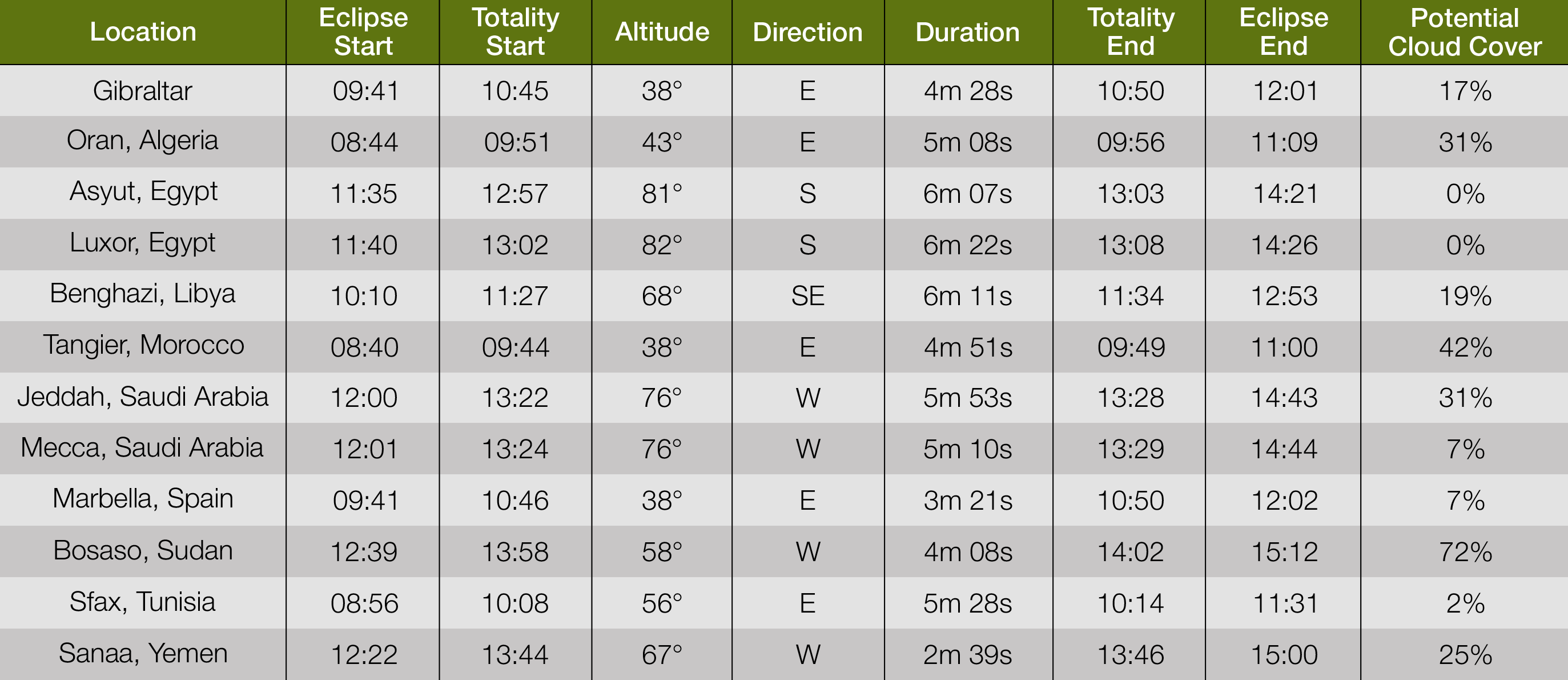
If all this data leaves you feeling a bit overwhelmed, here are the same locations ranked, based on the duration of totality and predicted cloud cover:
1. Luxor, Egypt
2. Asyut, Egypt
3. Sfax, Tunisia
4. Benghazi, Libya
5. Mecca, Saudi Arabia
6. Jeddah, Saudi Arabia
7. Gibraltar
8. Marbella, Spain
9. Oran, Algeria
10. Tangier, Morocco
11. Sanaa, Yemen
12. Bosasso, Sudan
Obviously, then, Luxor is the place to be. With 6 minutes 22 seconds of totality and little or no chance of clouds - not to mention the outstanding historical backdrop of ancient Egypt - nothing else compares. The bad news? This will also be the most crowded, as everyone will want to be here for this unmissable event.
Other options include Asyut, also in Egypt, with many towns and cities along the Nile also being a good bet. However, be aware that not every location may have the infrastructure in place to cater to tourists. Saudi Arabia may also be a good choice.
Gibraltar is perhaps the one location that might seem like a deceptively good option; it can be accessed from mainland Spain by either car or on foot, and its long totality and low cloud cover might seem appealing. Unfortunately, its tiny land area - just 2.6 square miles (6.8 square kilometers) could result in it being overcrowded, to say the least.
It’s also a territory of the United Kingdom, so if you want to travel between Gibraltar and Spain, you’ll need to have your passport with you!
Wherever you happen to be during totality, be sure to take a moment to notice the stars and planets. With the Sun in Cancer, you’ll find brilliant Venus just under three degrees to its right, with Mercury another seven degrees further along. Meanwhile, Jupiter will shine some way to its left - but can you see Regulus beside it?
Regardless of whether you find yourself amidst the ancient ruins of Luxor or tucked away in a more remote corner of the shadow's path, the 2027 eclipse is set to be a unique, once-in-a-lifetime astronomical spectacle.