Definitions for Over 300 Astronomy Terms!
Astronomy is an incredibly rewarding hobby. Whether it be finally seeing your favorite planet through the lens of a telescope or putting together a complicated astrophotography set up to take breathtaking images, there is a lot to love about astronomy and the universe beyond our planet. Just like the vast expanse of space, there is a vast amount of information and terms in the topic of astronomy. Those terms might be are based on scientific principles, gear needed to help you view or image celestial objects, or general photography terms needed for astro-imaging. Here at High Point Scientific, we are committed to providing amateur astronomers with the tools they need to fully embrace the hobby. With that mission in mind, we have put together a glossary of common and not-so-common terms you might come across during your adventures through the night sky.
Don't see the term you're looking for? Check back, as there may be a good chance we will add that term at a later date.
Navigation Menu
Numbers
#-Element (i.e. 2-element, 3-element, etc.)
When a refractor is described as having a 2-element, 3-element, 4-element, etc. optical design, that dictates the number of lenses within the refracting telescope. The number of elements also dictates how that refractor is classified: 2-element refractors are doublets, 3-element refractors are triplets, 4-element refractors are quadruplets, and so on.
1.25"/2" diameter
Typically these are used to describe eyepieces, referring to the outside diameter of the barrel that is inserted into the focuser or diagonal for visual astronomy. However as some astrophotography setups do use/reuse some of the same connections, this is seen in some astrophotography accessories, most notably nosepieces.
500 Rule
In astrophotography, the 500 rule refers to how long of an exposure you can have when taking a non-tracking photo with a camera on a tripod. Any longer of an exposure and the stars will begin to trail. To find this exposure length, you will need to divide 500 by the focal length of your lens. For example, if you have a 35 mm focal length for your wide angle lens, then you would do the following: 500/35 = 14.28 seconds of exposure.

A
Abbe Number / Abbe Value / V-Number
The Abbe number or V-number is a numerical value representing the measured amount of light dispersed into different wavelengths through a transparent material. High values of V indicate low dispersion and higher quality of optics. This term was coined by German professor of physics, mechanics, and mathematics, Ernst Abbe (1840 - 1905).
Absolute Magnitude
The measure of brightness or luminosity of a celestial object as observed from a distance of ten parsecs.
Absolute Zero
Defined as 0° Kelvin and equivalent to -459.67° Fahrenheit and -273.15° Celsius, absolute zero is considered the lowest theoretical temperature. While our current scientific models suggest it is impossible for a system to reach absolute zero, scientists have briefly approached this temperature within controlled settings, coming as close as thirty-eight trillionths of a degree of 0° K.
Absorption Line / Absorption Spectrum
The absorption spectrum consists of the dark(er) lines on a continuous spectrum. These lines are caused when an electron in a lower energy state moves to a higher energy state and the required photo from an outside source of energy is extracted.
Accelerometer
An accelerometer is a device that measures the rate of change in the velocity of an object, allowing it to track movement and orientation.
Accretion
Accretion occurs when there is an accumulation of particles into a massive celestial object through gravitational pull. This is typically gaseous matter. Most celestial objects like galaxies, stars, and planets are formed by this process.
Accretion Disk
An accretion disk is a flattened, circular or elliptical flow of gas, plasma, dust, or other particles orbiting in the gravitational field around a celestial object, most often a star.
Achromatic / Achromat
This describes a type of lens system in telescopes that use two lenses (elements), made of different glass to bend light individually, and then merge the light together.
Advanced Coma-Free (ACF) Telescope
This type of telescope is a proprietary design from Meade Instruments. Based on the SCT, ACF telescopes improve image quality for those looking to do astrophotography. These telescopes work by eliminating a problem called coma using a hyperbolic secondary mirror.
Afocal
This term is used to describe optical systems that has no finite focal point of convergence of light beams.
Airy Disk
An Airy disk is a type of diffraction pattern that occurs when light passes through any size aperture. The pattern is made up of a bright, central spot with rings around it, that decrease in brightness as they move away from the center.
Albedo
Albedo is the measure of how a surface reflects light, particularly sunlight. This measurement is presented through a fraction, and that formula is the following: albedo = reflected light / incoming light. This calculation impacts global climate and weather patterns. An excellent example to illustrate albedo is to compare a white surface and black surface that is sitting in the Sun. The black surface will be hotter because it absorbs the solar radiation, while the white surface, with the higher albedo, reflects the solar radiation.
Alignment
In astronomy, alignment can be referring to two different concepts. The first is known as planetary alignment, which describes the apparent proximity of at least two planets, as observed from Earth. The second concept is the precise positioning of optics to allow light through and create the best possible image.
All-Star Polar Alignment
All-Star Polar alignment is an innovation from Celestron that allows you to polar align your mount with the Celestron NexStar hand controller. As opposed to other polar alignment methods, this approach does not require a clear view of the north or south celestial pole, allowing you to set up almost anywhere even in the presence of large obstructions. The process is simple: once you have successfully star aligned your mount, slew to a bright star from the hand controller’s database. Next, press the Align button on the hand controller, then “Polar Align”, then “Align Mount”. Your mount will then re-slew to this star, and prompt you to center it within the eyepiece or camera. Next, the mount will position this star in the exact location it should be if your mount was properly polar aligned. Finally, adjust the altitude and azimuth knobs in your mount to re-center this star, and press enter. Your telescope mount is now accurately aligned with Earth’s axis of rotation!
Alpha Centauri
Located in the southern part of the constellation, Centaurus, Alpha Centauri is the closest star system to ours and consists of three stars: Alpha Centauri A, Alpha Centauri B, and Proxima Centauri.
Altitude
In astronomy, altitude is the angular distance of a celestial object from a person's observable horizon. It is measured in degrees.
Altitude-Azimuth (Alt-azimuth, Alt-az) Mount
Commonly referred to as Alt-Az mounts, this type of mount rotates in two perpendicular axes: left/right and up/down. The altitude axis alters the elevation angle while the azimuth axis alters the compass bearing angle. The two of these combined allow for a pointing to any location in the sky. As opposed to equatorial mount, these Alt-Az mounts don’t require alignment with the celestial pole, making it easy for beginners to utilize.
Amateur Astronomer
An amateur astronomer is a person you observes or studies the night sky and astronomy as a hobby, rather than having it as their profession.
Amperage / Amps
Amperage (amps) is the measurement of the rate in which electricity moves through a circuit.
Amplifier Glow / Amp Glow
Amp glow is a glow seen in images that is generated by the camera, often a result of the heat from readout circuitry.
Angstrom
The Angstrom is a unit of measurement, named after Anders Jonas Ångström. It is denoted by the Å symbol, and is equal to 0.1 nanometers (0.00000000001 meters). Classically the Angstrom has been used to quantify spectral lines, such as those important to astronomy like H-alpha, OIII, and SII. Currently the nanometer (nm) is the more common unit used for most applications, however the Angstrom is still prevalent when discussing solar viewing equipment such as the Etalons used in dedicated solar telescopes. It is easy to convert between the two by moving the decimal place one place. For example, Ha’s emission line can be expressed as 656.46 nm or 6,564.6 Å.
Angular Diameter / Angular Size / Apparent Size
Astronomers use angles to measure the apparent size of celestial objects from the point of view of the observer. This size is dependent on the observer, and can vary depending on the observers location.
Angular Distance
Angular distance is the measurement of the distance between celestial objects, measured in degrees.
Angular Resolution
Angular resolution refers to an imagers ability to distinguish the distance between two objects with a small angular distance and, ultimately, the ability to distinguish small details of the object being imaged.
Annual Parallax
Annual parallax is the phenomenon of celestial objects appearing to move on ellipses in the night sky throughout the course of one year. As Earth travels around the Sun, an observers perspective changes, and this creates an apparent shift in the position of nearer celestial objects when compared to the farther away objects.
Annular Eclipse
“Annulus” refers to a ring shaped object, and is where the Annular Eclipse gets its name. As the Moon has an elliptical orbit around the Earth, it is not always the same distance away. An annular solar eclipse occurs when the Moon is at or near its farthest point from the Earth, making it appear smaller in the sky. Due to this, when the moon passes in front of the Sun it does not block it as entirely resulting in a thicker ring around the Moon than what is visible in a total eclipse. While still rare, this type of eclipse is more frequent than a total solar eclipse.
Antimatter
Antimatter is a substance made up entirely of subatomic particles that have the opposite electrical charge of regular subatomic particles. Matter and antimatter cannot exist in the same space, as they will collide and release energy as they destroy each other. Antimatter is made of antineutrons, antiprotons, and positrons, and are collectively called antiparticles.
Aperture
Aperture is the diameter of a telescope's primary mirror or lens listed in millimeters or inches. The bigger the aperture of a telescope, the more light it will gather, allowing the observer to see more detail on celestial objects and ascertain finer details that a telescope of lesser aperture may not see.
Apochromatic
Commonly known by the abbreviation, APO, apochromatic refers to an optical design that corrects for chromatic aberrations. Apochromats merge three color wavelengths into a single image plane to correct for chromatic aberrations and two wavelengths for spherical aberrations.
Apparent Field of View (AFoV)
Also referred to as AFOV, apparent field of view is observable angle of the area viewed through optics (measured in degrees). The larger the AFOV degree, the bigger the field of view.
Apparent Magnitude
Apparent magnitude refers to the brightness of a celestial object as it appears to the person observing on Earth. For example, the Sun has an apparent magnitude of -26.7. The lower the magnitude, the brighter the object appears.
Arc Minute
An arc minute is a unit of measurement that denotes the angular size of an object within our night sky. There are 60 arc minutes within a degree of the night sky, and 60 arc seconds within an arc minute. For instance, the Moon is 31 arc minutes in apparent size, and therefore approximately 0.5 degrees.
Arc Second
An arc second is a unit of measurement that denotes the angular size of an object within our night sky. There are 60 arc seconds within an arc minute, and 60 arc minutes within a degree. For instance, the Moon has an apparent size of 1860 arc seconds, 31 arc minutes, and about 1/2 a degree.
Arca-Swiss
Arca-Swiss refers to a quick-release dovetail style most often used with photography equipment. The mechanism consists of two pieces: the plate and the clamp. The plate, designed in the Arca-style, has a width of 35 mm and a 45° dovetail. The length varies. The clamp operates as a mounting base that generally connects to tripod heads.
Artefact
An artefact, also spelled artifact, is a visible distortion or anomaly found in an image. This artefact was not present in what was originally imaged. It can be caused by image processing, lighting, or camera malfunction.
ASCOM
ASCOM is an acronym for Astronomy Common Object Model. ASCOM works as a liaison between different astronomy software (apps and programs) and hardware (physical devices). Considered universal, ASCOM aims to allow different types of astronomy equipment, no matter the brand or manufacturer, to seamlessly communicate.
Asterism
An asterism is an identified star pattern, but they are not constellations. Asterisms can be part of a constellation. An example of this can be seen with the Big Dipper. The Big Dipper is an asterism that is in the larger constellation called Ursa Major.
Asteroid
Asteroids are small rocky bodies that orbit the Sun. Asteroids are smaller than planets. They typically measure less than 600 miles in diameter. Asteroids are remnants of the formation of the solar system, and they are typically found between Mars and Jupiter. Asteroids vary in size and composition.
Astigmatism
When used in astronomy, astigmatism refers to an optical, off-axis, symmetrical aberration. Astigmatism occurs when the two planes in an optical system have a difference of optical power and two focal surfaces are created. This prevents the light from an object to meet at single focal point.
Astrobiology / Xenology / Exobiology
Astrobiology is the study of life in the universe, particularly the origins, evolution, distribution, and potential for life beyond Earth. This field of study is considered interdisciplinary and looks at astronomy, biology, chemistry, and physics.
Astrogeology / Planetary Geology / Exogeology
Astrogeology is a subset of geology, and focuses on the study of solid bodies in the solar system . This includes, but is not limited to asteroids, planets, and moons.
Astrograph
An astrograph is a telescope designed specifically for astrophotography. They are often used as tools to map the sky, but they are also used recreationally by hobbyists.
Astrometry
Astrometry is the measure of the position, size, and movements of stars and other celestial bodies. These measurements are made relative to an astronomical coordinate system.
Astronomer
An astronomer is someone who studies the scientific field of astronomy, most often for professional or educational purposes.
Astronomical Unit (AU)
An astronomical unit refers to the average distance between Earth and the Sun. This averages out to be about 93 million miles (150 million km). This unit of measure is typically used to mark the distances between objects within our solar system.
Astronomy
Astronomy is the scientific study of space and the celestial objects within it. It also deals with the physical universe as a whole. Astronomy can be broken up into four subcategories: astrophysics, astrometry, astrogeology, and astrobiology. The study of astronomy has helped measure time, seasons, and navigation on Earth.
Astrophotography
This refers to photography of astronomical bodies and phenomena. astrophotography is not new, for example the popular T threading still used today harkens from Tamron’s T-mount developed for their 35 mm cameras - however it has seen a notable increase in popularity with improvements in cameras, mounts, filters, and software making astrophotography much more accessible. This is not limited to celestial bodies such as nebulae, planets, or galaxies either, as solar imaging is now more within the reach of the average consumer than ever before.
Astrophysics
Astrophysics is a subset of space science that studies the physical nature of celestial bodies and how the fundamentals of physics apply to observations of the night sky.
Atmosphere
An atmosphere is a composition of various gases that surround a planet. The Earth's atmosphere, for example, is composed of 21% oxygen and 78% nitrogen with the remaining one percent made up of other gases.
Aurora
Aurora is the name of the Roman goddess of the dawn. It also refers to a phenomenon consisting of ribbons and arches of colored light that appear in the magnetic polar regions of Earth's upper atmosphere. This phenomenon is caused light emitted from electrons accelerated along Earth's magnetic field lines.
Auto-Focus
Automatic focusing utilizes software to shift the focus of a telescope in and out to determine the precise focal point of the optics. It does this by reading the star size at each focus point, creating a graph of this data, then finds the minimum star size; bringing the optics into sharp focus.
Autoguiding
Autoguiding is a process which utilizes a smaller telescope, referred to as a guide scope, and an additional camera sensor, known as a guide camera, to assist your mount in its tracking precision. Alternatively, this can be achieved using an Off-Axis Guider (OAG), which is fitted within your primary imaging train. An OAG uses the light captured by your telescope and sends it to your guide camera via an internal prism. So, how does autoguiding actually work? Your guide camera will take a constant series of short exposures (typically 1-3 seconds each) that will then be analyzed by software. After the software selects the best guide star(s) to guide upon, the goal is to keep these stars as steady as possible from frame to frame. If there is a discrepancy in the positioning of the stars, the guiding software will communicate with the mount to make small adjustments to fix these tracking errors. While it may not be necessary for short exposure astrophotography, such as planetary, lunar, or solar, autoguiding is highly beneficial for long exposure astrophotography.
Autonomous Field Detection
Available with the smart telescope models by UniStellar, this setting allows for a fully automated alignment procedure in minutes. It works by comparing what the integrated camera sees in its field of view with its internal map of the coordinates of tens of millions of stars. This process helps the eVscope 2, eVscope eQuinox 2, Odyssey, and Odyssey Pro determine exactly where it is orientated, providing precise Go-To capabilities as well as tracking accuracy.
Azimuth
Azimuth is the angle between an object in the night sky and North. This angle is measured clockwise around the horizon of the observer.
B
Backfocus
Also called backfocal Distance or backspacing, all optical systems have a point at which an in-focus image is formed, and for astrophotography it is at this location that the camera sensor should be placed. When the telescope is used without corrective elements, this is done easily with the focuser mechanism; and so long as an image can be brought into focus, optimal optical performance will be achieved. However with corrective elements, oftentimes there is a certain distance that the camera sensor needs to be placed away from the rear of the corrector for optimal performance. This will be listed as the backspacing or backfocal distance for the corrective element.
Backlash
In a geared system, such as a telescope mount or an electronic focuser, backlash is the minimal space or "play" between the gear and the tooth that prevents gear binding. While space between the gear and tooth are necessary for smooth motion, this small space can cause very slight delays during directional changes.
Backlit
Also called Back-Side Illuminated or Back-Illuminated (BSI). A backlit or back-illuminated sensor is a type of digital camera sensor that places all of the wiring and circuitry for electronic signals behind the sensor. BSI sensors increase image quality in low-light conditions because the position of the wiring and circuitry prevents illumination loss.
Backyard Observatory / Home Observatory
A backyard observatory is a dedicated structure built on someone's residential property that is dedicated to visual observations or astrophotography. It often includes permanent structures and gear, such as a pier and a classic observatory dome.
Baffling
Baffling is a type of technique used in optical design that helps prevent unwanted/stray light from reaching an eyepiece or camera sensor. It is often done using rings on the inside of the optical tube.
Bahtinov Mask
A Bahtinov mask is a tool that aids the user in finding optimal focus and was created by Russian astrophotographer Pavel Bahtinov in 2005. This type of focusing aid creates 3 diffraction spikes over a bright star within the field of view. While adjusting the focus knob, the point in which the three lines intersect perfectly over the star result in perfect focus. This tool is widely used by astrophotographers worldwide and creates an effortless focusing routine.
Baily's Beads
This is the name for a visual phenomena that occurs during an eclipse, where dots or "beads" appear around the Moon. Due to the Moon being home to mountains and craters just like Earth, the outer edge of it is not a smooth circle but instead full of peaks and valleys. As a result when the Moon passes in front of the Sun these structures create sections where more or less Sun can shine through, forming the distinct beads.
BAK-4
BAK-4 refers to BAK-4 prisms, which is an optical glass called Barium Krownate. This particular type of glass is high-quality, high-density, and has a refractive index of 1.568. These prisms are considered high quality than the BAK-7 prisms, and result in a brighter and clearer image.
BAK-7
BAK-7 or BAK-7 prisms are the most common and cost-effective type of optical glass used in binoculars and telescopes. This glass has a lower refractive index than BAK-4 at 1.5168. This means the images are dimmer and there can be more distortion, particularly at the edges of the field of view.
Bandpass
Bandpass is a filter property the describes a specific range of frequencies the filter lets pass through. Any frequencies not in that range are blocked.
Bandwidth
Bandwidth, when being applied to astronomy, is the width of a range of frequencies between the half way point up the curve and half way down the curve of a signal.
Barlow
Named after Peter Barlow, a Barlow is telescope accessory that will increase the magnification of your eyepiece, most often by 2x or 3x, and won't change the eye relief. Placed in the focuser tube, it will increase the effective focal length of the telescope in order to provide that increase in magnification.
Barrel
The barrel is a part of accessories like eyepieces and Barlows that is inserted into other parts of your telescope set up. For example, an eyepiece barrel is inserted into the focus tube on the telescope.
Barrel Diameter
The diameter of the eyepiece, typically expressed in inches. The most popular telescope barrel sizes are 1.25” and 2”. Regardless of their diameter, most eyepieces are interchangeable with the aid of an adapter.
Bias Frame
Bias frames are to try and capture just the noise inherent to the camera sensor, so you take them at as fast an exposure time as possible. Whether or not the camera is connected would be irrelevant, as again we're just attempting to profile the camera at this point.
Binary Star
A binary star describes a star system where a pair of stars orbit around a common center of mass, also known as the barycenter.
Binoculars
Binoculars are an optical instrument that utilizes two lenses, one per eye, to view distant objects.
Binoviewer
A binoviewer is a telescope accessory that will allow the user to use two eyes (using matching eyepieces) instead of a singular eyepiece. In a sense, it's an adapter that splits the optical path into two eyepieces (either splitting the view or keeping the view consistent between the eyepieces, depending on the type of binoviewer) to make viewing easier for those who would rather use both their eyes.
Bit / Bit Depth
A unit of information used when processing data. Bit depth describes the possible color range available. Higher bit depths provides a larger color range, which in turn provides smoother gradients betweem colors.
Black Hole
A black hole is a powerful celestial object created when a super massive star reaches a critical stage in its lifecycle and can no longer sustain the fusion reaction taking place in its core. Unlike less massive stars, such as our Sun, when a super massive star reaches this critical threshold, the star begins collapse under it's own gravitational pull. The resulting "black hole" produces a gravitational pull so strong that almost nothing can escape, not even light.
Blackbody
A blackbody is a theoretical physical body that will absorb all electromagnetic radiation it receives. This means it will not reflect light and light cannot pass through it. Blackbody radiation is the radiation this object would emit, a continuous spectrum of energy across all wavelengths. The intensity of this emission depends on the blackbody's temperature.
Blocking Filter
Blocking filters are used in dedicated solar telescopes to reject all remaining light outside of the H-alpha wavelength. This is necessary as etalons pass harmonics of the desired wavelength. Luckily however these harmonics are far enough apart that while the filter in a blocking filter has a relatively speaking large bandpass, compared to that of an etalon, it can block them while still providing a clear view of the H-alpha light.
Blood Moon
A Blood Moon is another name for a total lunar eclipse. Due to the phenomenon where the Moon appears to be a shade of red as the shadow of the Earth covers the Moon.
Blue Filter
Blue filters are an accessory meant to enhance your visual observations. #80A is common filter and helps bring out details of the cloud belts of Jupiter. Deeper blues, like the #50 can help enhance the Great Red Spot.
Blue Moon
A Blue Moon is a rare occasion when there is a second full moon in a single month. It can also be used to describe a third full moon in a season that has four full moons.
Blueshift
Blueshift is used to help astronomers figure out how far an object is from Earth. It is the observable change in frequency of a light wave when an object is moving toward Earth.
Bluetooth
Bluetooth devices contain certain hardware that allows transmission of data via an antenna. The discoverable device sends out signals that are then detected by the receiving device, and their connection allows a transfer of information. This association between devices is called a piconet, where short radio waves are communicated back and forth.
Bolt Case
A bolt case is a style of case most often used for eyepieces. It's often made of durable plastic and comes with a secure locking mechanism. It is used to protect and store the accessories, either when just in storage or being transported.
Bore Size
Bore size is the internal diameter of a cylindrical hole. In astronomy, this is most often applicable with matching up counterweight shafts/bars with a compatible counterweight.
Bortle Scale
The Bortle scale measures how light polluted a particular area is, and classifies the level of brightness from 1 to 9, with 9 being the brightest. This scale is incredibly helpful for astronomers, as the darker the sky, the more celestial objects are able to be discerned.
Broadband
Broadband targets are like reflection nebulae, galaxies, and star clusters that emit light in a broad range of spectra. If it's a broadband filter, then it's good for those types of targets. Unlike narrowband imaging that focuses on particular light emissions given off by the emission nebulae that emit those wavelengths
Brown Dwarf
A brown dwarf is a celestial object that is too big to be a planet, but too small to become a star. They are generally 13 to 75 times the size of Jupiter, but not large enough to reach stable luminosity due to hydrogen fusion.
Bubble Nebula
Located 8,000 light-years away, the Bubble Nebula (also called NGC 7635, Sharpless 162, and Caldwell 11) is an emission nebula in the constellation, Cassiopeia. The bubble shape in which it was named after was formed from stellar wind caused by SAO 20575, an extremely hot central star. The diameter of the bubble in the middle of the molecular cloud measures about 10 light-years.
C
C-Mount / C-Adapter / CS Adapter
A C-Mount adapter is a a lens mounting standard traditionally found on small camera devices such as CCTV cameras and legacy devices such as 8 mm motion film cameras, with a flange distance of 17.526 mm (or 12.526 mm in the related CS-Mount). In astrophotography C-Mount lenses are often seen with 'All Sky Lenses', so called because of their wide field of view.
CAF2 Glass
Short for calcium fluoride, CAF2 glass gives a low index of refraction and high-transmission from 200-7000nm wavelengths. It is a softer optical glass and can be more susceptible to scratches when compared to other types of glass.
Calibration Frames
Calibration frames are types of images that are applied to light frames to remove unwanted artifacts caused by a number of different factors. Dark frames are images taken at the same temperature as the light frames, and are necessary to remove hot pixels or other fixed noise for a cleaner image. Bias frames are similar in this aspect, though their purpose is to reduce the sensor’s readout noise seen within the light frames. Another type of calibration frame are flat frames, which remove dust motes or unwanted gradients for a uniform, even field.
Camera Rotator
A camera rotator is fitted onto the back of the telescope and allows the user to rotate their imaging equipment to find the desired photographic angle. These devices can either come manually operated or electronically operated. Electronic camera rotators are extremely beneficial for creating mosaics of the night sky, as they help you achieve precise camera orientation.
Carbon Fiber
Carbon fiber is a material that is composed of carbon atoms within a crystalline orientation. It is known for its incredible strength comparable to steel, though weighs much less (5x less to be exact). Because of this, the use of carbon fiber is highly beneficial in the realm of astrophotography, as this material provides a strong, yet lightweight, base for telescope and tripod construction.
Carbon Star
A carbon star, also called C-type star, is an evolved red giant star that generally has a temperature lower than 4,000 Kelvin. They have a high level of carbon molecules in their atmosphere.
Catadioptric
A catadioptric design is a combination of both refractive and reflective elements. Due to the combination of optical elements, the optical path is able to be folded, which provides bigger aperture in shorter optical tube assemblies, making them more portable than either a reflector or refractor in the same size class.
CCD
CCD is an acronym for Charge-Coupled Device. This term is used to describe a particular type of image sensor in cameras. This type of sensor that converts that light (photons) into electrical charges which are then processed into electronic signals that form an image. When compared to CMOS sensors, CCD sensors were more popular and seen as superior, though advancements in CMOS technology is changing that trend.
Celestial Coordinates
Celestial Coordinates are part of a coordinate system used by astronomers to locate objects on the celestial sphere. The spherical coordinates for the celestial sphere are declination and right ascension, which are similar to the concepts of latitude and longitude. Much like you would use longitude and latitude to find the location of something on Earth, astronomers use declination and right ascension to identify locations of celestial objects in the sky.
Celestial Equator
The celestial equator is a line that circles the celestial sphere, and it lies directly on top of the Earth's equator. Like the equator on Earth, it divides the celestial sphere into northern and southern hemispheres. It also marks a 0° point for celestial coordinates.
Celestial Object (Body) / Astronomical Object (Body)
A celestial object refers to a natural aggregation of matter in the observable universe. Stars, planets, nebulae, moons, and other objects that exist beyond Earth's atmosphere are considered celestial objects.
Celestial Pole
The north and south celestial poles are positions within the night sky that extend from Earth’s axis of rotation. As the Earth rotates, these poles remain fixed within the night sky as the stars appear to rotate around them. These points on the celestial sphere are incredibly important to astrophotographers, as their equatorial mountmust be aligned with these celestial poles to achieve perfect counteraction of Earth’s rotation. If in the northern hemisphere, the bright star Polaris is incredibly close to the northern celestial pole, and as such, is denoted as the “North Star.”
Center Balanced
Center balanced refers to a type of mount design that puts more of the payload weight at the center of gravity. This provides better stability and allows users to get closer to the equator than can typically be done with a classic German equatorial mount. They are also often more compact than a German Equatorial mount.
Chromatic Aberration
Different wavelengths of light travel at different speeds based on the medium it occupies. When white light is exposed to glass such in a telescope or lens, blue light, red light, and green light slow at varying rates. This change of speed causes each wavelength to focus at different points along the focal plane, resulting in color fringing seen within the images taken.
Chromosphere
Like Earth, the Sun has layers spanning from its surface down to its center. The chromosphere is one of these layers, and can be observed once some of the other visible light from the Sun is filtered out. As the chromosphere and its features are predominately only visible in H-alpha, a dedicated solar telescope is needed to isolate this wavelength that is otherwise washed out by brighter light standard solar filters pass.
Circle of the Horizon
The Circle of Horizon is an apparent visual marker of the boundary between Earth and the sky. Also can be defined as the place where the Earth meets the sky. It is called a circle because the horizon is a 360° circle that surrounds an observer.
Citizen Science
This type of science utilizes data taken from the general public to aid in research conducted by professional scientists. UniStellar offers the option for citizen space science to those with the eVscope 2, eVscope eQuinox 2, Odyssey, or Odyssey Pro by supplying user captured images to professional astronomers at the SETI Institute. With numerous citizen science programs from planetary defense, exoplanets, comets, asteroids, and cosmic cataclysms, UniStellar allows anyone to become an amateur scientist themself.
City Light Suppression (CLS) Filter
A CLS filter is an accessory designed to aid in both visual and astrophotography sessions in areas with artificial light pollution. This filter works by filtering out sources of artificial light like sodium vapor and mercury vapor spectral lines. This allows the largest part of visual light and H-alpha emissions to pass through, and ultimately removes the orange glare created by the artificial lights.
Clamshell / Split Rings
Clamshell or split rings are a style of telescope tube mounting rings that open on an hinge to allow installation of the telescope. Using this style, you can set your telescope in the rings and close the ring around the tube. This differs from other tube rings that do not open, so you must slide your telescope through the rings and use the tension knobs to secure it in place.
Clear Skies
Clear skies means the sky is providing great visibility and is ideal for astronomy related observations, such as observing visually or doing astrophotography. It is also often used as a sign off on correspondences between members of the astronomy community. For example, if you are writing an email, you might sign of "Clear Skies" instead of "Best Regards." It refers to wishing someone a clear sky so they can participate in the hobby in which they both share interest.
Click Lock
A Click Lock is a connection design for an unthreaded barrel connector, such as a barrel on an eyepieceor a camera nosepiece adapter. This design comes with a set "Unlocked" and "Locked" point. When rotated between the two points, you can often hear or feel some type of feedback that will indicate the lock is engaged. This is an alternative to standard screw or compression fittings, where it may be more difficult to know when the equipment is completely disengaged and you might end up marring your equipment by trying to remove it too soon. Click lock connections provide an even pressure when securing your barrels which can help you avoid misalignment.
Clip-in Filter
A clip-in filter is a type of filter that is specifically designed to be clipped into the body of a cameras and placed directly in front of the sensor. These types of filters are an alternative to threaded filters and work with cameras that either don't have threads or required special adapters to use threaded filters. Clip-in filters are often design specific, so it is important to cross check compatibility between the clip-in filter cell and the camera being used.
CMOS
Complementary Metal-Oxide Semiconductor (CMOS) camera sensors are the most predominant type of sensor available within digital cameras today. Thanks to their low light performance, these cameras produce astroimages of similar quality to the Charged Couple Device (CCD) cameras that were previously used, though at a fraction of the price. Also, CMOS cameras have a much faster readout rate, making them optimal for planetary imaging.
Collimation
Collimation is the process in which the optical elements of a telescope are aligned to deliver the best performance possible. In refracting optical systems, lens collimation is performed by the manufacturer at the time of assembly. In contrast, reflecting telescopes contain mirrors that are often bumped out of alignment. As a result, these types of telescopes require periodic collimation from the user to ensure peak clarity and sharpness. Various tools are available for collimation, such as laser collimation, Cheshire eyepieces, and collimation caps, just to name a few.
Color Camera / One-Shot-Color Cameras (OSC)
Often referred to as One-Shot-Color (OSC) cameras, these cameras are able to produce an image in full color without the use of additional filters. This greatly simplifies the imaging process, and allows astrophotographers to complete a project in far less amount of time. They are especially useful for those who have limited clear nights, where they can go weeks to months without having an imaging opportunity due to their climate. These cameras are excellent choices to image the planets, the Sun, the Moon, and deep space.
Color Filter Array
With the aim to filter incoming light into each corresponding color, a color filter array lays across the camera sensor with a specific color pattern. For instance, a pixel well with a blue filter over it will only collect blue light, a green filter will only allow green through, etc. The most popular color filter array is the Bayer filter mosaic, with one red filter, one blue, and two green within in a repeating 2x2 grid.
Colored Filter
Colored filters is a broad categorization of filters used in astronomy, both visual and astrophotography. Colored filters are pieces of colored glass that block certain wavelengths of lights and lets others pass through. Depending on the color of the filter, it can be used for different scenarios, but in general, they are used to enhance contrast and reveal details on celestial objects like the Moon, planets, and nebulae. They are often housed in circular, threaded cells, but they can also be available unmounted.
Coma
Coma is the comet-like appearance of stars near the edges of the frame. This occurs when light entering the optics focuses at different points around the corners of the image, causing an overlap of unfocused stars that present itself in a trailing manner.
Coma Corrector
To remedy comatic aberration, the comet-like appearance of the stars around the edges of the frame, the addition of a coma corrector is necessary. These optical accessories fit inside of your telescope’s focuser and correct the incoming light, delivering crisp stars across the entire field of view.
Comet
A comet is a large object composed of dust, rocks, ice, and frozen gases that orbits the Sun. When a comet gets close to the Sun, it will warm up and release gases. There are two types of comets: short-period comets that take less than 200 years to orbit the Sun and long-period comets that take longer than 200 years. These later comets are one the outer edges of the Solar System, which causes them to take longer. Two common places to find comets are in the Kuiper Belt and the Oort Cloud.
Computerized Mount
A telescope mount controlled by motors and software that can be used to automatically locate and track celestial targets. Typically operated with a hand controller (though sometimes remotely or via a personal computer), users can either enter coordinates or simply select the star, planet, or other object of their choice. Computerized mounts can either be alt-azimuth or equatorial and are especially useful in areas where light pollution may hinder your ability to see stars.
Constellation
A constellation is a group of stars that forms a pattern or shape in the sky. Constellations are typically named after mythological figures, animals, or objects. They can be used to navigate the celestial sphere, but they also serve an important role in folk lore around the world. Many cultures create and tell stories to explain the patterns of the stars, such as many of the constellations being named after Greek heroes and monsters. The constellations were also used by different cultures for navigation here on Earth.
Continuous Spectrum
A continuous spectrum is when a spectrum is made of a complete range of wavelengths with no breaks.
Contrast
Contrast, in the context of astronomy, describes the difference in brightness between the celestial object(s) and the background of the sky.
Control Unit
A control unit is a term used to describe a types of astrophotography accessory that streamlines your set up by giving you a "control center" for your gear. The units tend to be a simple design that includes input and output ports for various accessory connections. The user can then use this "hub" to control those accessories. Types of equipment that can be controlled by a control unit are mounts, cameras, filter wheels, dew heaters, focusers and more.
Cooled Camera
A cooled camera utilizes cooling technology to decrease the temperature of the sensor below ambient temperature. This allows for a reduction in the thermal noise of the images.
Coordinated Universal Time (UTC)
UTC is a standardization for time throughout the world. UTC 0 is the time zone at 0 degrees Longitude, with other time zones adding or subtracting an hour as they move away from this zone. For example New York City, NY in UTC -5 is 5 hours behind UTC time. As UTC does not observe daylight savings time, the difference from UTC can change in time zones that do. This standard is important to know as some events, such as solar eclipses that can travel through multiple time zones, and other astronomical data/ equipment may use this standard.
Corona
The corona is the outermost layer of the Sun's atmosphere, extending far from the solar surface. This layer is usually invisible due to it being very diffuse and easily outshined by the other light emitted by the Sun, however is observable during a total solar eclipse. When a solar eclipse is at totality, where the Moon is directly in front of the Sun, the corona can be seen around the Moon.
Coronagraph
A coronagraph is a specially design telescope or instrument that blocks bright light from objects like the Sun or stars in order to reveal corona or nearby orbiting bodies. It works by creating an artificial eclipse with the placement of an occulting disk in the focal plane of the telescope. The disk will block most of the light.
Coronal Mass Ejection
Coronal mass ejections, commonly shortened to CME, are eruptions of high energy from the Sun. CME’s are similar to solar flares, and these ejections can occur after a flare, though these phenomena are different. In a CME there is a large explosion of energy, ejecting sizable amounts of electromagnetic energy and particles out into space. Again CME’s are similar to solar flares in that they interact with the Earth’s atmosphere and cause technological interference.
Correct-Image Finder
A correct image finder is a type of accessory that provides a visual through the scope where the image being viewed is the correct orientation. This makes it easier to locate objects within the finder, therefore making it easier to locate objects with the telescope to which the finder is connected. A finder, in general, is a small optical device attached to a larger telescope that aids in located and aiming your telescope at the desired celestial object.
Corrective Element
This refers to an optical accessory such as a field flattener, coma corrector, or reducer. These improve some facet of a telescope’s performance, such as optical distortions that might otherwise appear on the edge of the frame; or augments it, for example by providing a wider field of view.
Corrector Plate / Corrector Lens
A corrector plate is a lens housed within front of the optical tube assembly on Schmidt-Cassegrains, Maksutov-Cassegrains, and Celestron RASA telescopes. This lens has the important job of correcting for spherical aberration, delivering improved views and images.
Cosmic Rays
Cosmic rays, also called astroparticles, are high-energy and charged particles that travel through space. If the hit Earth, our atmosphere will block them. They can be created by stars exploding, black holes or other extreme cosmic events, and they move very fast, close to the speed of light.
Counterweight
A counterweight is an equatorial mount accessory. The purpose of a counterweight is to attach it to the mount, and it will create an opposing force to help balance the payload connected to the mount. This reduces the strain on the mount, which allows it to function better and track celestial objects easier. Counterweights come in different weight options. It is very important to verify compatibility between a mount, counterweight, and counterweight shaft.
Counterweight Shaft
A counterweight shaft is typically a metal cylindrical bar that is connected to a mount, and then a counterweight is added and can be moved anywhere along the bar to help balance the load. The weight of the shaft is also often calculated into finding the correct balance for the gear.
CovalENS
CovalENS is an observing mode developed by Vaonis featured on their Vespera II and Vespera Pro which offers a wider field of view through panoramic imaging. This type of observation mode allows larger celestial objects to be captured, such as vast nebulous clouds, large galaxies, or small asterisms. After selecting the field of view within the Singularity app by Vaonis, Vespera will then capture various images and “stitch” them together to create a completed mosaic.
Conventional Equatorial Mount
A conventional equatorial, also called conventional EQ, mount is a type of mount that is design to follow the apparent path of celestial objects moving across the sky. They are ideal for astrophotography because they provide smooth tracking. In order to facilitate the smooth tracking, they compensate for the rotation of the Earth by having one axis that rotates parallel to the Earth's axis and another axis that functions perpendicular to the first.
Crab Nebula
The Crab Nebula, also known as Messier 1 (M1), is a remnant of a supernova explosion. It lives in the Taurus constellation, about 6,500 light years away from Earth. This nebula can be seen best in January, and can even be seen with a small telescope. At the center of the Crab Nebula is a fast-spinning neutron star.
Crater
A crater is a depression on the surface of a rocky celestial object (mostly associated with the Earth's Moon). Craters are caused when a meteor, asteroid, or comet collides with the surface. Some features of the crater are central peaks, rays of debris, and raised rims. Craters can easily be observed on the surface of the Moon due to the lack of erosion and atmosphere.
Crayford Focuser
A Crayford-focuser is a type of focuser used on telescopes. This focuser was named for the Crayford Manor House Astronomical Society located in England. The design utilizes friction to move the eyepiece or camera in and out to help achieve focus. This friction is created by turning a shaft that presses a roller bearing or flat against a flat surface on the drawtube.
Crescent Moon
A crescent moon refers to two of the eight major phases of the Moon. When the Moon is in a crescent phase, the illuminated side faces away from the earth, making the Moon appear slim and inwardly arced.
D
Dark Current
Dark current is the amount of electrons that accumulate within the pixel wells with increased exposure time. These electrons contribute to the overall noise within the images, and proves problematic for long-exposure astrophotography applications. Dark current also depends on the surrounding temperature — the warmer the sensor, the worse the dark current will be. To help combat dark current, most deep sky cameras are fitted with cooling technology to help lower noise drastically.
Dark Frame
A dark frame is a type of calibration frame that aims to subtract sensor heat noise and hot pixels from your final image. These frames are taken at the same exposure length and ISO/gain settings as your light frames, though are taken with the lens cap or telescope cover on instead. In general, the more dark frames you take to subtract from the final image, the better.
Dawes' Limit
Dawes' Limit is the name for a formula that expresses the theoretical maximum resolving power of a telescope or microscope. Named for William R. Dawes, this formula is meant to define the finest details available to view under the most ideal seeing conditions. W.R. Dawes established this formula based on visibility tests on double stars through various telescopes of different apertures. The formula itself is R=4.56/D. This calculates the resolving power in arcseconds, and the D stands for aperture in millimeters.
Declination (Dec)
The north-south angle of an object in the sky, measured in hours, arc-minutes, and arc-seconds. Declination corresponds to Earth’s latitude.
Dedicated Astronomy Camera
Dedicated astronomy cameras don’t look like what one traditionally thinks of when imaging a camera; instead taking the form of cylinders or pucks, with no physical controls, displays, or viewfinders to speak of. These require a computer or WiFi control device to take images, with more advanced models additionally requiring external power. What they give in return for all of these concessions is granular control over the sensor settings, increased sensitivity to wavelengths that more traditional cameras filter out, options for deBayered sensors (true monochrome), designs that easily connect with astronomy equipment, and in some cases cooling for increased performance.
Dedicated Solar Telescope
While there are telescopes that permanently integrate standard solar films or glass which could be thought of as a dedicated solar telescope, typically the term is used to describe telescopes that use more specialized Etalon and blocking filters. These filters are designed to isolate a specific wavelength, H-alpha, from the wide spectrum of light that the Sun emits, revealing more detail and contrast on the solar surface.
Deep Dark Technology
Designed by UniStellar, this technology greatly enhances the contrast seen within the images captured through the eVscope 2, eVscope eQuinox 2, Odyssey, or Odyssey Pro. It works by utilizing algorithms to discern the light coming from celestial objects from surrounding light pollution. The light pollution is then removed, enhancing clarity on the target captured. This allows amateur astronomers to enjoy the night sky even from light polluted urban areas.
Deep Sky Camera
A deep sky camera is designed to capture images of celestial objects such as galaxies and nebulae. They tend to utilize larger sensors than planetary cameras, often making them larger in body size and weight, as well as more expensive.
Deep Sky Object
A deep sky object is a faint celestial object that exists beyond our solar system. Deep sky objects are primarily nebulae, star clusters, and galaxies. This categorization does not include individual stars.
Depth of Field (DoF)
Depth of Field is the distance range between the closest and furthest acceptable in-focus points in an image. Essentially, the closest in-focus object in the image to the furthest in-focus object in the image. The depth of field is impacted by aperture, distance between the camera and subject of the image, focal length, and size of the sensor.
Depth of Focus
Depth of focus refers to the distance between the camera lens and the sensor. Particularly, it refers to the tolerance of tip and tilt between the lens image plane and sensor plane before an image will no longer appeared focused to the human eye.
Dew Controller
Dew controllers regulate the power of dew heaters that prevent moisture from building up on a user's telescope optics. The controller will supply controlled heat to the straps that are wrapped around the optics. They are ideal of extended observation sessions where dew accumulation is likely. Some dew controllers even come with features like multiple channels, temperature sensors, and adjustable power settings.
Dew Heater
Dew heaters are a low wattage dew prevention tool. It utilizes an electrical heater to warm up a lens to prevent the accumulation of moisture.
Dew Prevention
Dew prevention is the act of using specialized accessories to fight off dew/moisture accumulation on telescopes optics while in use. This often happens in cool, humid environments, and there are active and passive forms of dew prevention (using heat and without) to block the optics and/or keep the surface temperature above the dew point.
Dew Strip
A
Diagonal
A diagonal is a telescope accessory that works as a bridge between the focuser and the eyepiece. It bends the light either 45° of 90° using a mirror or prism. This redirects the light sideways, and ultimately allows users to look down into the eyepiece, rather than having to look up into the eyepiece as the telescope is directed to the sky.
Diamond Ring
Another visual phenomena that occurs during a solar eclipse, the "Diamond Ring" is related to Baily's Beads. As a solar eclipse progresses, Baily's Beads will begin to disappear. When all but one bead has disappeared, the eclipse can be said to resemble a diamond ring with one bright section "set" in an even band of light.
Disk Stars
Young stars found within the galactic disk of a spiral galaxy are known as disk stars, or population I stars. Their chemical composition and position in a galaxy make them distinct from population II and III stars.
Dispersion / Chromatic Dispersion
Regarding optics, dispersion is light that is separated into different wavelengths (colors) as it passes through a material, like a lens. A rainbow will form when the white light enters the material and is separated into the different wavelengths.
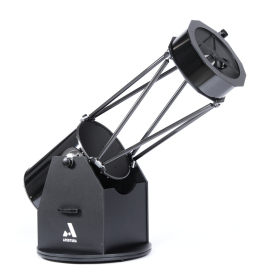
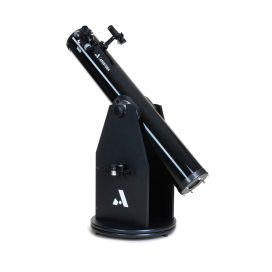
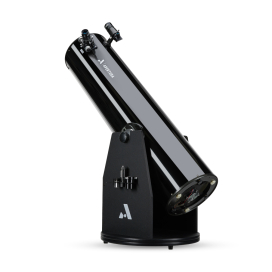
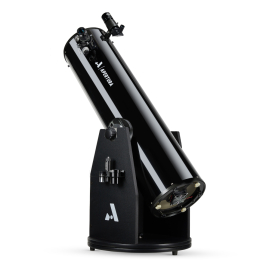
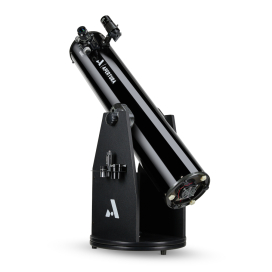
Dobsonian Base
An alt-azimuth mount incorporating a flat platform and “rocker box” base, similar to that of a cannon. Dobsonian telescopes are favored by many beginners as they do not require tripods, counterweights, or drive components to operate.
Dobsonian Telescope
The Dobsonian telescope consists of a Newtonian reflector optical tube assembly mounted on a very simple alt-azimuth box-style mount with a lazy Susan base. This base was invented by John Dobson to encourage people to make their own telescopes from start to finish. Up until that time, telescopes required a heavy equatorial mount that produced a financial or weight barrier for some otherwise enthusiastic budding astronomers. John Dobson and his base changed all that, and even today, Dobsonian telescopes still provide the most light-gathering dollar for dollar.
Doublet Refractor
A doublet refractor is a type of telescope that utilizes two lens elements. Often referred to as achromatic doublets, the use of two lenses help reduce the detrimental effects of common aberrations by focusing red and blue light on the same focal plane. These types of refractors are popular with beginners as they perform well, are easy to use, do not require collimation, and are generally quite affordable.
Dovetail Plate / Dovetail Bar
A dovetail is a mounting plate that attaches to the bottom of your telescope. This allows the telescope to be mounted to a telescope mount via the dovetail saddle. Dovetails can come in many different designs, though are most often found in Vixen or Losmandy styles.
Drawtube / Focuser Tube
On reflectors such as a Newtonian & RCs, as well as on most all refractors, there is a section that can move in and out of the main body of the telescope. It is here that visual observing or astrophotography equipment is connected, so that they can then be moved to focus on the object in view. This moving section is known as the focuser tube or drawtube.
DSLR / Mirrorless Camera
What one may consider a “regular” camera; used for everyday photography and feature an interchangeable (removable) lens system. Popular brands from this category that also enjoy wide support in the astrophotography hobby are Sony, Canon, and Nikon.
E
Earth
Also known as the Pale Blue Dot, Earth is the unique planet we are standing on right now. It's located between Venus and Mars in the goldilocks zone of our solar system, making it the third planet from the sun. Our Earth is estimated to be around four billion years old, and is currently the only known planet to support the necessary conditions for life.
Eclipse
An eclipse is when one celestial body blocks the light that comes from another celestial body. This causes a shadow to fall on a third celestial body. From Earth, people can observe both solar and lunar eclipses. These phenomena happen when the Sun, Earth, and Moon align in different orientations.
Eclipse Glasses
Eclipse glasses are a special type of glasses that utilize special solar filter lenses. These protect viewers from the harmful effects of looking at the Sun. Solar glasses must come certified for safety by meeting the international ISO 12312-2 standard. This certification must be clearly marked on the glasses.
Ecliptic Plane
First described by the Greek astronomer and mathematician Hipparchus, the ecliptic plane is an imaginary two dimensional plane on which planets orbit their host star. Not all celestial objects are confined to the ecliptic plane. For example, Pluto's orbit is titled by about 17° when compared to the other planets and dwarf planets, making is the largest object to deviate from the ecliptic plane.
ED Refractor
A refractor using lenses made from Extra-low Dispersion glass. This reduces the false color effect typically seen in refractors. Doublet ED refractors are commonly known as semi-apochromatic while triplet ED refractors are apochromats.
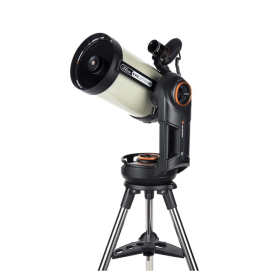
EdgeHD Telescope
EdgeHD is Celestron's top of the line flat field aplanatic Schmidt-Cassegrain telescope series. You can buy a variety of apertures, from 8 to 14 inches, as an OTA or as part of a telescope/mount package. EdgeHD telescopes are great for visual use but they really shine for astrophotography. With a wide field of view that is three times flatter than a standard SCT, you will see beautiful, pinpoint stars across the entire field, even if you have a full frame (35 mm) CMOS or CCD camera sensor to satisfy.
Electronically Assisted Astronomy (EAA)
Electronically Assisted Astronomy describes the process of attaching a digital cameras to a telescope and viewing through a screen rather than a traditional eyepiece. Essentially, the camera replaces the eyepiece in the telescope set up.
Enhanced Vision Technology
Enhanced Vision Technology, from UniStellar, periodically improves the view of the celestial object by taking short exposures and stacking these images. By adding frames together, the signal of the target within the image is greatly enhanced and a reduction in noise is apparent. This live accumulation of light results in higher quality images that reveal more detail and color than that seen in a single frame or a standard eyepiece. The longer the smart telescope stays imaging the target, the better the image becomes.
EQ Wedge
An EQ wedge is an accessory that allows astrophotography to be conducted with an alt-azimuth mount, specifically the Celestron fork-arm mounts. These additions introduce a polar axis to these mounts, allowing alignment with the celestial pole. In doing so, the issue of field rotation is eliminated, and the resulting images are sharp and distortion-free.
Equatorial Mount
An equatorial mount is an astronomy instrument that features two axes of rotation: right ascension (RA) and declination (DEC). Equatorial mounts also feature an additional axis, called the polar axis, that these RA and DEC axes rotate about. This polar axis is to be lined up with Earth’s celestial pole to accurately counteract Earth’s rotation. These mounts are ideal for astrophotography applications, as the addition of a polar axis eliminates the issue of field rotation within captured images.
Etalon Filter
Etalons are the primary filters used in dedicated solar telescopes to isolate the H-alpha light emitted by the Sun. Contrary to standard astronomical filters that use coatings to block unwanted light, etalons use two reflective surfaces placed closely together that interact in such a way that only light of certain frequencies will pass through to the other side. The spacing between these surfaces and properties of the air inside determine which light is allowed through, features that are exploited in etalon tuning systems to adjust the wavelength being passed.
Exit Pupil
The diameter of the light cone that exits an eyepiece, dependent upon magnification and aperture, expressed in millimeters. A larger exit pupil. means more gathered light and an easier viewing experience. But, because the dark-adapted human pupil is approximately 7 mm, exit pupils greater than 7 mm do not necessarily provide more light gain.
Exposure Time
Exposure time is the amount of time the camera sensor is allowed to collect light. In general, the longer the exposure time, the more light collected, and the brighter the image will become. This should be selected with caution though, as an exposure time that's too long can oversaturate the pixels and blow out the image, resulting in a loss of signal. Determining the correct exposure time is highly dependent on the aperture of the optics as well as the gain settings used. A larger aperture will produce a brighter image than that of a smaller aperture with the same exposure time. In a similar fashion, an image with a higher gain setting will be brighter than a lower gain setting image with equal exposure time. Finding the perfect balance between the aperture, gain, and exposure time will maximize image quality.
Extra-Low Dispersion (ED) Glass
ED stands for “extra-low dispersion”, and is a type of glass designed to specifically reduce the separation of wavelengths when light passes through. Coatings of magnesium fluoride, zirconium dioxide, calcium fluoride, and titanium dioxide help bridge the gap between the different wavelengths of light, providing a singular focal point for all wavelengths. This helps reduce chromatic aberration and in turn provides heightened optical performance. Also, the more coatings on the lenses, the higher the transmission rate becomes for brighter, more detailed views and images.
Eye Relief
The distance you can situate your eye from the eyepiece lens and still obtain a full, unobstructed field of view. Eye relief. that is either too short or too long can make observation uncomfortable, especially if you wear glasses. Generally speaking, eyepieces with shorter focal lengths have shorter eye relief. When necessary, you can increase eye relief without sacrificing magnification by swapping a high-power eyepiece for a low-power eyepiece and a Barlow lens.
Eyepiece
An eyepiece is a group of lenses housed in a small package that is closest to the eye when used with a telescope, microscope, or spotting scope. The eyepiece provides a particular magnification when paired with a telescope, therefore most amateur astronomers use a variety of eyepieces to change magnification for different types of objects. The eyepiece nomenclature is expressed in its focal length in millimeters. To figure out the magnification, simply divide the focal length of the eyepiece into the focal length of the telescope. The result is the magnification provided in your particular telescope or one with the same focal length.
F
Field Flattener
A field flattener straightens incoming rays of light in a flat image, effectively correcting field curvature.
Field Curvature
Field curvature is an optical aberration that presents elongated stars along the corners of the frame. This is due to the geometric difference between a flat camera chip and a curved optical plane, causing the center of the image to be sharp and in focus while the outer edges are increasingly distorted.
Field of View (FOV)
In simple terms, your field of view is the amount of sky that is observable through your telescope's optics. This measurement is calculated in angular degrees. To calculate how much of the sky you can image with your astrophotography rig, take the width of your camera chip, multiply it by 57.3, then divide that product by the focal length of your optics. If you want to determine how much of the sky you can view through your eyepiece, take the apparent field of view of your eyepiece (provided by the manufacturer), then divide it by the quotient of your telescope’s focal length & the focal length of your eyepiece.
Field Stop
A ring placed inside of the eyepiece barrel designed to limit and sharpen the edges of the field of view.
Filter
A filter is an accessory that is inserted within the imaging train. These accessories allow only select wavelengths through to the camera sensor. For instance, a blue filter will only allow the camera sensor to collect blue light, while all other light is blocked out. There are a wide variety of filters, from light pollution filters to narrowband filters. The combination of data from filters is a great way to create images that highlight certain wavelengths from celestial objects.
Filter Wheel
A filter wheel is a device that holds a number of filters. These accessories are great for easily swapping between filters, such as red, green, and blue filters for a streamlined imaging session. Filter wheels can hold either 1.25”, 2”, mounted, or unmounted filters based on the model. They also can be operated manually or electronically.
Finder Scope
A finder scope fits on top of the main telescope and is used to help you find and center objects in your eyepiece. A finder can be as simple as a red dot finder or it can be a high quality small telescope in its own right.
Focal Length
The focal length is the distance, usually measured in millimeters, between the primary mirror or lens and the point at which the image comes to focus. Generally, classic refractors have a longer focal length, Newtonian reflectors tend to have a focal length that is shorter, and Schmidt-Cassegrains fall somewhere in the middle.
Focal Ratio
The focal ratio is calculated by dividing the aperture (mm) of the primary mirror or lens into the focal length. Example: 2,500 mm divided by 254 mm (10") equals an f/ratio of 9.84, which is usually rounded off, in this case to f/10. The focal ratio signifies how quickly a telescope gathers light and tells us something about the telescope's field of view, how long exposures will take during astrophotography sessions, and how much magnification the eyepiece will produce for that telescope.
Focal Reducer
A focal reducer is an optical modifier that reduces the focal length of your telescope. These accessories come in a wide variety of reducing powers and are typically dedicated for use with one specific telescope model. They are great options for those looking to widen their field of view without having to create complicated mosaics. Also, the use of a focal reducer increases the overall speed of the telescope, allowing more light to be collected in less time.
Focuser Knob
This component allows the end user to adjust focus. With refractors and some reflectors this is done by moving the visual observing or imaging equipment. Other optical designs, like SCTs, move the optical elements. Typically, there are three focusing knobs to provide coarse and fine focus. However, SCTs will often just have one that provides fine focus only.
Fork Mount
A telescope mount shaped like a short two-pronged fork, with the telescope mounted between the two prongs. Fork mounts come in two varieties: alt-azimuth and equatorial.
Full Moon
When the Moon passes through the far side of its orbit, and it is completely illuminated by the sun, it's considered a full moon. Since the shadow is no longer visible, the Moon appears as a bright disc in the night sky.
Full Well Capacity / Full Well Depth
This refers to the amount of signal that a pixel can store before it becomes fully saturated. This becomes important especially with longer exposure times, as if pixels become fully saturated then the contrast between them and surrounding detail will be lost as those details continue to brighten but the saturated pixels remain the same. It is important to understand that this is not a static figure, but rather one that much like other camera specifications changes depending on the gain setting.
G
Galactic Arm
Galactic arms are the massive bands of ionized gas, dust, stars, and nebulae that stretch out from the center of a spiral galaxy. The arms of a spiral galaxy are a vital part of the life cycle of population I stars and planetary nebulae.
Galactic Core
The galactic core, also known as the galactic nucleus, is the luminous center point of a ecliptic and spiral galaxies. In our galaxy, the galactic core is home to a supermassive black holes know as Sagittarius A.
Galactic Disk
The relatively thin plane within which various stars, dust clouds, and nebulae travel around the center point of a spiral galaxy. The Milky Way galaxy’s Galactic disk is around 1,000 light years thick, and 100,000 light years wide.
Galactic Halo
The halo is the luminous structure surrounding the galactic nucleus. It ranges in size and shape depending on the type of galaxy. In spiral galaxies, like our Milky Way galaxy, the halo elongated and shaped similarly to a football.
Galaxy
Galaxies are massive collections of various celestial objects, and structures, that share a common orbital path around a galactic nucleus. The three types of galaxies are spiral, elliptical, and irregular.
German Equatorial Mount
A German equatorial mount is a specific type of equatorial mount created by Joseph von Fraunhofer in 1824. These mounts feature a design that places the telescope on one side of the declination axis, which is offset by counterweight(s) on the opposite end. The declination and right ascension axes meet each other within a T-joint. This T-joint is aimed at the north or south celestial pole, parallel to Earth’s axis of rotation, and rotates about this polar axis. With these three axes, these mounts are popular within the astrophotography community due to their ability to counteract Earth’s rotation without presenting field rotation within the captured images.
Gibbous Moon
A gibbous moon refers to two of the eight major phases of the Moon. When the Moon is in a gibbous phase, the illuminated side appears to bulge outward, but does not look quite as circular as a full moon.
GoTo (Go-To) Technology
In simple terms, Go-To technology is a telescope mount’s ability to slew to an object in space. This process requires alignment with the night sky, and is achieved through correlation with the optics of the telescope and software. Alignment can be achieved a number of ways and is necessary in order to determine the pointing position of the telescope. The user can either calibrate their telescope with 1-3 well-known bright stars or planets, or can utilize plate solving if their software offers it. In plate solving, the field of view is compared to a database, and the software can then determine the exact positioning of the telescope. Plate solving is considered more accurate than star alignment, and is widely featured within the smart telescopes on the market today for accurate Go-To functionality.
GPS
Originally invented by the U.S. Department of Defense, this technology became fully functional in the United States in 1995. This radio navigation system utilizes satellites to provide the precise global position of GPS enabled devices. Out of the 31 GPS satellites orbiting Earth today, GPS receivers only need information from 4 GPS satellites to determine accurate location. Cell phones, computers, and endless other devices act as GPS receivers. GPS is helpful in astronomy and astrophotography by providing the imaging software with the correct time, date, and location, helping create a detailed image of what the sky should look like based on this information.
Guide Camera
A guide camera has the important job of assisting your mount with its tracking capabilities. It does this by capturing constant frames of the night sky, usually 1-3 seconds each, that are then sent to autoguiding software. The software analyzes the field of view, selects guide stars and determines their center of mass, then compares each incoming frame to this calculated center of mass. If any discrepancies are found between the captured frames, the software will then communicate with the mount to fix these errors.
Guide Port
A port used to connect a computerized telescope mount to an autoguider, which moves the OTA automatically at set intervals to track objects as they move across the sky. On a mount, this is typically ST4.
H
Harmonic EQ / Strainwave
Harmonic equatorial mounts, often times referred to as strainwave mounts, are a type of equatorial mount with unique internal gearing. How these mounts work is as follows: A motor within this mount attaches to an internal wave generator, which is fixed inside of a flexible spline gear. While the motor rotates this wave generator, the flexible spline gear then pushes against the ring gear it’s housed inside of. The coupling of the flexible spline gear and ring gear is what drives the mount. One key advantage of this internal gearing system is that it can work with unbalanced loads, making the use of counterweights optional in most cases. Also, these mounts deliver high torque values, and have impressive weight-to-payload ratios. As such, these mounts are much smaller and more compact than other equatorial mounts, making them ideal for traveling.
Hemisphere
A hemisphere is a mathematical term that describes half of a sphere or globe. While the dividing line between hemispheres can be arbitrary, when talking about our planet or the celestial sphere, we tend to divide the hemispheres into west, east, north, and south.
Highest Useful Magnification
The term Highest Useful Magnification is used by telescope manufacturers to describe the most magnification you can typically be expected to use on a normal night and still bring an image to sharp focus. A basic rule of thumb for maximum magnification is 40X-50X per inch of aperture, with max magnifications generally topping out at 500X or so regardless of the aperture. You will find that maximums vary depending on the night. Observing conditions change constantly and will cause a once sharp view to become blurry or allow a blurry view to clear up in seconds. It is the nature of telescope observing on a planet with an atmosphere.
Hydrogen-Alpha (Ha, H-a, H-alpha, Hα, H-α)
In very simplified terms, when atoms change energy levels, specific wavelengths of light can be emitted. Hydrogen has one of these wavelengths (or more specifically, spectral lines) around 656.46 nm, in the form of H-alpha. This is close to red and can be observed in nebulae - or more importantly for the subject at hand, in stars such as our Sun. When being written, H-alpha is commonly shortened to simply Ha in the astronomy community.
I
Image Capture Software
Astrophotography image capture software are specialized pieces of software designed to operate your astrophotography equipment. There are plenty of options available, though some of the most popular ones are N.I.N.A, Astro Photography Tool, Sequence Generator Pro, and SharpCap, just to name a few. These applications have been designed to provide seamless imaging sessions, allowing extensive opportunities such as target selection, target framing, plate solving, autoguiding, image acquisition, camera cooling, automation, and plenty more.
Image Circle
This specification refers to the area where an image is formed by the optics/ corrective element. This is useful for assessing whether a certain camera sensor size will be supported by the optics, or if vignetting/ poor performance will be seen in frame.
Imaging Newtonian
An Imaging Newtonian is a Newtonian telescope that has been optimized for astrophotography equipment. Where a traditional Newtonian would have its point of focus just above the end of the draw tube (in order to best focus with eyepieces), an imaging Newtonian is designed to focus further back to provide adequate space for astrophotography cameras and accessories. A side-effect of this focal point shift is a decrease in field-illumination, which presents as vignetting in images. Accordingly, imaging Newtonians also have larger secondary mirrors than their traditionally designed counterparts, which evens out illumination. In addition to these optical changes, these scopes can (but don't always) have hardware that has been upgraded or replaced with components that make attaching supporting equipment easier. Some of these scopes can be used visually as well as for astrophotography, however the optical changes and astrophotography hardware focused design does not make them the best candidate for visual observation.
Imaging Train
Your imaging train is your telescope, camera, and any other accessories that are fixed between them, such as filters, filter wheel, off-axis guiders, focal reducers, etc.
Incoming Light
The term incoming light refers to the photons emitted by the celestial object being imaged. These photons are collected by your telescope and camera, then converted into signal.
Interstellar Clouds
Interstellar clouds are a collection of various elemental gasses, dust, and plasma left over from various galactic events, such has supernovas and galactic collisions.
ISO
ISO is an acronym for the International Organization for Standardization. This organization works to create standards for various technologies, practices, and methodologies. In the case of imaging sensors, ISO is a numerical value assigned to the sensor's light gathering sensitivity. Higher ISO values collect more light and a faster speed, while lower ISO values collect less light and a slower speed.
ISO Certified
The International Organization for Standardization (ISO for short) is an organization that, as the name implies, seeks to create sets of unified standards - most notably film speed standards. They created the ISO 12312-2 standard for products to be used in direct solar observing. Solar glasses, films, and other gear that have this certification, have been found to meet this agreed upon standard for safe viewing of the sun and solar eclipses.
J
Joule (J)
A joule is a unit of energy. It is equal to the the force of one newton moving the distance of one meter.
K
Kellner Eyepiece
A Kellner eyepiece is an accessory with a specific eyepiece design containing three lenses which are cemented together. This creates an achromat design and color defects are minimized. Kellner eyepieces are ideal for higher magnification telescopes that have a 1:10 aperture ratio.
L
Latitude
Latitude is one of two coordinates used to find a position on a globe. Lower latitudes are closer to the equator, while higher latitudes are closer to the poles.
Light Pollution
Light pollution is the brightening of the atmosphere due to lights from streetlamps, other forms of artificial light, and even the Moon. As light enters the atmosphere, it washes out the night sky, making it very difficult to observe the stars, nebulae, and planets. In order to combat light pollution in astrophotography, special filters have been developed to cut through excess light and enhance images. These filters are known as City Light Suppression filters, commonly referred to as CLS filters.
LRGB / RGB
Luminance, red, green, and blue filters are used in astrophotography to enhance the images being produced. Whereas the red, green, and blue filters emphasize those specific colors, the luminance filter is clear and is used to bring out detail in the selected target object.
Luminosity
Luminosity is the when an object produces or reflects light and appears to shine. For astronomy, this refers to the radiant power emitted, reflected, or received per unit of time.
Lunar Cycle
A lunar cycle refers to the 29.5 day orbital period of the Moon around our planet, in which the Moon transitions through all 8 of its main phases.
Lunar Eclipse
A lunar eclipse occurs when the Moon passes through Earth’s shadow. One of the reasons for this celestial event is orbital inclination of the Moon to the ecliptic plane of the solar system. Since this orbital inclination is constantly shifting, lunar eclipses can happen at various different times of year and have been historically difficult to predict.
Lunar Phases
Lunar phases are the various shapes caused by the shadow of the Moon as it moves around our planet. These phases are normally categorized into eight major phases: waxing crescent, 1st quarter, waxing gibbous, full moon, waning gibbous, 3rd quarter, waning crescent, and new moon.
M
Magnification
Magnification is calculated by dividing the telescope’s focal length by the focal length of the eyepiece being used. For example, using an eyepiece with a focal length of 20 mm and a telescope with a focal length of 600 mm gives a magnification of 30x.
Magnitude
Magnitude is the measure of a star's or other celestial body's brightness. The brighter an object is, the lower the magnitude number.
Maksutov-Cassegrain Telescope (Mak-Cass)
A type of catadioptric telescope with a long focal length that offers higher magnification than an SCT, translating to a narrower field of view but a darker night sky background.
Megapixels
A megapixel is one million pixels, and refers to the number of pixels a sensor contains. For example, if a sensor has 2,000,000 pixels, then this would be a 2-megapixel (2MP) sensor. These pixels capture light and color from the subject, and when combined, the signal collected results in an image. This measurement of the pixels available determines the resolution of a sensor and overall quality of the image produced. In general, the more pixels a sensor has, the higher resolution images that sensor will yield.
Meridian Flip
While tracking the night sky, there may be a time when your target reaches the meridian, the imaginary line directly overhead that can be traced from the north celestial pole to the south celestial pole. While your telescope is pointed this high in the sky, it’s necessary to “flip” your equipment to the east side of the tripod or pier, so you can continue to track your target and avoid damaging your gear.
Milky Way
The Milky Way is the name of the galaxy that hosts our solar system. Named for its bright milky appearance in the night sky, the Milky Way is home to countless stars, nebulae, and a even a few supermassive black holes. It estimated to be over 13 billion years old, and it would take over 100,000 light years to travel from one side to the other.
Modified DSLR / Mirrorless Camera
A type of DSLR or mirrorless camera that has had a filtering component removed. This component, a piece of glass, is put in place to block out frequencies that would otherwise make “regular” images look unnatural; as modern sensors are sensitive to a wider range of frequencies than the human eye can perceive. However there are some frequencies on the edge of this range that are important to astrophotography (mainly Ha), which these filters block to some degree. Accordingly removal of this filter will provide better astrophotography performance, but impact “regular” photo taking unless a clip-in or lens filter that filters these frequencies is used. Given the difficulty of removing this filter, this is something most users need to work with 3rd parties on.
Monochrome Camera
Monochrome cameras deliver the most detail and sensitivity out of all other camera options. Color cameras have an arrangement of pixel filters in a 2x2 grid, typically consisting of two green, one red, and one blue, which is then repeated across the entire sensor in what is known as a Bayer pattern. Monochrome cameras however, have photosites that do not contain an alternating pattern of those red, green, and blue light pre-filters. Instead, their photosites collect all incoming light regardless of color – allowing for up to 3x the collection of signal (red, green, and blue light). Because the camera itself is not pre-filtering each color, in order to produce a full color image, they must be paired with filters to create a full color image. These filters can range from simple RGB filters to narrowband filters, and the collected data is then combined in a photo editing software. Though light is still passed through an external filter, every pixel well is utilized, resulting in 4x more red or blue signal and 2x more green signal compared to a color camera.
Moon
A moon is a naturally occurring object that orbits a planet or other celestial bodies (excluding stars). These are also called natural satellites. The Moon, capitalized is the Earth's only natural satellite and is the brightest object in the night sky. The Moon stabilizes the tilt Earth's orbit, causing the seasons, and tides.
Mounted Filter
Mounted filters are filters that are encased within a metal rim. This rim is usually fitted with threads to attach it to other devices within an imaging train, such as a filter wheel or an eyepiece.
N
Nadir
The nadir is geometrical term which describes an imaginary line running below and perpendicular to a two dimensional plane. In the context of visual astronomy, it refers to the point directly below you when standing upright. While less commonly used than its opposing term zenith, it can be useful when describing the location of objects that are below your celestial horizon.
Narrowband
Filters that only allow specific wavelengths of light to pass through. These are particularly useful for imaging emission and planetary nebulae since both types of nebulae emit their own light within those wavelengths.
Native Backfocus / Flange Distance
These terms are used to describe the distance from the camera’s connection point to its sensor. This is important for back spacing calculations, to account for spacing the camera will be “adding” on its own. Each term is used to describe the same concept with two different systems, with Native Backfoucs being used with dedicated astro cameras and flange distance used with DSLR/ mirrorless cameras; however this rarely comes into play with DSLR/ mirrorless cameras as the T-Rings produced for these systems add the requisite amount of space to for a 55 mm backfocus system.
Nebula
A nebula is a type of celestial body that is made up of gas and/or dust. There are 3 different types of nebulae within space. Emission nebulae have a “glowing” effect, where they absorb and emit light from surrounding stars. The colors emitted are entirely dependent on the gasses present within the nebulae itself. This type of nebula also includes planetary nebula and supernova remnants, produced by stars themselves. As opposed to emitting light itself, reflection nebulae reflect starlight from neighboring stars. Reflection nebulae are typically blue in color, such as the Pleiades or the Running Man Nebula. The last type of nebulae is dark nebulae, which blocks stars and other objects from our view, creating a dark silhouette.
Neutral Density (ND)
In astrophotography, these filters block light from hitting the camera’s sensor. This allows the photographer to alter the amount of light in the image without having to change the exposure length or aperture of the camera.
Neutral Density (ND) Filter
A neutral density filter, commonly shortened to ND filter, is a filter most common in the world of traditional photography though some smart telescopes do have ND options available. These filters cut the amount of light that reaches the imaging sensor, which for smart telescopes can be helpful in daytime scenarios where over-exposure can’t be tamed with gain and exposure time alone. It’s important to note that these filters do not block enough light to image the Sun, for which a dedicated solar filter is needed. The exception to this is the ND filters from DwarfLab for the DWARF II telescope, in which both included ND filters must be equipped to avoid damage to the device.
New Moon
New Moon marks the beginning of a new cycle of moon phases. This is where the Moon seemingly disappears from the sky, as its non-illuminated side is facing us. Because of the lack of moonlight shrouding dim celestial objects, this phase of the Moon is important to astronomers and astrophotographers. The moon will soon appear as a crescent as it continues to orbit the Earth.
Newton
A newton is a unit of force. One newton is equal to the force that will accelerate one kilogram of mass the distance of one meter per second.
Newtonian Telescope
A Newtonian telescope (sometimes colloquially called just a ‘Newt’) is a reflector telescope with a fairly simple, yet effective, optical design. Using just a basic parabolic-shaped primary mirror and an even more basic flat secondary mirror, this optical design is one of the most cost effective reflector designs; and yet it still offers compelling performance. Coma is an aberration inherent to the Newtonian optical design, which is why coma correctors are commonly used when imaging with these telescopes. Compared to most newer reflector designs, Newtonians do not utilize a folded mirror system, meaning they are physically longer than SCTs, RCs, or Mak-Cass. This also means that light does not exit out the back of the scope, but the side. This is a comfortable location for observing, but a bit less ideal for imaging equipment.
Node
When describing the Moon's position in relation to a solar eclipse, a node is a point along its orbit that would place the Moon in line with the Sun. This isn't necessarily where an eclipse will happen, just a location where it can happen as the Moon still needs to be in the New Moon phase when passing through this point for eclipse to occur. There are two nodes in the Moon's orbit, one where a solar eclipse can happen and one where a lunar eclipse can happen.
Nosepiece
An adapter that allows cameras to be installed in place of visual observing equipment such asdiagonal or eyepieces. These adapters feature threading for a T-Ring or camera on one side, and an 1.25” or 2” barrel on the other.
O
Off-axis Guider (OAG)
As opposed to using a guide scope, off-axis guiders are fitted into the main imaging train itself, and utilizes the incoming light from the primary telescope for guiding. It achieves this via an internal prism that sends light into the guide camera. When using traditional guide scopes, these scopes can alter in position slightly through the night of imaging, causing the issue of differential flexure. But utilizing the main imaging rig’s incoming light, off-axis guiders eliminate this issue.
Optical Tube Assembly (OTA)
The acronym OTA stands for Optical Tube Assembly. An OTA is simply the telescope portion of a telescope/mount/tripod package. Some telescope users prefer to buy the OTA separately so they can create a custom astrophotography set-up or use a mount they already own.
Optics
In basic terms, this refers to the system that “collects” and focuses incoming light down to a smaller, brighter, magnified image that is then viewed through an eyepiece or captured by a camera. There are different ways to accomplish this, most commonly with glass elements (refractor) or with systems of mirrors (reflector). Each approach comes with its own set of tradeoffs, whether that be chromatic aberration, coma, etc. which can sometimes be mitigated with upgraded optical components (ED glass) or additional corrective components (like coma correctors). Numbers of standard optical designs have emerged as well, such as doublets, triplets, Petvals, Newtonians, SCTs, RCs, and more.
Orbit
An orbit is a predictable and periodic path an object follows as it moves through the space-time warped by a more massive celestial object. We have known about celestial orbits since early antiquity, however, it was not until Johannes Kepler formalized the three laws of planetary motion that we gained the ability to acutely predict the movements of our planetary neighbors
Orbital Incline
An orbital incline is the degree to which a celestial body tilts above or below the ecliptic plane of the solar system. These tilts are caused by the conservation of the celestial body’s momentum as it’s pulled towards a massive star or planet. Our Moon has a slight orbital incline of around 0.5°.
P
Parallax Angle
The parallax angle is measured using the distance to a celestial object and the angle in which it appears to have moved in the night sky. This distance is measured in parsecs and the angle is measured in arcseconds.
Parsec
A parsec is a standard unit of measurement in astronomy for distances. This unit is used as an alternative to light-year, as it is equal to 3.26 light-years. A parsec is calculated using trigonometry and observations of parallax. It is used most often to describe the distances between stars and galaxies.
Path of Totality / Centerline
As the Earth is constantly spinning and orbiting the Sun, with the Moon continuously orbiting the Earth, the area on Earth's surface where the Moon appears to line up with the Sun shifts over the course of an eclipse. This traces a path across the Earth, where an eclipse will be visible at different times. This can have several "sections" or "lanes", to denote where a total solar eclipse will be visible vs only a partial solar eclipse. The section where a total eclipse is visible is known as the path of totality. Within this path, the line running directly in the middle of the path of totality is called the centerline. Locations that fall along the centerline will experience a total solar eclipse that lasts longer than areas further out in the path of totality.
Payload Capacity
The payload capacity of a telescope mount is the maximum weight it can carry. It’s important to respect the rated payload capacity, as exceeding this limit can result in serious damage to the mount, or to the gear riding atop.
Peak QE / Quantum Efficiency
Camera sensors have differing sensitivities to different wavelengths, which are often described as a percentage of how much light of a certain wavelength is converted to actual signal. These are plotted on a graph, which often overlays the sensitivity of the green pixels, red pixels, and blue pixels for each wavelength. The peak quantum efficiency, or peak QE value, is the highest percentage measured across all of the pixels on the camera sensor.
Penumbra
Referring to a shadow, the penumbra is the lighter outer section that is only partly in shadow. When the Moon passes in front of the Sun, the section of the Earth that is only partly in shadow therefore is consider to be in the penumbra. From this zone, only a partial solar eclipse will be visible.
Petzval Design
The Petzval design is an orientation of lens elements within a refractor telescope. This arrangement features a doublet near the front of the optical tube, and a doublet near the back of the tube, with air-spacing in between. The second doublet corrects for aberrations that the first was unable to correct for, such as comatic aberration and field curvature. As a result, refractors of this design are well suited for astrophotography, producing exceptional clarity and contrast within the images captured.
Pixel
Digital images are made up of many, many, small boxes arranged in a grid, and these boxes are called pixels. To create these digital images, camera sensors are similarly made up of thousands or millions of small light measuring components arranged in a grid. These too are referred to as pixels.
Pixel Pitch
Measured in micrometers, or microns, the size of the pixel can determine the quality of the final image. For example, if there are too few pixels, the image can appear blocky, or “under sampled”. To increase the quality, more pixels may be required, but this might also require a reduction in the field of view in order to “zoom in” on the target. This, in turn, is called “oversampling”. In practice, the best pixel size for astrophotography can depend upon your equipment and your seeing conditions. For example, to calculate the number of arc seconds per pixel, divide the telescope’s focal length by 200 and then divide the pixel size by the result.
Pixel Size
When describing camera sensor pixels, the pixel size refers to the measurement across one pixel, corner to corner. This is listed in μm (micrometers, also called microns). The larger the pixel size, the more surface area available to collect light, resulting in a higher signal-to-noise ratio. In contrast, the smaller the pixel size, the less of a chance of photon collection, though more detail will be able to be resolved when light is captured. Pixel size also plays a huge role in the sampling of the image. It's important to ensure your telescope's focal length and chosen pixel size will yield images that are not too oversampled nor too undersampled for the best possible image quality.
Planets
A planet is a type of celestial body that is created as the proto-planetary disk of a young star system is pulled inwards towards the host star. As this disk contracts, its matter condenses into asteroids, comets, and ionized gas clouds. These celestial objects inevitably collide with one another to form protoplanets, dwarf planets, and eventually, planets like those easily viewed in our night sky
Plate Solving
The process of plate solving involves software analyzing a captured frame and comparing the star patterns to a database to determine the exact pointing position of the telescope. This procedure is incredibly helpful in Go-To processes, allowing the user to slew directly to the desired object with the click of a button.
Polar Alignment
Polar alignment is the process of aligning a telescope mount's polar axis with the Earth’s axis of rotation. By having these two axes parallel to one another, precise counteraction of the Earth’s rotation can then be achieved. While a typical process of equatorial wedge with two-axis alt-azimuth mounts.
Polar Scope
Polar scopes are small telescopes that assist with aligning a mount’s polar axis with the Earth’s axis of rotation. They are found within your mount, and are fitted with an internal reticle that shows Polaris’s position in reference to the true celestial North Pole, and Sigma Octantis’ position in reference to the true celestial South Pole. Through alignment of these pole stars within the polar scope, the mount will then be accurately polar aligned.
Polarizing
Darkens the sky and suppresses glare. Most commonly used for observing the Moon, a polarizing filter will significantly reduce the brightness of the Moon and allow it to be observed comfortably. Polarizing filters can also be used for observing the planets and for astrophotography.
Post-Processing
In order to complete an astro-image, it’s necessary to bring the captured frames into software to perform post process editing. This action varies for different types of astrophotography, though in general, it involves image stacking to reduce noise and remove artifacts, and image editing to enhance the captured detail and color.
Q
Quadruplet Refractor
Quadruplet refractors contain a total of four internal optical elements that provide images free from chromatic, comatic, and spherical aberration. As opposed to triplet refractors, quadruplet refractors also correct for field curvature aberration, where the additional lens acts as a built-in field flattener to straighten out incoming rays of light. This flat field also means there is no need to calculate backspacing; as long as the imaging system can reach focus, stars will be sharp across the entirety of the image. The four lenses in these telescopes can be arranged in various different orientations, though most often adopts the Petzval design. This design features two lenses in the front and two in the rear, and is so often used that quadruplets are regularly referred to as Petzval refractors. Most of the quadruplets produced today are manufactured specifically for astrophotography, and do not allow visual applications.
Quintuplet Refractor
Quintuplet refractors are telescopes that include a total of five lens elements. These lenses can be combined in various different arrangements to deliver superb color correcting abilities. Common aberrations such as chromatic, comatic, spherical, and field curvature are eliminated when using telescopes of this design, making them optimal for astrophotography. The inherent flat field also eradicates the need to calculate backspacing, making them exceptionally easy to use.
R
Rack & Pinion Focuser
Rack & Pinion focusers utilize a gear-oriented system to bring the telescope into focus. When the focusing knob is turned, the gears of the Pinion mechanism mesh with those of the Rack mechanism to move the eyepiece or imaging equipment into the focal point of the optics. By using gears, this type of focusing design is less likely to suffer from slippage as other focusers are prone to, and are one of the most commonly used in today’s most popular telescopes.
Radiant Power / Radiant Flux / Radiant Energy
Radiant power is the total energy, emitted, transferred, or received as electromagnetic radiation during a defined period of time. It is measured in watts.
Rayleigh Limit
Also known as the Rayleigh Criterion, the Rayleigh limit is a formula that defines the minimum separation between two sources of light, such as stars. The equation will provide the smallest possible angle between the sources in order to be resolved into distinct celestial objects. The formula is θ = 1.22 λ D
Read Noise
The noise generated when the value of each pixel is read out; as the amplifier in the camera converts electrons into voltage, a few electrons are typically either gained or lost in the process.
Reflector Telescope / Reflecting Telescope
A reflector is a telescope design in which mirrors are used to gather and focus light. Reflector telescopes are commonly called Newtonian reflectors, or simply a Newtonian in deference to their inventor, Sir Isaac Newton.
Refractive Index / Index of Refraction
When applied to optics, the refractive index is a parameter that finds the speed in which light travels through a medium that is not a vacuum. This parameter is used to determine the angle light is reflected and refracted through different materials and is necessary for the development of optical equipment.
Resolution / Resolving Power
In terms of camera sensors, the resolution is the number of pixels each image contains. It will typically be listed either in a width-by-height format, such as 1920x1080, or as the total number of pixels (given in megapixels). More resolution is generally better as it provides more detail, the ability to zoom in or crop an image more before pixelation becomes visible, or the ability to present or print the picture larger. As a frame of reference, a typical Full HD TV or monitor is 1920x1080 (2.1 MP) with 4K screens coming in at 3840x2160 (8.3 MP).
Right Ascension (RA)
The east-west angle of an object along the celestial equator, measured in hours, minutes, and seconds. Right ascension corresponds to Earth’s longitude.
Ritchey-Chrétien (RC)
A color and coma-free telescope designed for photography that offers spherical aberration-free optics. RC telescopes are not recommended for visual observation.
Rowe-Ackermann Schmidt Cassegrain (RASA)
An astrograph is a type of telescope (typically a refractor) specifically designed for astrophotography. They’re built to be “faster” with lower focal ratios, allowing for a shorter exposure time. The was specifically developed by Celestron to make astrophotography easier and quicker, without compromising on image quality.
S
Saros Cycle
While it may seem like every eclipse is unique, it has been determined that about once every 18 years the Earth, Sun, and Moon will return to a similar position resulting in a similar eclipse; though the locations through which this near identical path will differ. This period of 18 years is known as a saros, and is used to describe this cyclical nature of solar eclipses.
Schmidt-Cassegrain Telescope (SCT)
The acronym SCT stands for Schmidt-Cassegrain Telescope, one of the most popular telescope designs in amateur astronomy today. A Schmidt-Cassegrain, which belongs more broadly to the Catadioptric telescope type, uses a folded optical design incorporating both mirrors and lenses to gather and bring the light to focus. The folded light path allows for a short tube assembly even with relatively large apertures of 8" or more. A shorter tube length makes the SCT far more portable than a classic Newtonian or refractor of the same aperture.
Seeing Conditions
This term refers to the overall clarity of the night sky at any given time and within any given location. This clarity fluctuates constantly, as it is based on numerous different atmospheric conditions, such as humidity, turbulence, high clouds, heat, and plenty more. To give an example, you may have witnessed stars in the night sky “twinkle.” This is due to our atmosphere distorting their incoming light, causing a twinkling effect. When it comes to astronomy, especially when observing the planets and the Moon, seeing conditions are very important to consider, as these distortions can cause the subjects to become blurred and unfocused. It’s best practice to observe celestial objects when the atmosphere is most stable.
Sensor
A camera sensor is the main component of a DSLR, deep sky camera, or smart telescope that turns incoming light into data that can then be displayed on digital devices like mobile phones or computers. Accordingly, these are just as important as the optics of a system for a quality image. There are a wide variety of specifications that are important for a sensor - physical size, pixel size, resolution, dynamic range, amounts of image “noise”, and other technologies such as back-side illumination. As a result there is also a wide variety of sensors available that attempt to balance these in differing ways for different applications and price points.
Sensor Size (Full Frame, APS-C, Micro 4/3, Etc)
Imaging sensors come in many different proportions, such as 4:3 or 1:1, and physical sizes. There are some common combinations that have received a name - full-frame, APS-C, micro four thirds (4/3). The most important component of sensor size for astrophotography is the measurement from corner to corner (diagonal) of the sensor, which can then be compared to a telescope/ corrective element's image circle to assess how well the two may pair.
Septuplet Refractor
Septuplet refractors house seven lens elements for outstanding astrophotography performance. Aberration is virtually non-existent with this multitude of correcting lenses, providing images with heightened clarity and contrast. There is no backspacing calculation required from the user as long as the imaging equipment can reach focus, and the inherent flat field provides sharp stars from corner to corner.
Sextuplet Refractor
Sextuplet refractors are telescopes that contain six lens elements. These six correcting lenses provide excellent aberration correction, producing images free from coma, chromatic aberration, spherical aberration, and field curvature. Telescopes of this design have a built-in field flattener, and don’t require backspacing calculations as long as the imaging assembly can reach focus. These qualities make sextuplet refractors the ideal choice for astrophotographers wanting high quality, well-corrected images.
SHO Filter Set
A SHO filter set is a set of filters that includes an SII filter, a H-alpha filter, and an OIII filter. These filters isolate these wavelengths, in which the data is then combined in post processing software to create a SHO image, mapping SII to red, H-alpha to green, and OIII to blue. This palette is also referred to as the Hubble Palette.
Single Stacked / Double Stacked
Single or double stacking in a dedicated solar telescope context refers to the number of Etalon filters used. Stacking of filters is done to further isolate the wavelength of light that passes through the telescope, or in other words reject more light that isn’t the desired wavelength. The range of wavelengths above or below the desired wavelength is commonly referred to as a filter’s “bandpass”. The smaller this range is, the more detail and contrast from the selected wavelength can be resolved. This is desirable for solar viewing, where there is a good amount of H-alpha detail.
Sky Atlas
Sky Atlas is a digital planetarium created by ZWO for their ASIAIR and Seestar platforms. Digital planetariums are representations of the night sky as it appears at a certain time and location, generally synchronized to those of the user. This allows users to look for objects to observe/ image, usually showing a visual representation and technical information about the targets. In more advanced planetariums like the Sky Atlas and those included in most other smart telescope apps, GoTo functionality will be included to slew the user's telescope to whichever section of the sky they desire.
Sky Glow
As light interacts with the various component chemicals that make up our atmosphere, it occasionally changes direction and intensity. We perceive this interaction as a reduction in the transparency of our atmosphere, which can impact the visibility of objects in the night sky. Sky glow can be caused by terrestrial light pollution, sunlight, and even moonlight.
Slewing
The act of rotating a telescope from one area of the sky to view another.
Smart Telescope
Smart telescopes are, relatively speaking, new in the consumer space. These telescopes seek to combine as much separate hardware as possible into one unit, and pair these electronics and optics with modern quality-of-life and computational advancements such as digital planetariums and target lists, plate solving, and image processing. Smart telescopes are often fully self-contained units that can be set down and then moved/observed remotely from a mobile application. Most manufacturers now offer dedicated solar filters for these smart devices, allowing for general solar and solar eclipse viewing in addition to their night sky observing capabilities.
Smartphone Dedicated Telescope
A smartphone-dedicated smart telescope is one that offloads some of the functionality to a smartphone, such as the imaging capabilities and processing. This allows these units to come in a more accessible price point by utilizing technology the user may already have, at the cost of a bit of ease of use and compatibility (as these generally don’t support every model of smartphone or any model of tablet).
Software
Software consists of programs and data used by a computer to complete certain tasks.
Solar Calendar
A solar calendar is a timekeeping algorithm that keeps track of the 365.25 day solar year, as well as the associated seasonal shifts. The widely adopted Gregorian Calendar is one example of a solar calendar. Solar calendars often incorporate leap days, weeks, months or years, to account for the gradual drift caused by Earth’s 365.25 orbital period around the Sun.
Solar Eclipse
A solar eclipse occurs when the Moon passes between the Earth and the Sun, causing the Sun to be obscured by the Moon in the process. Since the Moon has to pass directly between the Earth and the Sun, a solar eclipse can only occur at the new Moon. While new Moons occur about once a month, the moon’s orbit is tilted resulting in many months where perfect alignment of the Sun, Moon, and Earth doesn’t occur. This means that even for those who land in the path of an eclipse (the band around the Earth where the Moon will pass in front of the Sun) may not see an eclipse; as this phenomena can be over in mere seconds. The longest a total solar eclipse can last is seven and a half minutes. You must view a solar eclipse with the proper solar filtering technology to ensure your safety.
Solar Filter
A filter that blocks the majority of incoming light from the Sun, only allowing a small amount through. These block much more light than sunglasses, tinted glass, or neutral density filters. The superior light blocking ability of solar filters allow for direct viewing or imaging of the Sun and solar eclipses through magnified optics. Without these filters it is not safe for people or camera sensors to directly observe the Sun.
Solar Flare
A solar flare is an eruption of electromagnetic energy from the Sun. These eruptions occur in areas of high activity on the solar surface, and eject their electromagnetic energy far out into space. At times where the Earth is in the path of this energy, it interacts with the upper atmosphere and can cause radio wave interference.
Solar Granule
These “granules” give the surface of the Sun its textured appearance. These form when hot plasma pushes to the top, and cooler plasma begins to sink. The difference in temperature results in a bright center and dark edges. As the plasma sinks it begins to heat again, and the previously heated plasma begins to cool, resulting in an ever changing pattern across the solar surface.
Solar Maximum / Solar Minimum
The amount of activity on the Sun's surface is not static, instead increasing and decreasing over time. When activity is at its peak, this is known as the solar maximum. Intuitively, the solar minimum is when activity dies down and the Sun is at its most calm. This occurs cyclically, with the Sun reaching its solar maximum every 11 years on average. For solar observing, this is important as observable features such as sun spots, solar flares, and CME's are most prevalent during a solar maximum.
Solar Midnight
Unlike true midnight, solar midnight is the point where the sun is closest to your nadir (the point directly below your feet). Solar midnight also delineates the half way mark between dusk and dawn.
Solar Noon
Unlike true noon, solar noon is the point where the sun is closest to your zenith (the point directly above your head when standing upright). Solar noon also delineates the half way mark between dawn and dusk.
Solar Prominence
Solar prominences are “structures” that project from the surface of the Sun, and are sometimes referred to as solar “filaments”. These structures are loops of plasma that extend far out from the Sun, and can be seen during a total eclipse. These can be seen when generally observing the Sun (particularly in H-alpha) as well, as they contain comparatively cooler gas that gives them a darker appearance. These dark loops snaking across the solar surface is where they get their other name of solar filaments.
Solar Safe Film
Solar Safe Films are, as the name suggests, films that have been designed to provide a safe solar viewing experience. These films are covered on both sides in a coating that rejects most of the incoming light, only passing a safe amount through to be viewed. These films can often be referred to as Mylar films, due to part of their construction, or sometimes “white-light” films owing to the white hue they usually (but not always) give the Sun.
Solar Safe Glass
A popular option for safe solar eclipse viewing is the Solar Safe Glass filter. These filters use a piece of glass that is typically coated on the underside, as opposed to solar films which are coated both top and bottom. The solid construction makes them a bit more durable and easier to clean, as the uncoated outer surface can be cleaned without concerns of damaging the safety coating. These can sometimes be known as “orange view” filters, as the light they safely let through usually has a warmer tone as compared to solar films.
Solar System
A solar system is any collection of celestial objects, and structures, found orbiting a star, or set of stars. Our solar system is home to many planets, dwarf planets, comets, and asteroids, but these are just some of the celestial objects that come together to form a solar system.
Spacer
A spacer is fairly simple adapter, designed to add spacing to an imaging system. While there are some sizes that have become common due to corrective element backspacing, dedicated astronomy camera native backfocus, and popular accessory thicknesses coalescing around certain spacing distances, there are still plenty of unique sizes and thickness available for unique builds/ equipment.
Spherical Aberration
As opposed to converging at a singular focal point, light rays entering the edges of a lens focus at differing points than that of light rays entering the center of the lens. This results in sharp stars in the center of the frame while blurry, unfocused stars are prevalent around the edges of the image.
Stacking
A method used to bring out what would otherwise be faint or invisible detail and contrast in an astrophotography image. When imaging a target, the longer an exposure is, generally the more faint detail will become visible. However as exposure time becomes longer several complications emerge - motion blur due to compounding small deviations or errors in tracking, increased sensor noise and glow, and overexposure of the bright areas of an image. Stacking mitigates these issues by combining a number of shorter exposure images, commonly called sub exposures, sub frames, or simply “subs”, into one image that effectively has a longer exposure time. The stacking process can further improve the resulting image with the use of calibration frames that help identify and compensate for visual artifacts introduced by the optics or sensor itself.
Star
A star is a luminous sphere of plasma held together by the collective gravitational attraction of hydrogen and helium atoms. Stars also contain various trace elements, such as lithium, carbon, and towards the end of there life cycle, iron. Stars come in many temperatures, colors, and sizes. High mass stars like Betelgeuse appear to shine red from our perspective because our eyes are only sensitive to a small portion of the electromagnetic spectrum. To see the true luminosity of Betelgeuse, you need specialized equipment designed to capture the appropriate wavelength of light.
Star Tracker
A star tracker is a mini equatorial mount that has a motorized RA and static DEC axis. They are designed with portability in mind, and as such, are very lightweight and compact. They’re perfect for tucking away in a backpack, and many even run on batteries for heightened portability. While optimal for Milky Way photography and small imaging trains, some models are robust enough for carrying small refractors.
Star Trail
Star trails are a phenomena that occurs when taking images of the sky using long exposures. These images depict the apparent motion of the stars in the sky when imaged without tracking.
Stellar Parallax
Stellar parallax, or just parallax, is the perceived difference in position, depending on the observer's point-of-view, of a star or other celestial objects against the background of stars in the distance. The stellar parallax method is used to determine the distance to a far away star using trigonometry.
Summer Solstice / Estival Solstice
Also known as the Estival solstice, the summer solstice is the day with the longest duration of daylight hours. It occurs twice every year, once for each hemisphere.
Sun
Our Sun is the star the planets in our solar system orbit around. Like other stars, our Sun is a luminous sphere of plasma held together by the collective gravitational attraction of hydrogen and helium atoms.
Sun Spot
When an area on the surface of the Sun has a strong localized magnetic field, a Sun spot is created. These spots are visible when viewing the Sun through a solar filter or dedicated solar telescope, appearing as dark dots on the solar surface. This dark appearance comes from a difference in temperature, as the power magnetic field impacts the ability of new hot plasma to flow which causes a cool spot to form.
T
T-Adapter
Typically this is used to describe an accessory for SCT telescopes which is threaded to the back of the OTA or reducer (replacing the visual back). These spacersadd enough space to the imaging train such that only the industry standard 55 mm of backspacing remains. For information on the adapter that connects directly to a DSLR/ mirrorless camera, see T Ring.
T-Thread
This is the name given to the thread within the T Ring and T Adapter. The most common types today are the M42 and the M48, with 42 and 48 indicating the diameter of the thread in millimeters.
T-Ring
A T Ring is an accessory that is used to connect a DSLR/ mirrorless camera to threaded connections. These have a camera lens mount on one side, and a female/ internally threaded connection on the other in either M48 or M42. Most (but not all) T-Rings will set the camera at 55 mm of backspacing, making connections easy.
T2/ T2 Thread
Connections listed as T2/ T2 thread/ T2 thread diameter are referencing a M42x0.75 standard. This shorthand originates from the days when astrophotography was done with film and remains popular to this day, though referring to this type of connection simply as M42 is becoming more prevalent. It is noteworthy that at this point in time that there is no consensus on what thread pitch should be used for M42 (or M48) threads, though most are close to the 0.75 mm specification. As a result, while most all T2 thread size/ M42 components will thread together, on occasion you may encounter components with these labels that do not work together.
Tracking
As the Earth is continuously spinning and in motion, the location of a celestial object in the sky moves over the course of a night. This becomes apparent during observation as a target moves out of view, and particularly observable in images as stars and objects quickly become a blur as exposure time and focal length increases. To compensate for this, computerized mounts and smart telescopes employ tracking techniques to keep the target centered in the optics. Depending on the motion style of the mount, the resulting image can vary. Alt-Az motion, popular in smart telescopes, keeps the object centered but can not compensate for its “spin” without what is known as a wedge. Accordingly these images lose information on the edges of the frame as they rotate out of view, leading to ever smaller, circular, images as time spent imaging increases.
Tracking Modes
As opposed to the tracking rate that determines the speed in which the mount will track the sky, the tracking mode of a telescope mount determines the way in which the mount will counteract the Earth’s rotation. This can be selected from either the hand controller or software. Typically, you will find the modes of: EQ North, EQ South, Off, and Alt-Azimuth. For instance, if you are polar aligned with the north celestial pole, choosing EQ North will be the appropriate tracking mode to select, while EQ South is reserved for those polar aligned with the south celestial pole. Equatorial tracking modes are optimal for astrophotography applications, while the alt-azimuth mode is ideal for those who are conducting visual astronomy.
Tracking Rates
Unlike the tracking mode which denotes the way in which the mount will track the sky, tracking rates determine the speed at which the mount will track the sky. This can be selected from the mount’s hand controller or through computer software, and should be selected based on the target that is being tracked. Typically, there are three tracking rates: Sidereal, Lunar, and Solar. The sidereal tracking rate moves the mount at a speed that is equivalent in magnitude, yet opposite in direction as the speed of Earth’s rotation. This is ideal for all targets within the night sky save the Moon and the Sun, in which the lunar and solar tracking rates are appropriate for.
Triplet Refractor
Triplet refractors house three lens elements that work together to eliminate common aberrations such as chromatic, comatic, and spherical. While achromatic doublets only correct for two wavelengths (red and blue), apochromatic triplets correct for three, allowing red, green, and blue light to become focused along the same focal plane. These types of refractors excel for visual use though are especially popular within the astrophotography community thanks to their superb color-correcting abilities.
Tripod
A tripod is a tool that consists of three legs, of varying thickness and materials, and is used to support cameras, telescope mounts, and other equipment through (most often) a threaded connection. It acts as a stand to increase height and stability.
True Field of View (TFoV)
The amount of sky visible through an eyepiece in combination with a specific telescope, expressed in degrees. The TFoV changes depending on the specifications of the telescope used in conjunction with the eyepiece. To calculate the true field of view, divide the eyepiece’s apparent field of view by its magnification: TFoV = AFoV/Magnification.
U
Umbra
An umbra is the darker section of a shadow. When discussing a solar eclipse this refers to the darker section of the eclipse which is the section that will observe a total solar eclipse. The path the umbra will trace along the Earth's surface as an eclipse progresses is what is known as the path of totality.
USB
Universal Serial Bus or USB is a protocol for data transmission, and is by far and away the most common way astronomy equipment will communicate with a PC in a wired capacity. There are a number of USB connectors, such as USB-A (the rectangular port you’re likely familiar with), USB-B, USB-C, and micro USB; as well as a number of different revisions (2.0, 3.0, 3.1, etc.) that have brought more speed, power, and reliability to the protocol.
UV-IR
A UV-IR filter is one that blocks out unwanted ultraviolet and infrared light from entering the sensor. This filter helps improve the sharpness within the image, keeping the stars tight and increasing detail.
V
Vignetting
Vignetting is seen as the darkening of the corners of the frame within an image. This happens when the camera sensor is not exposed to enough light, resulting in a shadow effect along the borders of the image. This issue presents itself for a number of reasons, though most commonly occurs when using incompatible sensor sizes and image circles, and using too small of filters for the imaging assembly.
Visual Back
The visual back is the connection from the focuser where visual accessories are attached. Typically this is used to describe a component of a refractor or SCT, which can be removed to allow for a corrective element (or a different visual accessory) to be connected.
Visual Observation
Visual observation is the study of celestial objects using specialized visual equipment like telescopes and binoculars, or simply viewing the sky with your naked eye. Born from our species first attempts to understand the many mysterious objects that fill our night sky, visual astronomy has blossomed into an expansive field of study, and inspired to many to join in the pursuit of knowledge that beckoned our curious ancestors.
W
Waning Moon
As the Moon begins to move towards the sun in its orbit around the earth, the illuminated side appears to shrink with each passing day. This period of the lunar cycle is labeled “waning” to distinguish it from the opposing, yet similar, waxing phases.
Waterproof
To be waterproof means to prevent water from permeating the surface of the object.
Watts
A watt is a unit of power. This unit measures the rate of energy transferred over a unit of time. A single watt is equal to one joule per second.
Waxing Moon
As the Moon begins to move away from the sun in its orbit around the earth, the illuminated side appears to grow larger each passing day. This period of the lunar cycle is labeled “waxing” to distinguish it from the opposing, yet similar, waning phases.
WiFi (Wi-Fi)
Wi-Fi, sometimes shortened to just WiFi or wifi, is a protocol for wireless communication. Primarily it is used to transmit and receive data between a device (such as a smartphone, computer, smart TV, and an ever increasing number of other household devices) and a router or wireless access point that is connected to the internet. Communication with the internet is not the only function the Wi-Fi protocol is useful for, and indeed many of the aforementioned devices can communicate with each other locally using this protocol and the router as an intermediary. Increasingly this protocol has been used for more direct communication between two devices (like a smartphone and a smart telescope), with one creating its own access point or broadcast that both devices then send and receive data on. While this does have the disadvantage of disconnecting a device’s connection to the internet, it has become necessary to transfer large amounts of data quickly that otherwise exceed what Bluetooth can accommodate.
Winter Solstice / Hibernal Solstice
Also known as the Hibernal Solstice, the winter solstice is the day with the shortest duration of daylight hours. Its occurs twice every year, once for each hemisphere.
Worm Gear
A worm gear is a component within a worm drive gearing system that includes spiral threads. Driven by a motor, this worm gear’s threads mesh with the worm wheel to then rotate the right ascension or declination axis of a mount.
Wratten Number
A Wratten number is a designating label given to optical filters, most often used in photography. Coined for Frederick Wratten, each number is assigned to a distinct color. Some of these numbers are accompanied by a letter to dictate the level of filtration.
X
X-Ray
In astronomy contexts, an x-ray is a high-energy electromagnetic wave created by matter when under extreme physical conditions, such as heat. When compared to ultraviolet light, x-rays are shorter and have higher energy levels. Due to their very short wavelengths, scientists will refer to x-rays by their energy instead of their wavelength.
Y
Yellow Dwarf
A yellow dwarf, also called a G-type main sequence star, is a stable, medium sized star. Yellow dwarf stars undergo hydrogen-helium conversion, meaning that they burn hydrogen to helium in their core using nuclear fusion. The Earth's sun is a yellow dwarf star.
Z
Zenith
The zenith is commonly used geometrical term which describes an imaginary line running above and perpendicular to a two dimensional plane. For visual astronomy, the zenith simply refers to the point directly above your head when standing upright, and can be a useful point of reference when describing the position of celestial objects in our night sky.
Zero Amp Glow Control
Zero Amp Glow is a camera feature that prevents amp glow, any glow in an image caused by the camera. This control feature is managed using a combination of software and/or hardware that reduces the power consumption of the sensor and supporting circuitry.
Zoom Eyepiece
A zoom eyepiece is a type of eyepiece that has the ability to change its focal length (called variable focal length) using manual adjustments by the user.
Click the arrow above to see MLA, APA, and Chicago Manual of Style citations.
MLA:
High Point Scientific Team. "Astronomy Glossary," AstronomyHub, High Point Scientific, 9 Jan. 2026, https://www.highpointscientific.com/astronomy-hub/post/equipment-reviews/astronomy-glossary.
APA:
High Point Scientific Team. (2026, January 9). Astronomy glossary. High Point Scientific. https://www.highpointscientific.com/astronomy-hub/post/equipment-reviews/astronomy-glossary
Chicago Manual of Style:
Bibliography:
High Point Scientific Team. "Astronomy Glossary," AstronomyHub (blog), High Point Scientific, January 9th, 2026. https://www.highpointscientific.com/astronomy-hub/post/equipment-reviews/astronomy-glossary
Footnote:
High Point Scientific Team, "Astronomy Glossary," AstronomyHub, High Point Scientific, January 9th, 2026, https://www.highpointscientific.com/astronomy-hub/post/equipment-reviews/astronomy-glossary.