Our solar system is very, very large. Expressing the scale of our solar system results in meaningless numbers that are extremely cumbersome to both write and remember. For example, the distance between the Earth and the Sun is (on average) 93,000,000 miles. For the sake of simplicity, astronomers will instead use an “astronomical unit” with this 93 million-mile value as the reference. You can think of this similarly to how a yard or meter works. This unit provides significant value to astronomers by making calculations much simpler.
What Is an Astronomical Unit?
Per the International Astronomical Union (IAU), an astronomical unit is exactly 149,597,870,700 meters. That is the average distance between the Earth and the Sun. An average is used because the value between Earth and the Sun is not constant due to Earth’s orbit being a slight ellipse, as well as being slightly perturbed by other planets as they go around the Sun. On average, the solar system’s eight planets' average distance from the Sun in AU are as follows:
- Mercury 0.39 AU
- Venus 0.72 AU
- Earth 1 AU (by definition)
- Mars 1.52 AU
- Jupiter 5.2 AU
- Saturn 9.5 AU
- Uranus 19.2 AU
- Neptune 30 AU
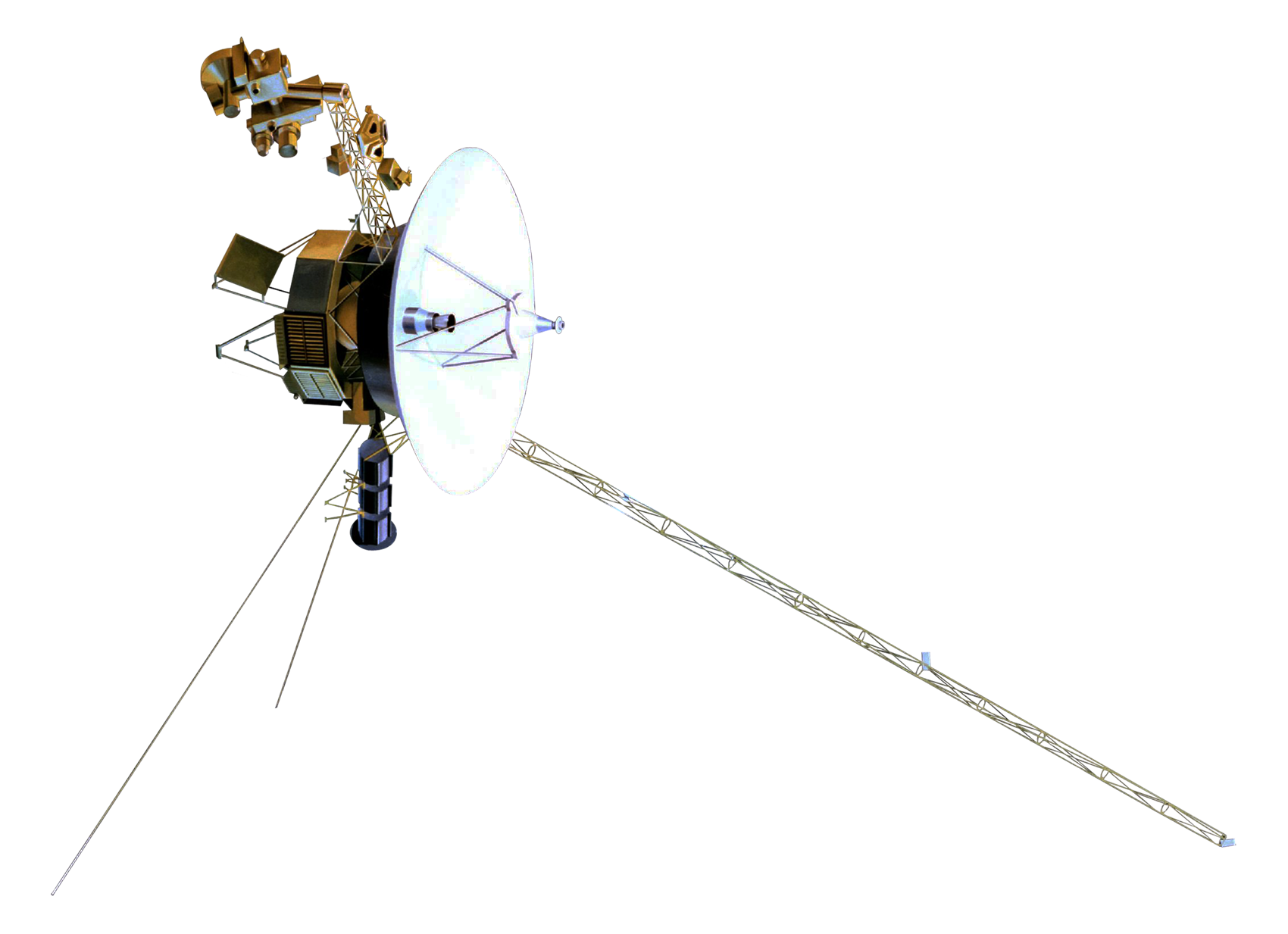
While the above may make these distances seem small, in reality, they are incredibly vast and make visiting other worlds a huge challenge. Voyager 1, a spacecraft launched in 1977, is currently moving at a speed of 38,027 miles per hour and has been traveling the solar system for nearly 50 years. Voyager 1 is currently 164 astronomical units from the Sun. This isn’t even the distance to the beginning regions of the Oort Cloud, where all the long-period comets are thought to reside, starting at 2,000 AU. Additionally, at this distance, it takes light nearly exactly 24 hours to reach the Voyager spacecraft, which means the round-trip time for communications to be sent and confirmed from Earth takes nearly two days! In fact, this year Voyager will reach the historical milestone of being 1 light-day away from Earth, or 173 astronomical units. For reference, the furthest from Earth any human beings have traveled was during the Artemis II mission, reaching 252,756 miles from the Earth – only 0.0027 AU! Voyager has traveled nearly 64,000 times further from the Earth than any human beings have, a spacecraft truly deserving of the name.
What Is a Light Year?
Using Voyager 1’s speed of 38,027 miles per hour as our reference, we can calculate travel times to greater “light” distances, or the value light travels in a day, year, decade, etc. These units become increasingly important as we travel away from the Sun. Like miles and kilometers, astronomical units also quickly become cumbersome as we head towards the nearest stars and, especially, galaxies. As such, a light-year becomes our new yardstick as we approach these cosmic distances. A light-year is defined as the distance light travels in a single year, or 63,241 astronomical units. At Voyager 1’s current speed, it will not reach 1 light year for another 18,000 years.
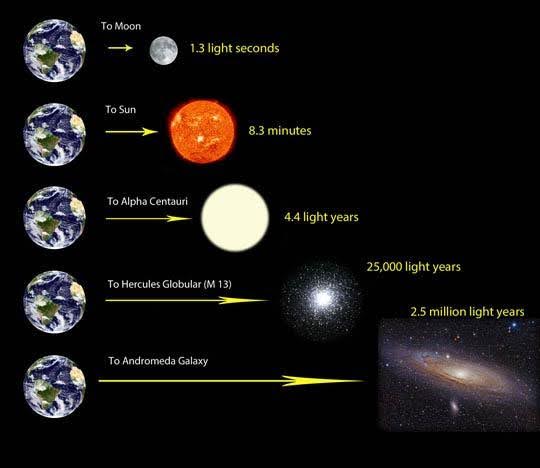
Although Voyager 1 will never ultimately reach any of these celestial objects, a spacecraft on the same velocity and correct headings wouldn’t reach Proxima Centauri, the nearest star at 4.25 light-years away, for approximately 76,800 years! Likewise, the spacecraft wouldn’t reach the star Deneb in Cygnus, at a distance of 1,400 light-years, for nearly 36 million years. And lastly, the center of our galaxy, where a supermassive black hole resides, is 26,000 light-years away. A spacecraft moving at Voyager 1’s speed would take an incredible 470 million years to reach the center of our own galaxy!
Interstellar Travel Challenges and Relativity
This illustrates the difficulty of interstellar travel. For a spacecraft to move anywhere near the speed of light, it would require an immense amount of energy and propulsion technologies far beyond our current capabilities with just rocket fuel. For a spacecraft to reach 99% the speed of light would need to move at over 663,000,000 miles per hour! Compare that to Voyager 1’s paltry 38,027 miles per hour value - a spacecraft moving at this speed from Earth would overtake Voyager 1 in a single day.
At these speeds, strange things would begin to happen from the perspective of the spacecraft. Astronauts heading to Deneb would be traveling at relativistic speeds, or speeds where Isaac Newton’s understanding of physics takes a back seat to Albert Einstein. A spacecraft moving at 99.999999% the speed of light would experience time dilation, and the perceived distance to an object would appear to “shrink”. At this proximity to the speed of light, for every second that passes on the astronauts’ clock, approximately 7,071 seconds pass on Earth. That means a journey to Deneb would take only 0.283 years for the astronauts – a short summer vacation! However, for observers on Earth, it would take 2,000 years! This application of relativity is the closest concept to time travel that our current understanding of physics allows, although it is purely hypothetical at our current technological limitations. Perhaps one day, NASA will invent antimatter propulsion?