Image Credit: Astrotourism WA
Eta Aquariid Meteor Shower: A Summary
What Is the Eta Aquariid Meteor Shower?
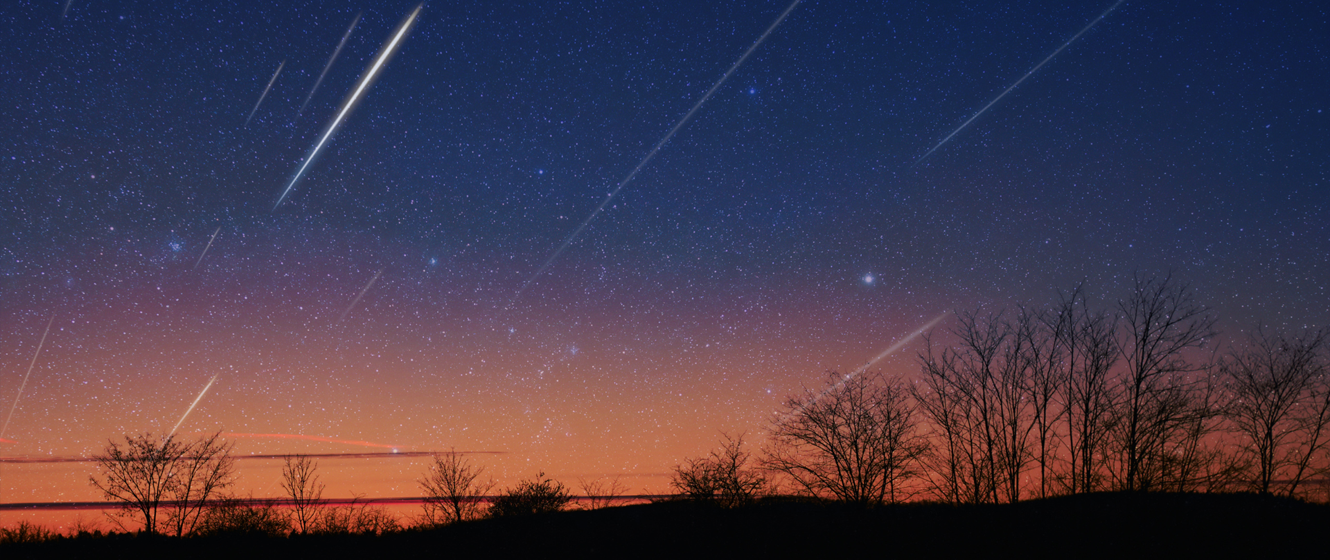
A major meteor shower, the eta Aquariids are fairly prolific, bright, and fast, but thanks to the location of their radiant, they’re not necessarily easy to observe. Like the Southern delta Aquariids, you might see this shower’s name spelled several different ways (ie, with Aquariid having a single i or two i’s), but the correct spelling is with two - Aquariid. As with all meteor showers, it’s named for the region of sky that the meteors appear to originate from, and in this case, that’s the constellation Aquarius, close to the star Eta Aquarii.
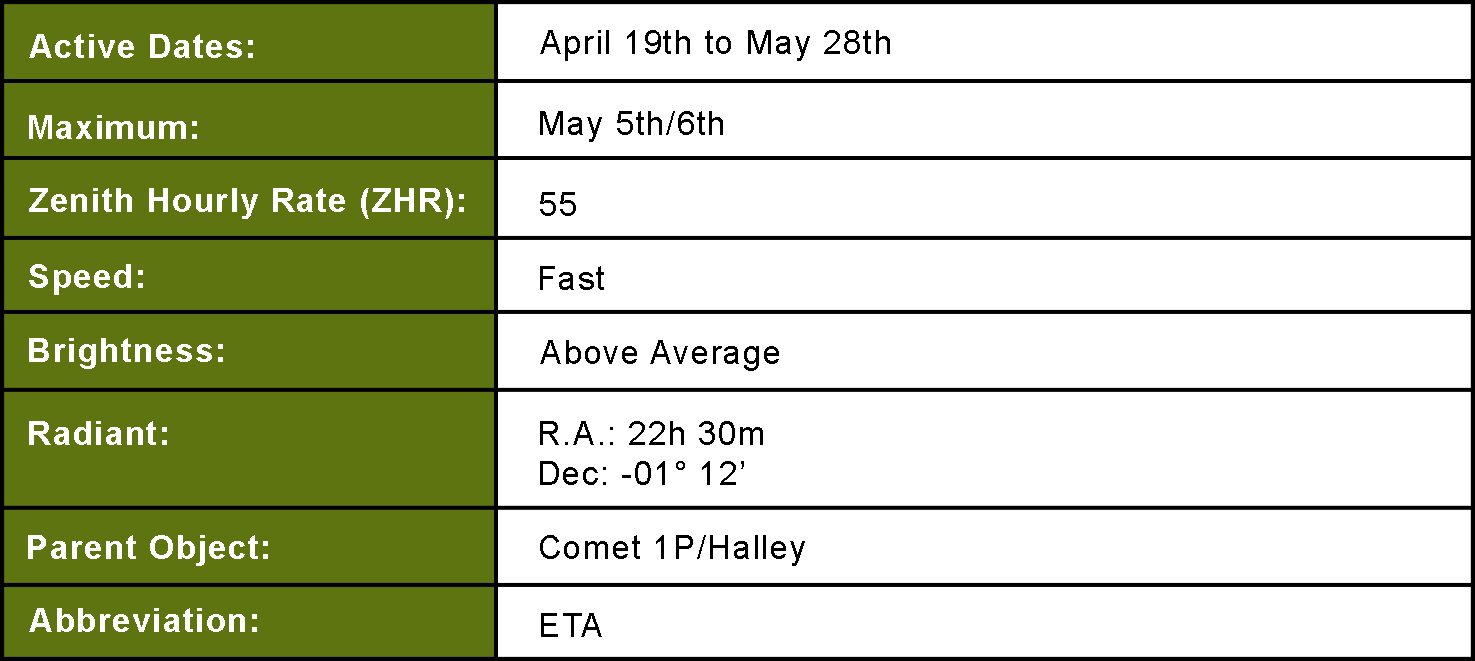
The shower itself has the fourth highest zenith hourly rate (after the Geminids, Quadrantids and Perseids), and with a velocity of 40.6 miles per second (65.3 km/sec) its shooting stars are some of the fastest around. (For the record, the Orionids are about the same speed, while the Leonids outpace everyone, with an average speed of 43.3 miles per second, or roughly 69.7 km/sec.) Unfortunately, this speed makes the shooting stars a little harder to spot, as it means the meteor may have already streaked across the sky before you’ve had a chance to spot it!
The eta Aquariids are disadvantaged in another way. Aquarius is an autumnal constellation, but the shower reaches its maximum in spring. As a result, its radiant barely rises above the horizon before the oncoming dawn begins to brighten the sky. This means the shower isn’t very easily seen from northern latitudes, and is best seen from the equator to roughly 30 degrees south instead.
However, it’s not all doom and gloom. On the plus side, unlike most other meteor showers, the eta Aquariids have a broad maximum that lasts for two to three days on either side of May 5th. So while the shower is typically most productive in the early hours of the 6th, there’s still a good chance you’ll see some activity any time between May 3rd and May 8th.
Lastly, the eta Aquariids can be thought of as being the siblings of the Orionids, as they share the same very famous parent body - Comet Halley. Of the two, you might even think of the eta Aquariids as being the elder, as it was the first shower to be linked to the comet. More than that, they’re of similar speed and brightness - although the eta Aquariids produce roughly three times as many shooting stars.
A Brief History of the Eta Aquariid Meteor Shower
While there are no confirmed observations, Korean records show a potential outburst of the shower as early as 687 BCE, while Chinese observers documented potential outbursts in 74 BCE and 401 AD. Similar outbursts and observations also occurred in 443, 466, 530, 839, 905, 927, and 934, while the Mayans also appear to have observed an outburst around 461. However, it wasn’t until 1863 that the shower's existence was first suspected, when the American astronomer Hubert A. Newton analyzed historical records and noticed the regular occurrence of increased activity in early May.
Officially, the discovery of the shower is attributed to the English astronomer George Lyon Tupman, who recorded more than two dozen meteors originating from the same point in Aquarius on April 30th and May 2nd, 1870. Six years later, in 1876, Alexander S. Herschel, grandson of the famed astronomer William Herschel (discoverer of the planet Uranus), made the first link between the shower and Comet Halley. He correctly predicted that when Halley’s orbit was closest to Earth on May 4th that year, a shower would occur close to the coordinates Tupman had recorded meteors originating from. Subsequent joint observations, conducted by Herschel and fellow British astronomer William F. Denning, then confirmed the placement of the radiant close to Eta Aquarii.
By the 1910s, the link between Comet Halley and the shower was firmly established, and regular observations by astronomers in the southern hemisphere from the 1930s to the 1950s helped to establish the profile of the shower. Meanwhile, astronomers at Jodrell Bank in England made the first radio detection of the shower in 1947.
From the 1990s onwards, the International Meteor Organization has compiled reports and data relating to the shower from all around the world, which has helped to establish the zenith hourly rate at around 50 to 60. That said, the shower, as noted above, and like numerous other major showers, has also been known to produce outbursts, most recently in 1975, the 1980s, 2013, and 2023, with future outbursts predicted for 2045 and 2046.
How Can I Observe the eta Aquariid Meteor Shower?
As mentioned above, the shower is not easily observed from the northern hemisphere as its radiant remains low above the horizon as the sky begins to brighten prior to dawn. The radiant itself lies close to the trio of Eta, Zeta1, and Gamma (Sadachbia), but despite the shower being named for Eta Aquarii, its radiant is actually slightly closer to Zeta1 and Gamma. (More specifically, it lies a degree and a half south of Zeta1 and a degree and a half east of Gamma, compared to nearly two and a half degrees southwest of Eta.) Either way, locating this trio of stars will have you looking in the right direction.
The radiants of most meteor showers rise at around midnight, but unfortunately, the eta Aquariid radiant doesn’t climb over the eastern horizon until 2:30 AM, and it won’t clear the thicker air near the horizon until shortly before the sky begins to brighten. It then culminates at around 8:30 AM, at least several hours after sunrise for many observers. Taking all this into account, the best time may be around 3:15 AM, or roughly an hour before night ends, when the radiant will be just ten degrees above the eastern horizon.
If you’re outside at this time, looking towards the northeast and southeast will give you your best chance of spotting a shooting star or two. Due to the shower’s poor visibility from the northern hemisphere, observers north of the equator are less likely to see a fireball, but if you’re lucky enough to catch one, you’re also likely to see a long-lasting train.
A 10 Year Forecast
The table below shows the Moon phase and planets that may be visible above the horizon at 3:15 AM on May 6th of each year. It should be noted that (again, as with all meteor showers) the date of the maximum can vary a little from year to year, and the exact timing isn’t typically known until the International Meteor Organization releases its annual report.
With that in mind, although the eta Aquariids are often at their best on the evening of the 5th and in the early hours of the 6th, they can also peak on the evening of the 4th and in the early hours of the 5th.
In terms of the rating, if the Moon is below the horizon at that time, then its light won’t drown out the fainter meteors, and the rating is five stars. However, if the Moon is above the horizon, then the rating is based upon the phase, altitude, and distance of the Moon from the radiant at that time.
Lastly, if the Moon is in the western hemisphere and more than half full, it might be best to wait for the Moon to set before stepping outside. If the Moon is waning and half full or a little less, then it’s best not to wait to observe the shower, as the Moon will only rise higher as the night progresses, potentially causing more interference as its altitude increases.