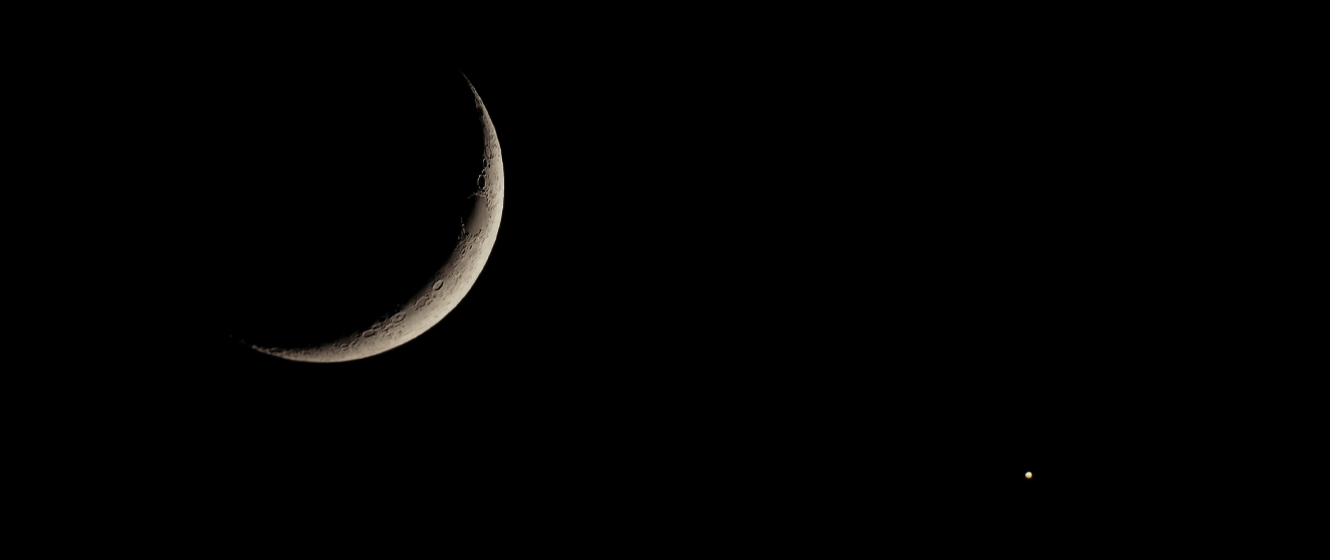
A few of us have been lucky enough to witness a solar eclipse, when the Moon passes in front of the Sun and obscures it, but did you know the Moon does the same thing to the stars?
Essentially, that’s what a lunar occultation is - the Moon passing in front of a background object. Much of the time, the Moon will hide a faint, background star, but occasionally, it will pass in front of a bright star, or even a planet.
How Do Occultations Occur?
Occultations of bright stars and planets are relatively rare, and depend upon a number of key factors. Firstly, and most importantly, an occultation can only occur when the Moon and object (whether it be a planet or star) are in alignment from your vantage point.
This will largely depend on your location on the Earth, as the alignment will not be precise for everyone. To demonstrate this, step outside and hold your thumb up so that it obscures a distant building or tree. Your thumb represents the Moon, while the distant object is the star or planet being occulted.
Now tilt your head up, down, or to the side, without moving your thumb. You’ll see the distant object is no longer obscured. Similarly, if you’re watching an occultation of a star, an observer to the north, south, east, or west may not witness the occultation because the Moon and star are not in alignment from their vantage point. They would see the Moon beside the star instead.
When Do Occultations Occur?
The Sun, Moon, and planets all follow the same path across the sky, called the ecliptic, and it takes the Moon 29.5 days to return to the same spot. You might, therefore, think the Moon will occult a planet or a bright star on the ecliptic once a month.
However, with the exception of the Sun, the Moon and planets each stray a little way to the north or the south of the ecliptic, making occultations a much rarer event. Not only must the Moon be in alignment with the object and observer, but the event must also take place during the night when the Moon and stars are visible.
What Can You Expect During a Lunar Occultation?
Besides the planets, there are currently several bright stars that the Moon can occult: Aldebaran and El Nath (Taurus), Regulus (Leo), Spica (Virgo), Antares (Scorpius) and Nunki (Sagittarius). Each of these lies relatively close to the ecliptic, with Regulus being the closest and Aldebaran and El Nath being the furthest. Messier 45, the Pleiades star cluster, can also be occulted.
First and foremost, you’ll want to know when an occultation will occur. The International Occultation Timing Association (IOTA) has a list of upcoming occultations on its website, complete with charts and tables to give you an idea of where and when it will be visible. The site also includes links to software that you can use to make your own predictions.
It’s also worth simulating the occultation with an app (such as SkySafari) to get an idea of how it will appear from your location. Pay particular attention to the moment the star or planet disappears (called the ingress) and when it reappears again (the egress.)
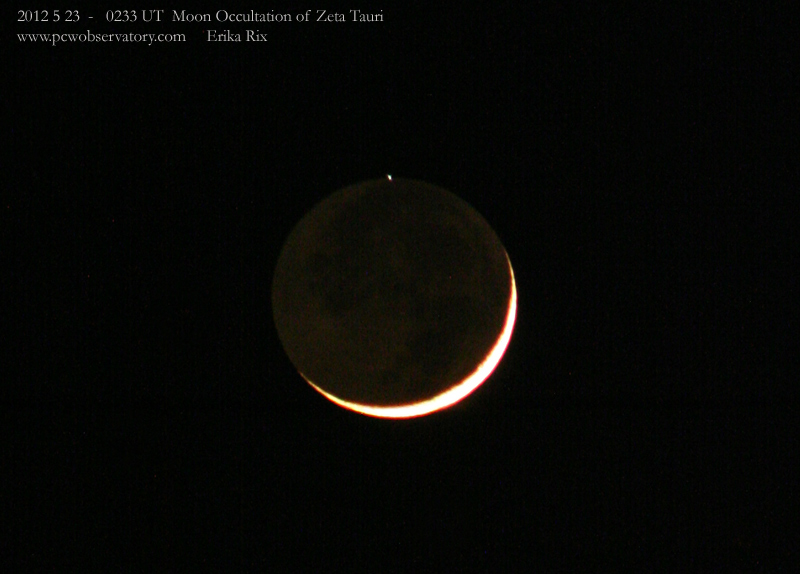 Image Credit: Erika Rix
Click to Enlarge Image
Image Credit: Erika Rix
Click to Enlarge Image
Images and video of the Moon occulting a planet can be spectacular, but you don’t need equipment to see occultations of the naked eye planets (Mercury, Venus, Mars, Jupiter, and Saturn) and the brightest stars. Be sure to step outside at least a few minutes before the occultation begins, and keep your eyes on the star or planet being occulted. This is a blink-and-you’ll-miss-it event, as the object will vanish in an instant. Look away, even for a moment, and it might be gone!
It’s a similar story when it comes time for the star or planet to reappear again. Keep your eyes on the Moon, don’t look away, and all being well, at the predicted time, you’ll see it suddenly appear again.
Occultations can last a maximum of 90 minutes, but very occasionally (and depending on your location), rather than seeing the star or planet disappear, you’ll see it flicker instead. Called a grazing occultation, this happens when the object skims the edge of the Moon. The flickering is caused by the object being hidden and then reappearing from behind the bumpy edge of the Moon - which, in reality, are actually mountains on the lunar landscape!
Either way, whether it’s a full occultation or a grazing, if an occultation is visible from your location, it’s certainly an event not to be missed!


Learn More
Interested in diving deeper into the world of astronomy? Not sure where to begin? Check out our Astronomy Hub!