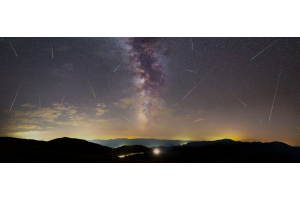
It would be nice to have a year in which every meteor shower reaches its maximum under moonless nights, but of course, that’s simply not possible. However, with the two most reliable and prolific showers - the Perseids and Geminids - peaking at or near new Moon, 2026 is as good as it gets.
What is a Meteor Shower?
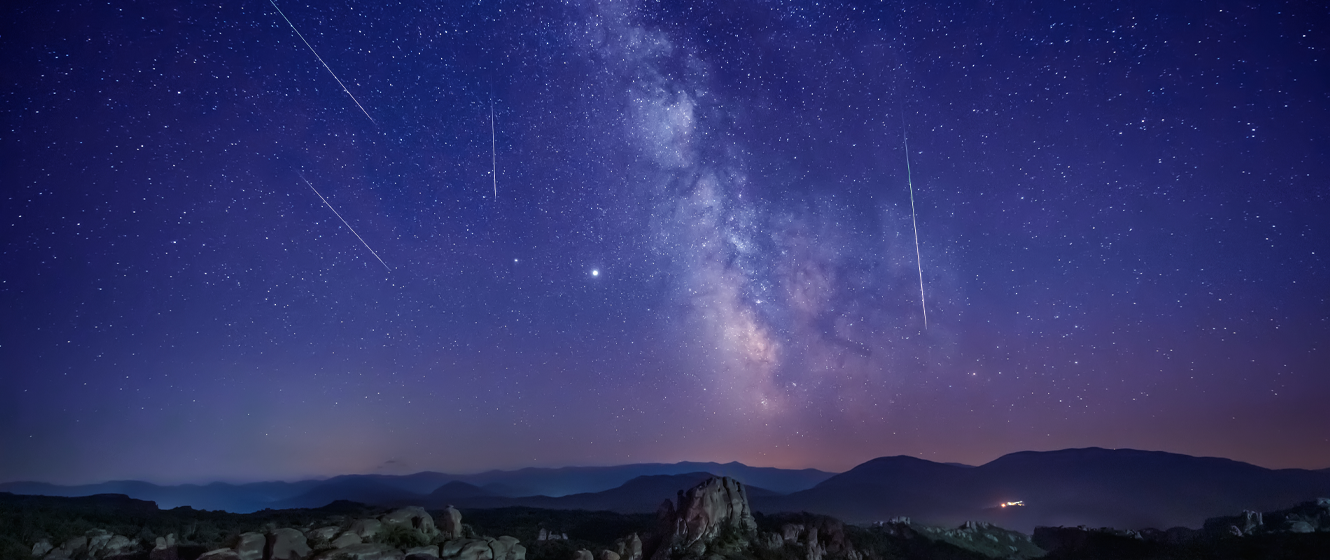
Despite what you might think, space is not empty! It’s filled with particles of gas and dust, and as the Earth orbits the Sun, it impacts these particles. A shooting star is really nothing more than a tiny fragment of rock that enters the Earth’s atmosphere at high speed (about 30 miles per second, on average) and burns up.
In fact, it might surprise you to learn that meteors are typically no larger than an apple seed!
A meteor shower occurs when the Earth passes through a cloud of dust as it moves along its orbit. These clouds of dust almost always originate from comets that regularly orbit the Sun. As the comet moves through space, it leaves a trail of dust in its wake, and where the trail intersects the orbit of the Earth, there’s a higher concentration of dust and a greater number of meteors.
This is why meteor showers always occur at roughly the same time every year, with the cloud being renewed with each orbit the comet completes. One shower in particular, the Leonids, puts on a fine show every 33 years when its parent comet makes another pass by the Sun. (The last of these was in 1998, with the next expected around 2031.)
What You Need to Know About Meteors - Tips and Terms for Beginners
- While there are some meteor showers that can be enjoyed throughout the night, most are best seen in the hours before dawn. That’s because the morning side of the Earth is the one that’s moving directly into the cloud of dust from which the meteors appear.
- Although you can see shooting stars from almost anywhere, you want to try and find a safe, dark location, far from the lights of a town or city. Many meteors may be bright, but there are just as many that are too faint to be seen from the light-polluted skies of suburbia.
- Regardless of where you are, give your eyes time to adapt to the dark. This can take up to about thirty minutes if you’re stepping out from a brightly lit interior, but when your eyes are properly adapted, you’ll see more of the fainter meteors.
- Once your eyes are properly dark-adapted, you’ll want to keep them that way. Looking at any bright light can instantly ruin your night vision, so make sure to get yourself a red flashlight. Red light doesn’t affect your eyes the way white light does, and as long as the flashlight isn’t too bright, you should be able to avoid dazzling yourself.
- One of the best things about meteors is that you don’t need any equipment to observe them. In fact, almost any kind of equipment is more of a hindrance than a help. Remember that meteors can appear almost anywhere, but if you use binoculars or a telescope, you’re limiting your view to just a small area of the sky. You’ll see more of the sky with just your eyes, so even if you’re looking in the wrong direction, you might still catch one or two with your peripheral vision.
- Beware the Moon! It might look pretty, but when the Moon is between first and last quarter (anywhere from a half Moon in the evening sky, through full Moon to a half Moon in the morning sky), it can considerably brighten the sky. This has the effect of drowning out the fainter meteors. A crescent Moon isn’t typically a problem because it’s not so bright and is often only visible either before or after the darkest part of the night.
- A shower’s radiant is the area of the sky from which the meteors appear. A shower is typically named after the constellation from which they seem to originate (eg, the Leonids have their radiant in Leo), but occasionally a shower is named for the nearest bright star instead (eg, the Alpha Centaurids).
- The zenith hourly rate (ZHR) is the number of meteors you could expect to see under ideal conditions. More specifically, this is the number you might see if the radiant were overhead and the skies were completely dark. In most cases, the radiant isn’t at its highest until the daylight hours, and is rarely overhead. Consequently, the actual number of meteors you can expect to see will greatly depend upon the altitude of the radiant in the sky, the darkness of your location, the weather, and the phase of the Moon at the time.
- It can be tempting to stare right at a shower’s radiant, but that usually isn’t the best strategy. Meteors near the radiant are flying almost straight toward you, which makes them look shorter and easier to miss. You’ll typically see longer, brighter streaks when you look about 45 degrees away, where the meteors cut across your line of sight and have more sky to travel through. With that in mind, be sure to scan a wide area rather than locking onto just one spot.
The Top Three Meteor Showers For 2026
2026 promises to be a year to remember, with the two most active showers - the Perseids and Geminids - both being free of moonlight.
- Geminids (December 14th) - with the Moon a waxing crescent and a zenith hourly rate of around 150, the Geminids should deliver the year’s best, most reliable show from late evening into the pre-dawn hours.
- Perseids (August 13th) - with a new Moon and a steady, reliable zenith hourly rate of around 100, this year’s Perseids should be close to ideal, with the strongest action building after midnight and toward dawn.
- Lyrids (April 22nd) - although not on a par with the Geminids or the Perseids, a respectable zenith hourly rate of around 18 makes the Lyrids a solid bet, with the best rates in the darker hours after midnight.
January
Despite a high zenith hourly rate, the Quadrantids are not an easy shower to observe at the best of times. The maximum only lasts a few hours, and many of the meteors are on the faint side. In 2026, the situation is made worse by the shower peaking during daylight hours, with a full Moon arriving roughly 12 hours earlier.
If you’d like to try your luck, get as far away from city lights as you can, and aim to be outside at around two and a half hours before sunrise on the morning of the 3rd. The Moon will be low in the west, the radiant will be roughly 50 degrees above the east-northeastern horizon, and the sky should still be dark. Look towards the northeast or east, and you may catch a meteor or two, with the best ones arriving as quick, sharp streaks.
Quadrantids
- Active: Dec 28th - Jan 12th
- Maximum: Jan 3rd 16:00 ET / Jan 3rd 13:00 PT
- Moon: Full Moon
- ZHR: 120
- Parent Object: 2003 EH (Asteroid)
- Radiant: 15:21h +49.5°
- Brightness: Faint
- Speed: Medium
February
The Alpha Centaurids are tricky for most of North America. The shower is best seen from farther south, and from mid-northern latitudes, the radiant never actually rises. However, this is a shower that can occasionally toss out a brighter meteor, so if you’re outside in early February anyway, it’s worth keeping a watchful eye out.
The best window is roughly three hours before sunrise, when the sky should still be dark, and the radiant is closest to (albeit below) the horizon. The Moon is near last quarter and low in the southeast, which isn’t ideal, as that’s also the general area of the sky you’ll want to be watching. Look between the horizon and roughly 45 degrees up, and spread your attention between the southeast, south, and southwest. Don’t expect a flurry, but rather hope for a small handful of brighter, medium-speed streaks instead.
Alpha Centaurids
- Active: Jan 31st - Feb 20th
- Maximum: Feb 8th
- Moon: Last Quarter
- ZHR: 6
- Parent Object: Unknown
- Radiant: 14:04h -58.2°
- Brightness: Bright
- Speed: Medium
March
What older guides sometimes called the Virginids is often grouped today under the antihelion source - a broad, weak region of meteor activity rather than a single, distinct shower. The name is derived from the radiant’s position, roughly opposite the Sun along the ecliptic, which makes it well placed in the March evening sky. Realistically, the rates are minimal, typically only a few meteors per hour, making this better suited to meteor aficionados than the casual observer.
For your best chances, watch from late evening into the pre-dawn hours, when the antihelion region is higher, and the sky is darker. Since this is a broad source rather than a tight radiant, don’t worry too much about staring towards a particular area - just focus on the side of the sky opposite the Sun’s position below the horizon, and scan patiently for occasional shooting stars.
Antihelion Source / Virginids
- Active: All year
- Maximum: Mar 15th/16th
- Moon: Waning Crescent
- ZHR: 2-3
- Parent Object: Unknown
- Radiant: 12:28h -4.0°
- Brightness: Medium
- Speed: Slow
April
The Lyrids are the best meteor shower of spring - reliable, fairly easy to catch, and often brighter than people expect. In 2026, things are complicated by the shower reaching maximum during daylight hours for much of North America, so your best bet is to watch on the morning of the 22nd, when you’re closest to the peak and activity should still be strong. The Moon’s light won’t be a problem as it’s only a waxing crescent and will set before the prime pre-dawn window.
The radiant rises around midnight and is in better shape from about 1AM onward, once it’s higher and you’re looking through less atmosphere. The later you observe, the better. Keep your eyes peeled towards the north-northeast through the east-southeast. You can expect quick, bright meteors, an occasional fireball, and sometimes a hint of color (white, with possible orange, blue, or green flashes).
Lyrids
- Active: Apr 14th - Apr 30th
- Maximum: Apr 22nd 15:40 ET / Apr 22nd 12:40 PT
- Moon: Waxing Crescent
- ZHR: 18
- Parent Object: C/1861 G1 (Comet Thatcher)
- Radiant: 18:09h +33.4°
- Brightness: Bright
- Speed: Medium
May
This year, the eta Aquariids reach their maximum on May 6th, and with the Moon a waning gibbous, many of the fainter meteors will get washed out. Still, the shower is known for bright, fast meteors, so if you have dark skies, it’s worth a shot. If you want to try in the evening, step outside on the 5th and watch the eastern sky - you may catch an occasional early meteor, even with the radiant below the horizon.
If you’d rather wait until the radiant is above the horizon, the pre-dawn hours of the 6th are your best bet, even though the Moon will be towards the southeast and bright. Look away from the Moon’s glare and focus your attention more towards the northeast. Expect quick, bright streaks, sometimes with a short-lived train, usually white and with the occasional hint of green or blue.
Eta Aquariids
- Active: Apr 19th - May 28th
- Maximum: May 6th
- Moon: Waning Gibbous
- ZHR: 50
- Parent Object: 1P/Halley (Comet)
- Radiant: 22:32h -00.8°
- Brightness: Bright
- Speed: Fast
June
The June Boötids reach their maximum at 9 PM ET on the 21st, which is a convenient time in the evening. However, being June, many locations won’t see a fully dark sky until close to 11PM. On the plus side, the radiant will be well placed in the evening sky, and with the Moon at first quarter and low in the west-southwest, it shouldn’t cause too much of a problem.
Regardless of your location, sometime between 11PM on the 21st and roughly 3AM on the 22nd is your best window of opportunity. The Moon sets around midnight, leaving darker skies and the radiant high for the rest of the session. Scan a wide patch from the northwest through the west and down toward the southwest. The shower is famously unpredictable - on a typical year, you might only catch a handful per hour, with occasional brighter streaks, sometimes with a warm yellow or orange tint. Fireballs aren’t common, but a surprise or two is always possible.
June Bootids
- Active: Jun 22nd - Jul 2nd
- Maximum: Jun 21th 21:00 ET / Jun 21th 18:00 PT
- Moon: First Quarter
- ZHR: Variable
- Parent Object: 7P/Pons-Winnecke (Comet)
- Radiant: 14:58h +48.0°
- Brightness: Bright
- Speed: Slow
July
The Southern delta Aquariids are unusual in that they tend to remain steadily active for a few days around the predicted maximum, and are capable of producing a steady stream of shooting stars under dark skies. This year, the full Moon is a significant drawback, as it will be visible throughout the night and may wash out many of the fainter meteors.
Your best chance comes from around midnight and into the pre-dawn hours, once the radiant has cleared the southeastern horizon and twilight is still some way off. Scan a wide patch of sky from the southeast, across the south, and over toward the southwest. Expect mostly faint, quick-to-medium streaks, usually white and sometimes with a hint of yellow. While fireballs aren’t common, a surprise is always possible.
Southern Delta Aquariids
- Active: Jul 12th - Aug 23rd
- Maximum: Jul 30st
- Moon: Full Moon
- ZHR: 25
- Parent Object: 96P/Machholz (Comet)
- Radiant: 22:42h -16.4°
- Brightness: Faint
- Speed: Medium
August
Arguably the most famous meteor shower of them all, under ideal conditions the Perseids can produce around 100 shooting stars an hour - and this year they may be close to their best. The Moon is new on the 12th and won’t brighten the sky, giving you a chance to catch even the faintest meteors from dark locations.
The shower reaches its maximum on the evening of the 12th, and while the radiant will be below the horizon, there’s still a decent chance of seeing a meteor or two. Perseus rises around midnight in the northeast, with the radiant clearing the thicker air near the horizon at around 1AM. From then until roughly two hours before sunrise is prime time, as the radiant climbs higher and more meteors become visible. Look towards the east and north, and roughly halfway between the horizon and the zenith. You can expect fast, bright streaks, frequent glowing trains, and a real chance of a fireball, sometimes with a hint of green, blue, or yellow.
Perseids
- Active: Jul 17th - Aug 24th
- Maximum: Aug 12th 22:00 - Aug 13th 00:00 ET / Aug 12th 19:00 - 20:00 PT
- Moon: New Moon
- ZHR: 100
- Parent Object: 109P/Swift-Tuttle (Comet)
- Radiant: 03:13h +58.1°
- Brightness: Medium
- Speed: Medium
September
A relatively weak shower, this year the September epsilon Perseids are a mixed bag. A plus is that the Moon is new, but the timing is off, as the maximum occurs at 2PM ET (11AM PT). With that in mind, it’s best to step outside during the predawn hours of the 9th, when the sky is still dark, and the radiant has risen high enough for at least a few shooting stars to be seen.
As the name implies, the radiant lies close to Epsilon Persei and just a few degrees west of Algol, the famous variable star. Like the Perseids, the best window is from around midnight until roughly two hours before dawn, when the radiant is higher in the east-northeast, and you’re looking through less atmosphere. Don’t expect big numbers - in a typical year you might only catch a few per hour. The meteors are also swift, so you’ll need to stay alert and on the lookout for the occasional brighter streak.
September Epsilon Perseids
- Active: Sep 5th - Sep 21st
- Maximum: Sep 9th 14:00 ET / Sep 9th 11:00 PT
- Moon: New Moon
- ZHR: 5
- Parent Object: Unknown
- Radiant: 03:15h +39.7°
- Brightness: Medium
- Speed: Fast
October
The Moon is against us this year for the Orionids, as it will be a waxing gibbous, drowning out a lot of the fainter meteors. On the plus side, Orionids are known for bright streaks and can occasionally produce a genuine fireball, with some meteors leaving glowing trains that hang around for a few seconds. They’re fast too - about 41 miles per second (66 km/s) - so blink and you might miss ’em.
The radiant sits near the feet of Gemini, close to Alhena, and rises in the east before midnight. It’s better placed by around 1:30AM, but your best odds come after the Moon sets around 2AM, leaving a few darker hours before twilight. Look towards the northeast and southeast, and expect quick, bright streaks, usually white, with the occasional hint of color in the brighter ones.
Orionids
- Active: Oct 2nd - Nov 7th
- Maximum: Oct 21st
- Moon: New Moon
- ZHR: 20
- Parent Object: 1P/Halley (Comet)
- Radiant: 06:24h +15.7°
- Brightness: Bright
- Speed: Fast
November
Another shower where the timing is off, the Leonids peak close to 8PM ET (5PM PT) on the 17th, and with a first quarter Moon in the evening sky, your best bet is to wait until the early hours of the 18th. If you do step out before dawn, you’ll also be treated to a rare sight - Mars and Jupiter huddled very close together in Leo, with Regulus nearby.
The radiant lies in the backwards question-mark of Leo’s head, very close to Adhafera. It rises around midnight, with the best chances occurring between 2AM and 5AM, once the radiant is higher. Scan the northeast and southeast, letting your eyes roam. At 44 miles per second (71 km/s), the Leonids are the fastest of the major annual showers, so they tend to appear as quick, sharp streaks.
Leonids
- Active: Nov 6th - Nov 30th
- Maximum: Nov 17th 19:45 ET / N ov 17th 16:45 PT
- Moon: First Quarter
- ZHR: 10 - 15
- Parent Object: 55P/Tempel-Tuttle (Comet)
- Radiant: 10:15h +21.8°
- Brightness: Bright
- Speed: Fast
December
Many consider the Geminids to be the best and most reliable major meteor shower of the year, and 2026 promises a good show. They peak on the night of December 13th/14th, when the Moon is only a thin waxing crescent and won’t be brightening the sky. If you’re under dark skies, it’s realistic to hope for dozens per hour during the darker hours, with the brightest being quite memorable.
The Geminids are also family-friendly, as the radiant rises early - around 7PM above the east-northeastern horizon - and is sufficiently high by about 9PM. The radiant lies just under a degree east of Pollux, but scan a wide area from the northeast through the southeast. You’ll find rates improving later, as Gemini climbs higher and you’re looking through less atmosphere. Geminids are often white or slightly yellowish, with a decent chance of a fireball, and at about 22 miles per second (35 km/s), they’re slow enough to track more easily.
December also includes a small holiday bonus: the Ursids follow on December 21st/22nd. However, in 2026, the Moon is close to full, so expect heavily moonlit skies and lower odds. It’s a modest shower, typically topping out at around 10 meteors per hour under ideal conditions, and most of the meteors are on the faint side, though an occasional brighter streak is possible. The radiant sits in Ursa Minor near Kochab and stays above the northern horizon for most of North America, so it makes sense to keep your attention toward the northwest and northeast.
Geminids
- Active: Dec 4th - Dec 20th
- Maximum: Dec 14th 11:00 ET / Dec 14th 08:00 PT
- Moon: Waxing Crescent
- ZHR: 150
- Parent Object: 3200 Phaethon (Asteroid)
- Radiant: 07:33h +32.4°
- Brightness: Bright
- Speed: Medium